Artwork
Ghatotkacha and three demons in his company chase Bhagadatta, from Bhishma-parva (volume six) of a Razm-nama (Book of Wars) adapted from the Sanskrit Mahabharata and translated into Persian by Mir Ghiyath al-Din Ali Qazvini, known as Naqib Khan (Pers
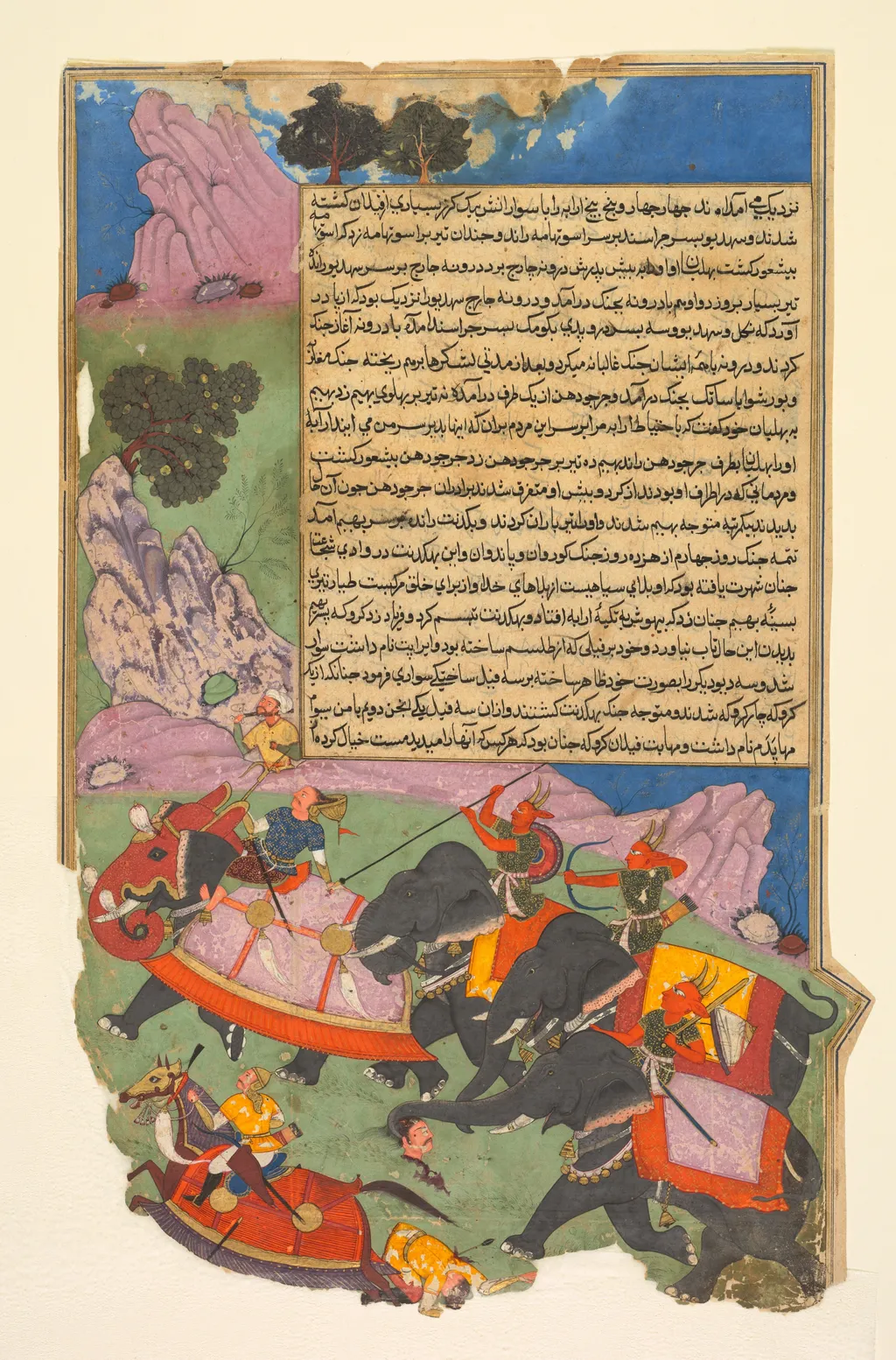
Ghatotkacha and three demons in his company chase Bhagadatta, from Bhishma-parva (volume six) of a Razm-nama (Book of Wars) adapted from the Sanskrit Mahabharata and translated into Persian by Mir Ghiyath al-Din Ali Qazvini, known as Naqib Khan (Pers is an unspecified painting by the Mughal Painting artist Fazl. It dates from 1616 and is held in the collection of the Cleveland Museum of Art. The 1616 painting, part of a Razm‑nama series, illustrates a dramatic episode from the Bhishma‑parva of the Mahabharata.
About this work
Overview
The 1616 painting, part of a Razm‑nama series, illustrates a dramatic episode from the Bhishma‑parva of the Mahabharata. In the scene, the demon‑born hero Ghatotkacha and three accompanying demons pursue the warrior Bhagadatta, whose mount is an elephant. The work is attributed to the Persian court painter Fazl and is currently in the collection of the Cleveland Museum of Art.
Subject & Meaning
The composition visualizes a moment of mythic combat, emphasizing the supernatural prowess of Ghatotkacha, a son of the wind god, as he leads a chaotic chase. The inclusion of demons underscores the epic’s themes of divine intervention and the tumult of war, while Bhagadatta’s desperate flight on an elephant highlights his status as a formidable but vulnerable opponent.
Technique & Style
Executed in vivid pigments, the painting employs bright reds, yellows, and gold to accentuate armor and textiles. Figures are rendered in dynamic poses, suggesting rapid movement, and the landscape features stylized green hills, a blue sky, and pink clouds. Persian calligraphic bands of text run along the top and right edge, integrating narrative description with the visual action.
History & Provenance
The image originates from a Razm‑nama—a Persian adaptation of the Sanskrit Mahabharata—translated by Mir Ghiyath al‑Din Ali Qazvini, known as Naqib Khan. Created under the patronage of the Safavid court in 1616, the work eventually entered the Cleveland Museum of Art’s collection, where it is displayed as part of the museum’s South Asian holdings.
Context
During the early 17th century, Persian artists frequently reinterpreted Indian epic narratives, merging local artistic conventions with Indian subject matter. This painting reflects that cross‑cultural exchange, combining Persian miniature techniques—such as intricate detailing and decorative script—with Indian mythological content.
Artist & collection
Artist
This painter worked in a Mughal workshop where artists turned India’s epic stories into delicate Persian-style paintings.
