Artwork
"He Turned Their Waters into Blood"
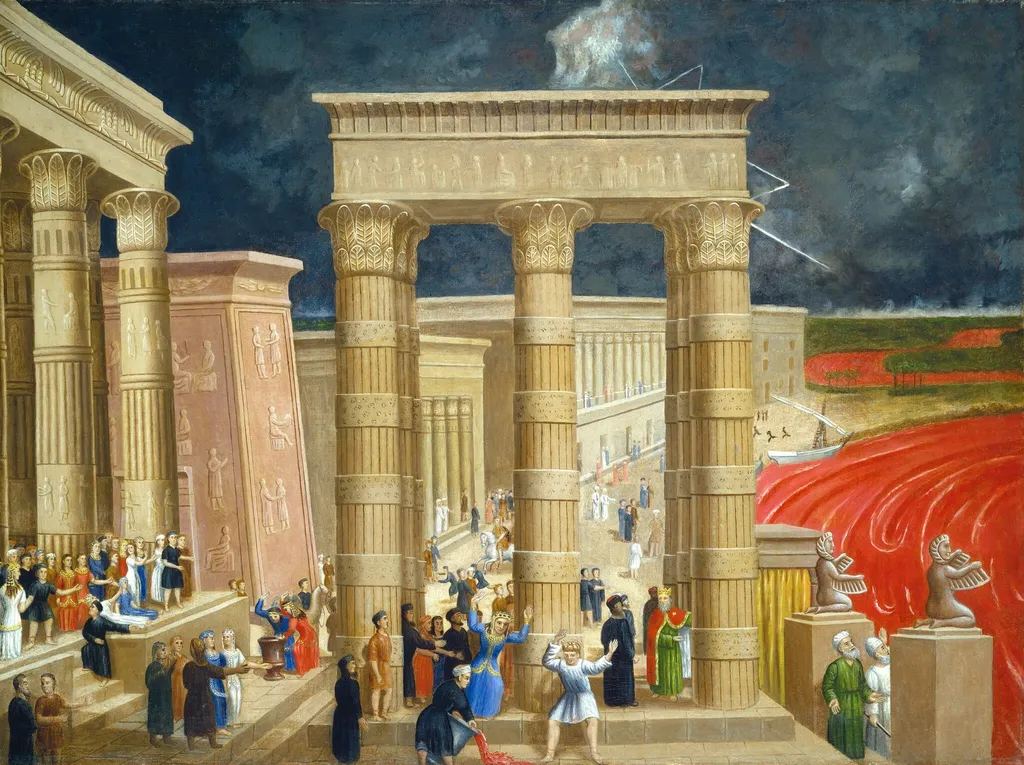
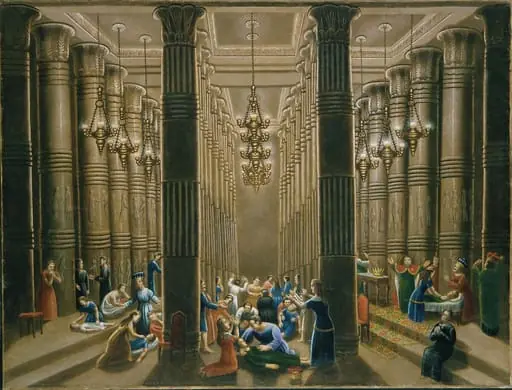
"He Turned Their Waters into Blood" is an oil painting by the American Folk Art artist Erastus Salisbury Field. It dates from 1872 and is held in the collection of the National Gallery of Art.
About this work
Overview
Erastus Salisbury Field’s oil on canvas, dated circa 1872, presents a biblical‑inspired scene titled “He Turned Their Waters into Blood.” The composition centers on an imposing, antiquated Egyptian‑style temple surrounded by a crowd, under a foreboding sky that hints at divine intervention.
Subject & Meaning
At the forefront, a robed figure in white lifts his arms, evoking a prophetic or pleading gesture. The surrounding onlookers appear uneasy, suggesting the painting visualizes the plague of blood described in the Exodus narrative, where water is transformed into a scarlet torrent.
Technique & Style
Field employs a rich palette dominated by reds, blues, and golds, creating a dramatic contrast between the luminous temple columns and the darkened heavens. The brushwork delineates architectural detail—tall columns and a red wall—while the figures are rendered with enough clarity to convey collective anxiety.
History & Provenance
Created in the early 1870s, the work reflects Field’s engagement with religious themes popular in post‑Civil War America. Its provenance traces back to private collections before entering a regional museum’s holdings, where it remains a representative example of 19th‑century American narrative painting.
Context
The painting aligns with a broader 19th‑century fascination with biblical catastrophes and exotic settings, merging Egyptian architectural motifs with a Judeo‑Christian story. This synthesis mirrors contemporary interests in archaeology and the expanding visual vocabulary of American religious art.
Own this work as a print
Artist & collection