Artwork
Sea-Poppy 2
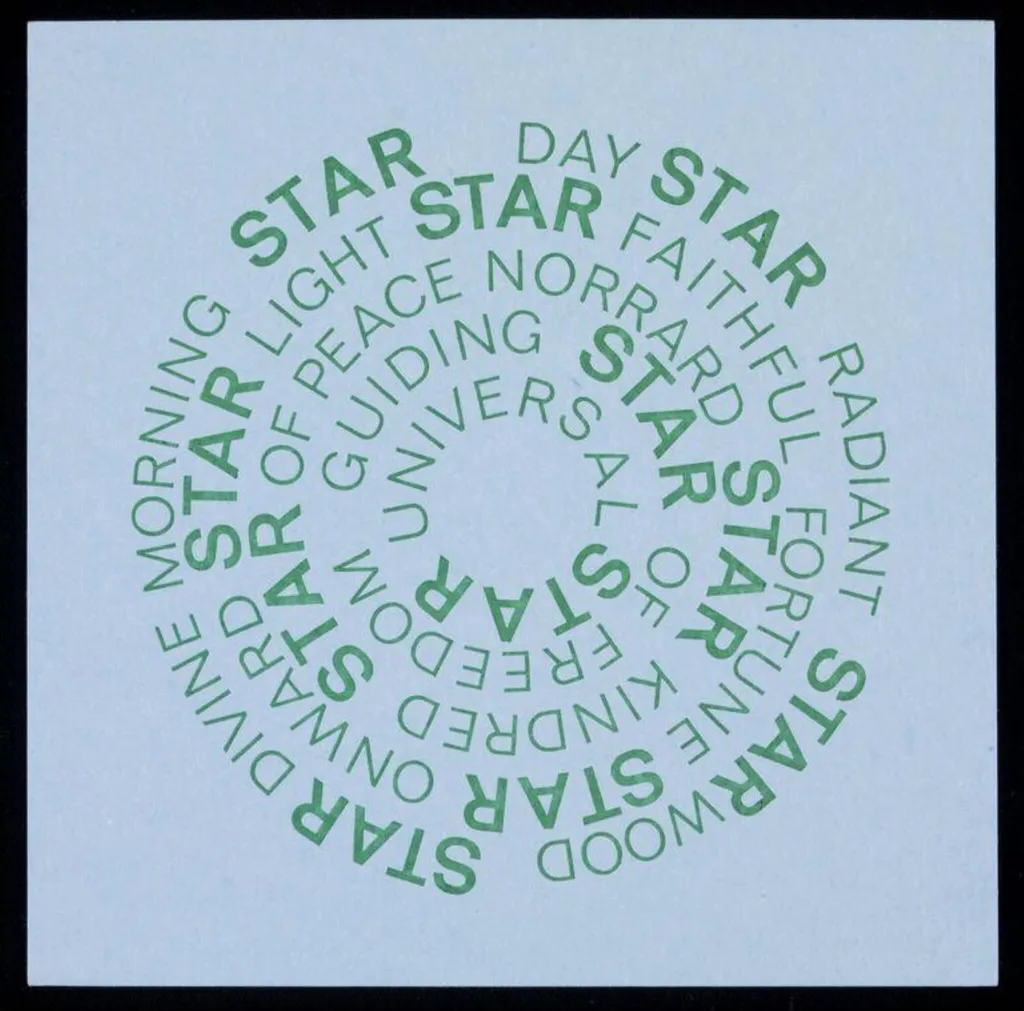
Sea-Poppy 2 is a print by Ian Hamilton Finlay. It dates from 1968 and is held in the collection of the Victoria and Albert Museum.
About this work
Overview
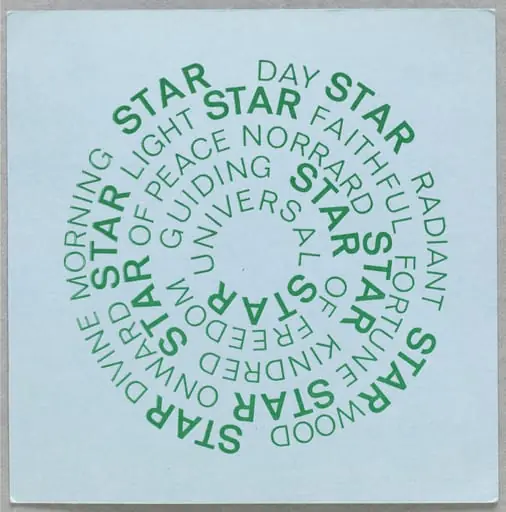
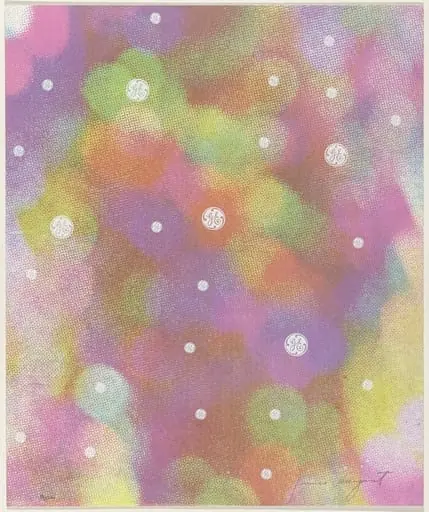
Created in 1968, *Sea-Poppy 2* is a printed concrete poem by Ian Hamilton Finlay. It presents text arranged in a circular, spiraling formation on a pale gray ground. The composition emphasizes visual rhythm over linear narrative, with words overlapping and curving outward in a deliberate, non-uniform pattern that challenges conventional reading.
Subject & Meaning
Phrases such as 'star,' 'light,' 'morning star,' and 'faith' recur subtly, suggesting themes of illumination and belief. Yet the work resists fixed interpretation; meaning emerges from the spatial arrangement rather than semantic content. The text functions more as visual motif than message, inviting contemplation of language as form rather than doctrine.
Technique & Style
Finlay employed a hand-altered stencil technique, producing uneven lettering with varying weight and opacity. The green ink contrasts softly against the gray background, enhancing the organic feel of the spiral. Words are deliberately misaligned and layered, creating a sense of movement and impermanence that mirrors natural patterns rather than mechanical precision.
History & Provenance
Produced during a period of intense experimentation with concrete poetry, it reflects his engagement with European avant-garde traditions.
This print belongs to Finlay’s broader series exploring the intersection of language, nature, and minimalism. Produced during a period of intense experimentation with concrete poetry, it reflects his engagement with European avant-garde traditions. The work entered public collections in the late 20th century, notably through institutions interested in textual art and postwar British experimental printmaking.
Context
Emerging in the late 1960s, *Sea-Poppy 2* aligns with international movements redefining poetry as visual object. Finlay’s work responds to influences from Dada, Futurism, and the Letterist International, while grounding itself in the quiet aesthetics of Scottish landscape and classical allusion. The piece reflects a broader shift toward dematerialized art forms that privilege structure over narrative.
Legacy
The print contributed to the legitimization of concrete poetry within fine art institutions. Its emphasis on spatial typography influenced later artists working at the boundary of text and visual design. Though modest in scale, *Sea-Poppy 2* remains a touchstone for those exploring how language can be reshaped into perceptual experience beyond linguistic meaning.
Artist & collection