Artwork
The Tomb of Caecilia Metella
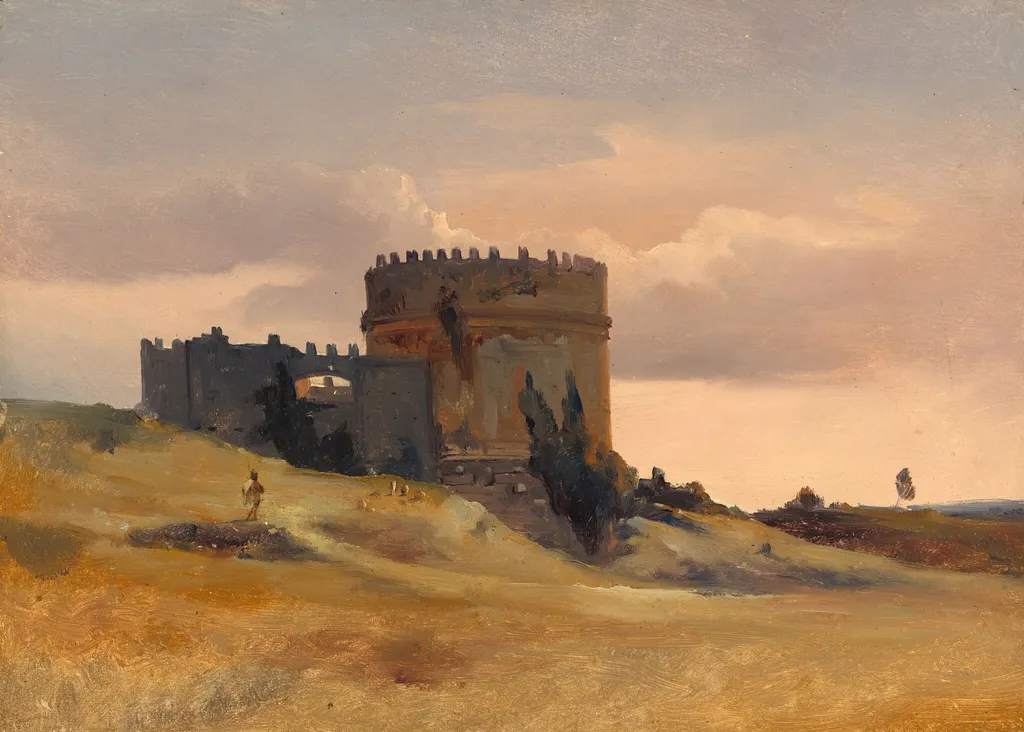
The Tomb of Caecilia Metella is an oil painting by the Romanticist artist Léon-François-Antoine Fleury. It dates from 1830 and is held in the collection of the National Gallery of Art.
About this work
Overview
Léon‑François‑Antoine Fleury’s oil on canvas, dated around 1830, presents a solitary Roman funerary monument known as the Tomb of Caecilia Metella. The composition isolates the ancient structure against a flat, arid landscape under an expansive sky, emphasizing its verticality and the passage of time reflected in the weathered stone.
Subject & Meaning
The work focuses exclusively on the tomb, a prominent example of Republican-era architecture that once marked the burial site of the influential Metelli family. By removing surrounding figures, Fleury invites contemplation of the monument’s endurance and the silent narratives embedded in its carved frieze.
Technique & Style
Executed in oil, the painting balances chiaroscuro: bright illumination falls on the right side of the tomb while the left recedes into gentle shadow, modeling the stone’s texture. Fleury’s brushwork renders the worn surface with subtle tonal variations, and the faint relief on the base is suggested through delicate, almost translucent strokes.
History & Provenance
Created circa 1830, the canvas entered the collection of the National Gallery of Art in Washington, D.C., where it is currently displayed. Its acquisition reflects the museum’s 20th‑century interest in 19th‑century French landscape and architectural painting.
Context
Fleury worked during a period when French artists often turned to classical antiquity for subject matter, integrating Romantic sensibilities with precise observation. The isolated depiction of a single ancient ruin aligns with contemporary interests in archaeological discovery and the aesthetic of the sublime landscape.
Own this work as a print
Artist & collection

