Artwork
A Bear Hunt
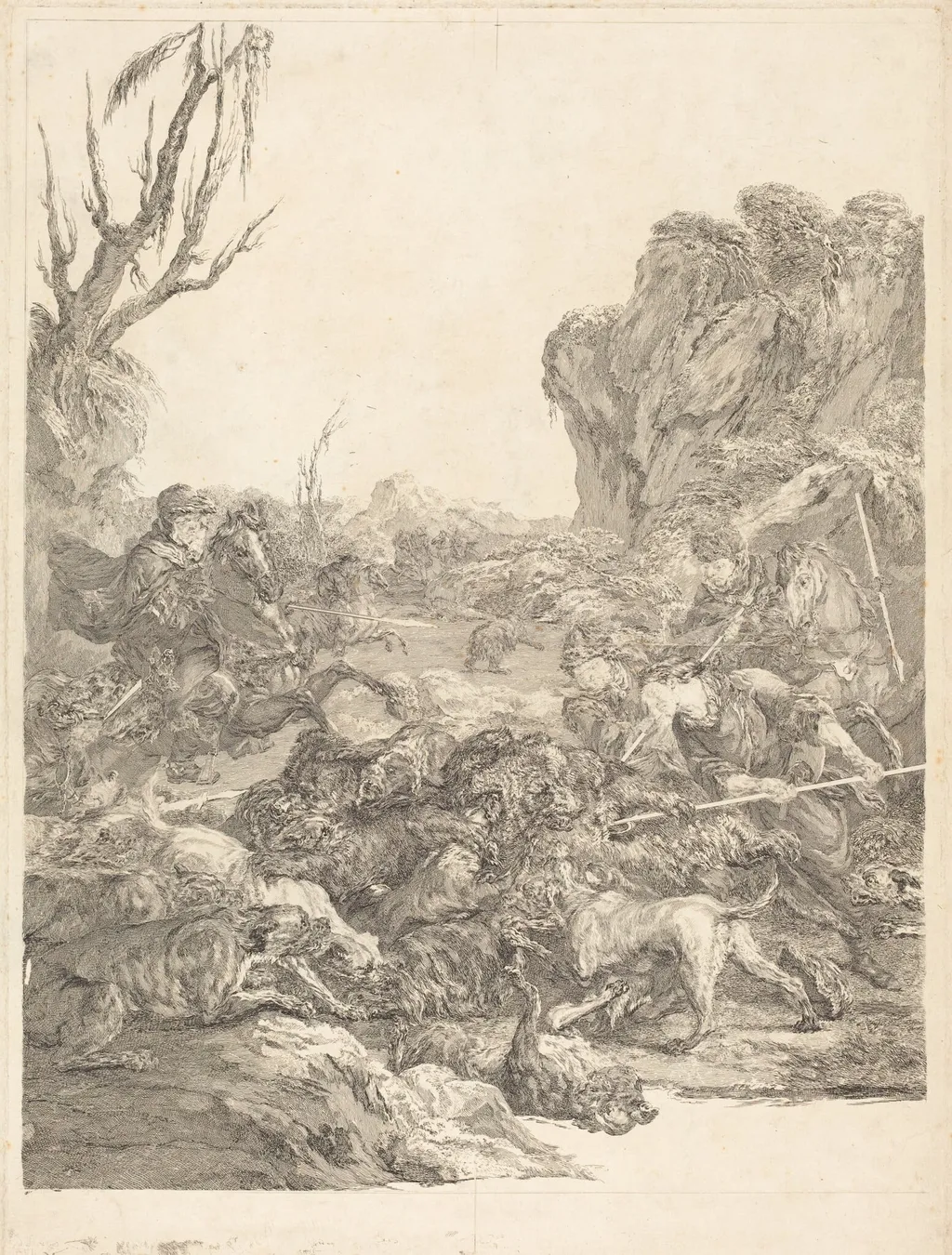
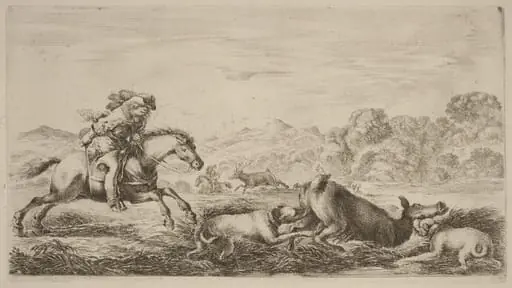
A Bear Hunt is an ink print by the Baroque artist Jean-Jacques Flipart. It dates from 1750 and is held in the collection of the National Gallery of Art.
About this work
The trees are thin and bare, with just enough detail to set a chilly mood.
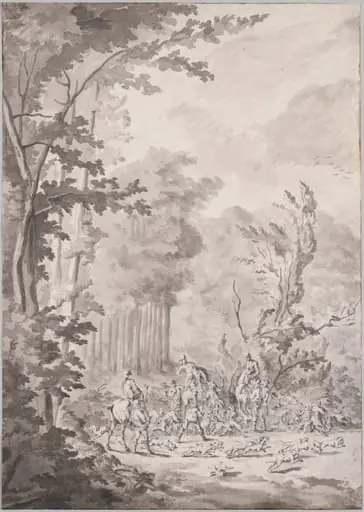
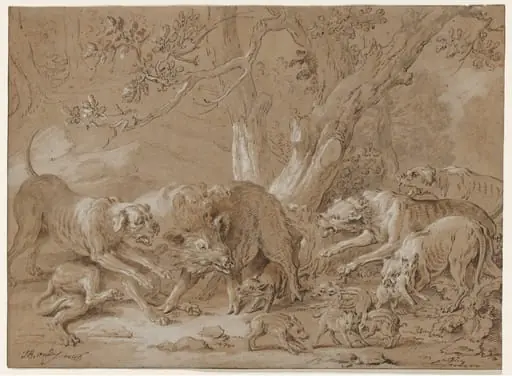
You see a hunter with a dog chasing a bear through a snowy forest. The bear looks calm, almost curious. The trees are thin and bare, with just enough detail to set a chilly mood.
This etching was made in 1757, the same year the artist died. It’s rare because it’s a proof—an early test print. Proofs often show the artist’s hand more clearly than final prints.
Want to see how prints evolve? Look up etching.
Overview
A Bear Hunt is an etching on wove paper, produced in 1757 by Jean-Jacques Flipart. This rare proof print captures a moment of quiet tension between hunter, hound, and bear in a winter woodland. As a proof, it predates the final edition and retains the immediacy of the artist’s initial impressions, offering insight into his working process before ink distribution stabilized.
Subject & Meaning
The scene depicts a hunter and his dog pursuing a bear through a snow-laced forest, yet the bear’s posture suggests neither fear nor aggression—instead, it appears alert, almost observant. The absence of violence and the stillness of the animal subvert typical hunting narratives, inviting contemplation rather than drama. The natural setting, stripped of excess detail, emphasizes solitude and the quiet coexistence of predator and prey.
Technique & Style
Flipart employed fine, controlled lines to render the bare trees and falling snow, using etching to achieve subtle tonal gradations. The wove paper’s smooth surface enhances the delicacy of the lines, while the sparse composition avoids clutter, focusing attention on the figures’ spatial relationship. The proof’s unpolished quality reveals the artist’s hand: slight irregularities in ink and line hint at the plate’s early state.
History & Provenance
Created in the final year of Flipart’s life, this print was likely an experimental impression made before the plate was used for commercial editions. Few proofs from this period survive, making this example uncommon. Its preservation suggests it may have been retained by the artist or a close associate, offering a direct link to his late creative practice.
Context
In mid-18th-century France, hunting scenes were popular in print culture, often glorifying aristocratic sport. Flipart’s version diverges by avoiding spectacle, aligning more with emerging naturalist tendencies. His focus on atmosphere and animal demeanor reflects broader shifts in artistic interest toward observed nature over staged drama, even within traditional genres.
Legacy
As a proof, this print serves as a document of artistic process rather than mass production. It illustrates how etchers refined their work through iterative trials, preserving traces of early intent. While Flipart is not widely known today, this work remains a quiet testament to the nuanced observation and technical restraint characteristic of his later years.
Artist & collection