Artwork
Ambroise Vollard, quatre esquisses (Ambroise Vollard, four sketches)
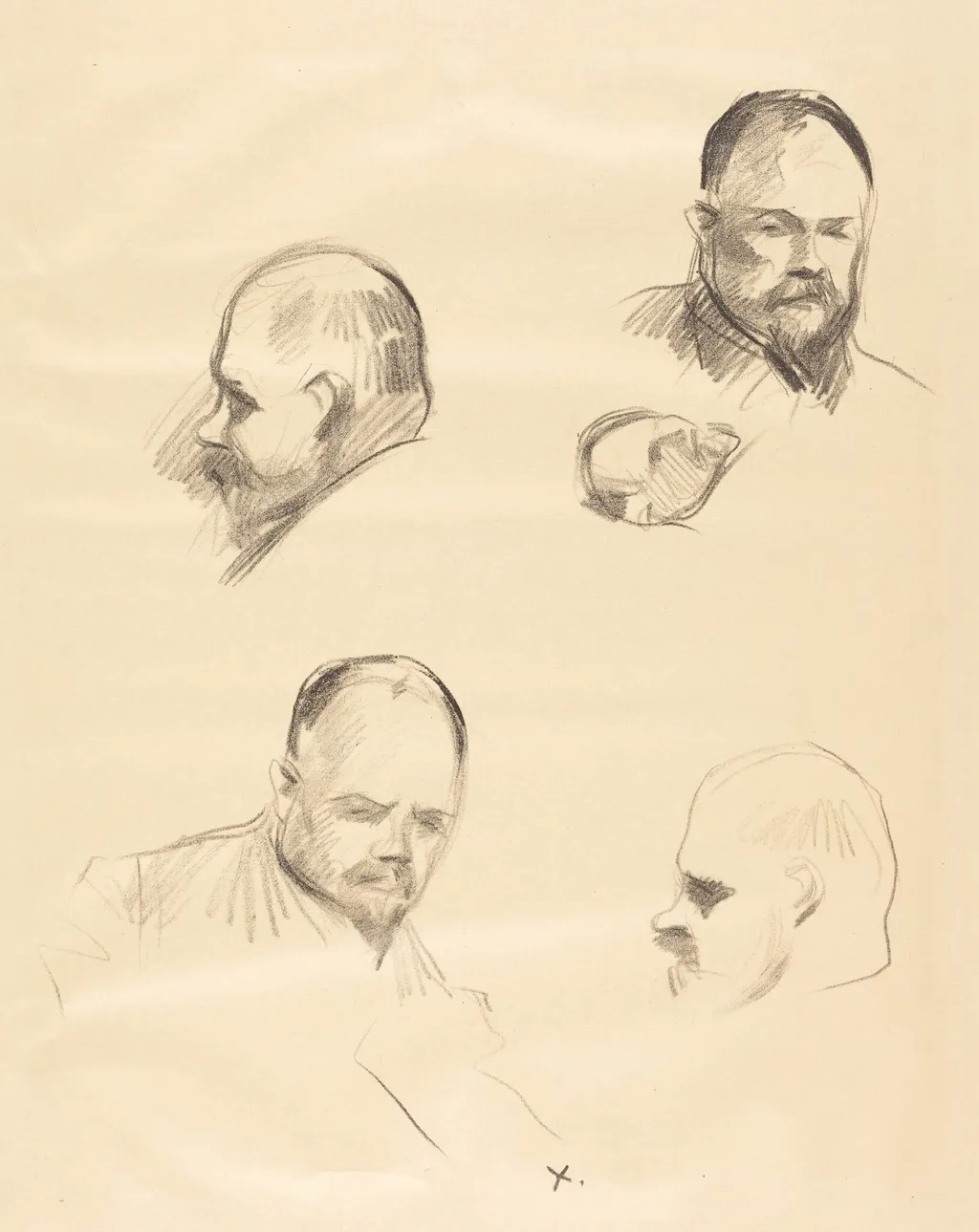
Ambroise Vollard, quatre esquisses (Ambroise Vollard, four sketches) is an ink print by Jean-Louis Forain. It dates from 1910 and is held in the collection of the National Gallery of Art.
About this work
Overview
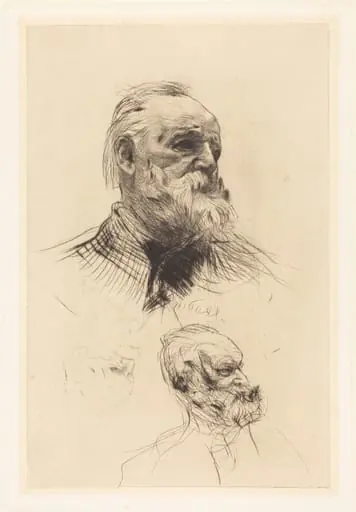
Executed in the medium of lithography, the work captures Vollard’s likeness through varying angles and expressions, reflecting Forain’s skill in graphic media.
Created around 1910, this lithograph by Jean-Louis Forain presents four distinct studies of the art dealer Ambroise Vollard on wove paper. Executed in the medium of lithography, the work captures Vollard’s likeness through varying angles and expressions, reflecting Forain’s skill in graphic media. Unlike his oil paintings, this piece emphasizes economy of line and tonal variation, showcasing the artist’s command of printmaking techniques.
Subject & Meaning
Ambroise Vollard, a central figure in early 20th-century Parisian art circles, is portrayed not as a formal portrait but as a series of intimate, unposed studies. The four sketches suggest a moment of quiet introspection, with shifting gazes and closed eyes conveying internal states rather than public persona. The focus on subtle facial cues—brows, beard, and head tilt—invites contemplation of the subject’s character beyond his professional role.
Technique & Style
Forain employed lithographic stone to achieve a range of tones, from deep blacks to soft grays, using bold, fluid lines and delicate hatching. The four heads vary in perspective: two in profile, two frontal, with eyes either open and averted or closed. The absence of background isolates the face, heightening the psychological intensity. The technique favors immediacy over finish, aligning with the sketch-like nature of the composition.
History & Provenance
The work emerged during a period when Forain was actively producing prints for publishers and private collectors. Though less documented than his paintings, this lithograph was likely part of a limited run, possibly intended for distribution among art-world patrons. Its survival in institutional and private collections attests to its recognition among contemporaries, even as Forain’s broader fame waned in later decades.
Context
In early 1900s Paris, lithography was a favored medium for artists seeking to reach wider audiences beyond gallery walls. Vollard, as a dealer, supported figures like Cézanne and Picasso, making him a symbolic presence in modern art’s development. Forain’s series reflects the era’s interest in psychological portraiture and the artist-dealer relationship, capturing a key figure through informal, repeated observation rather than ceremonial representation.
Legacy
While Jean-Louis Forain’s reputation faded after his death, this lithograph remains a quiet testament to his observational precision and sensitivity to character. It stands as an example of how printmaking could convey psychological depth without grandeur, offering a counterpoint to the more flamboyant modernist portraits of the time. Scholars continue to reference it as a nuanced study of a pivotal cultural intermediary.
Artist & collection

Artist
Jean-Louis Forain (French pronunciation: ; 23 October 1852 – 11 July 1931) was a French Impressionist painter and printmaker, working in media including oils, watercolour, pastel, etching and lithograph.


![Self-Portrait [recto], by William E. Winner](https://artifactworldgallery.com/img/william-e-winner--self-portrait-recto--33f2127f07962012-w320.webp)
![Self-Portrait [recto], by Paul Cezanne](https://artifactworldgallery.com/img/paul-cezanne--self-portrait-recto--800f9cf98766d770-w320.webp)