Artwork
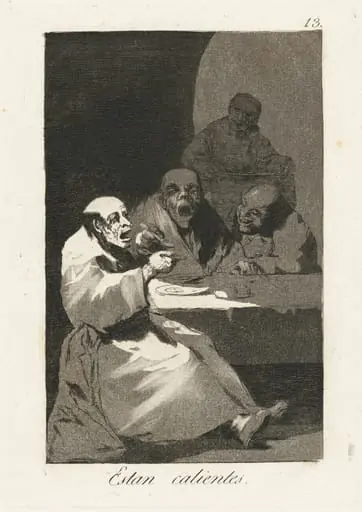
They are Hot, Plate 13
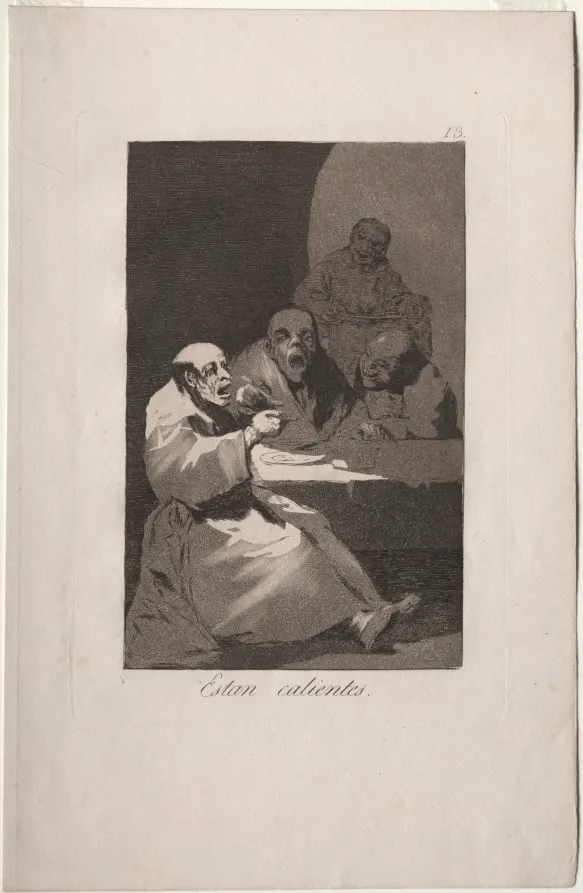
They are Hot, Plate 13 is a print by the Romanticist artist Francisco Goya. It dates from 1799 and is held in the collection of the Cleveland Museum of Art.
About this work
Overview
The print presents a scene of ambiguous tension among four figures in a dim interior, rendered with sharp linear detail and atmospheric contrast.
Created around 1799, 'They are Hot, Plate 13' is one of Francisco de Goya’s etchings from the series 'Los Caprichos.' It is currently held at The Cleveland Museum of Art. The print presents a scene of ambiguous tension among four figures in a dim interior, rendered with sharp linear detail and atmospheric contrast. The title, 'Están calientes,' suggests a sardonic remark, hinting at underlying absurdity or moral irony.
Subject & Meaning
Four men gather in a shadowed room: one kneels in a robe, gesturing toward an unseen object on a table, while the others react with bewilderment or alarm. The phrase 'They are hot' may refer to a literal object, a metaphorical scandal, or a sexual innuendo. Goya uses this moment of confusion to mock human credulity and the pretensions of authority, common themes in his satirical critique of Spanish society.
Technique & Style
Goya employed etching and aquatint to achieve deep shadows and subtle gradations of tone. The composition relies on stark chiaroscuro, with minimal light entering from a narrow window in the background, isolating the figures in pools of darkness. The lines are precise yet expressive, capturing gestures and facial expressions with economical strokes, enhancing the scene’s psychological unease.
History & Provenance
The print was produced as part of Goya’s 'Los Caprichos' series, published in 1799 after years of private experimentation. It was initially sold by subscription to a limited audience. The Cleveland Museum of Art acquired the work as part of its broader collection of European prints, preserving it as a key example of late 18th-century Spanish graphic art.
Context
Created during a period of political and social upheaval in Spain, 'They are Hot' reflects Goya’s disillusionment with institutional authority and superstition. The Enlightenment’s influence coexisted with lingering religious dogma, and Goya’s prints targeted both. This image, like others in the series, uses humor to expose the irrationality beneath social rituals and power structures.
Legacy
The print exemplifies Goya’s pioneering role in modern printmaking and social commentary. Its psychological depth and visual economy influenced later artists, including those of the 19th-century Realist and Expressionist movements. 'They are Hot' remains a quiet but potent example of how satire, when grounded in precise observation, can endure as a form of critical inquiry.
Artist & collection
Artist
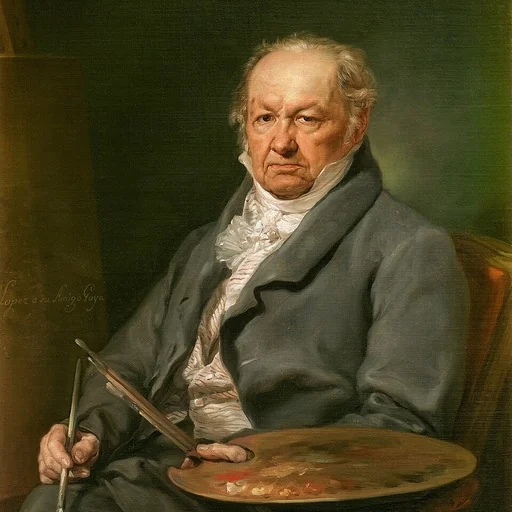
Francisco José de Goya y Lucientes (; Spanish: ; 30 March 1746 – 16 April 1828) was a Spanish romantic painter and printmaker.