Artwork
Mountainous Landscape
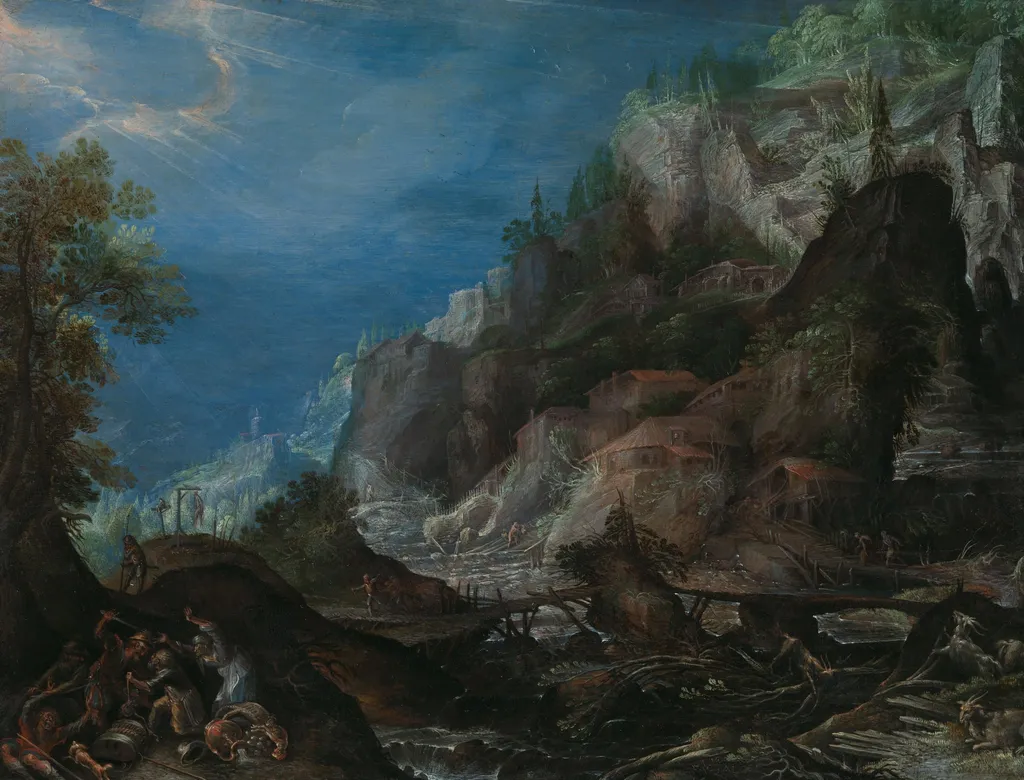
Mountainous Landscape is an unspecified painting by the Dutch Golden Age artist Frederik van Valckenborch. It dates from 1605 and is held in the collection of the Rijksmuseum. Created in 1605, this anonymous oil painting presents a rugged landscape dominated by a river that slices through steep, craggy hills.
About this work
The hills and river are drawn with careful lines, but the people are just quick dabs of paint.
You see a rocky river cutting through steep hills, with tiny people walking along the bank. On the left, robbers attack farmers carrying goods to market. In the distance, a gallows and a breaking wheel stand on a hill. Houses and bridges cling to cliffs on the right.
The painting was made in 1605, but no one knows who painted it. The small scenes of everyday danger—robbers, punishment—feel like a quiet warning. The hills and river are drawn with careful lines, but the people are just quick dabs of paint.
To see more paintings like this, look up the Rijksmuseum.
Overview
Created in 1605, this anonymous oil painting presents a rugged landscape dominated by a river that slices through steep, craggy hills. The composition balances natural scenery with narrative vignettes, arranging a central waterway flanked by distant structures and dramatic events that together convey a snapshot of early‑seventeenth‑century rural life.
Subject & Meaning
Along the riverbank, a group of farmers trudges toward market when they are ambushed by bandits, a scene that underscores the ever‑present threat of violence in agrarian societies. In the background, a gallows and a breaking wheel loom on a hill, serving as stark reminders of communal justice and the precariousness of daily existence.
Technique & Style
The artist renders the geological forms—rocky cliffs and the winding river—with precise, linear strokes, while the human figures are suggested through swift, gestural dabs of paint. This contrast between detailed topography and loosely applied figures creates a visual hierarchy that draws the eye to the landscape’s structure before acknowledging the fleeting human drama.
History & Provenance
Although dated to 1605, the work’s creator remains unidentified, and its early ownership record is absent. The painting entered public view through a Dutch collection, eventually becoming part of the Rijksmuseum’s holdings, where it is catalogued among other early modern Dutch landscape pieces.
Context
The image reflects a period when Dutch artists increasingly combined topographical accuracy with moralizing narratives, embedding cautionary tales within idyllic settings. The inclusion of punitive symbols such as the gallows aligns with contemporary visual conventions that linked natural order with societal order, reinforcing the notion that danger lurked beyond the pastoral veneer.
Own this work as a print
Artist & collection
Artist
Frederik van Valckenborch (1566 in Antwerp – 1623 in Nuremberg) was a Flemish painter and draughtsman known for his imaginary landscapes with figures executed in a late Mannerist style.
