Artwork
A junk off the south China coast
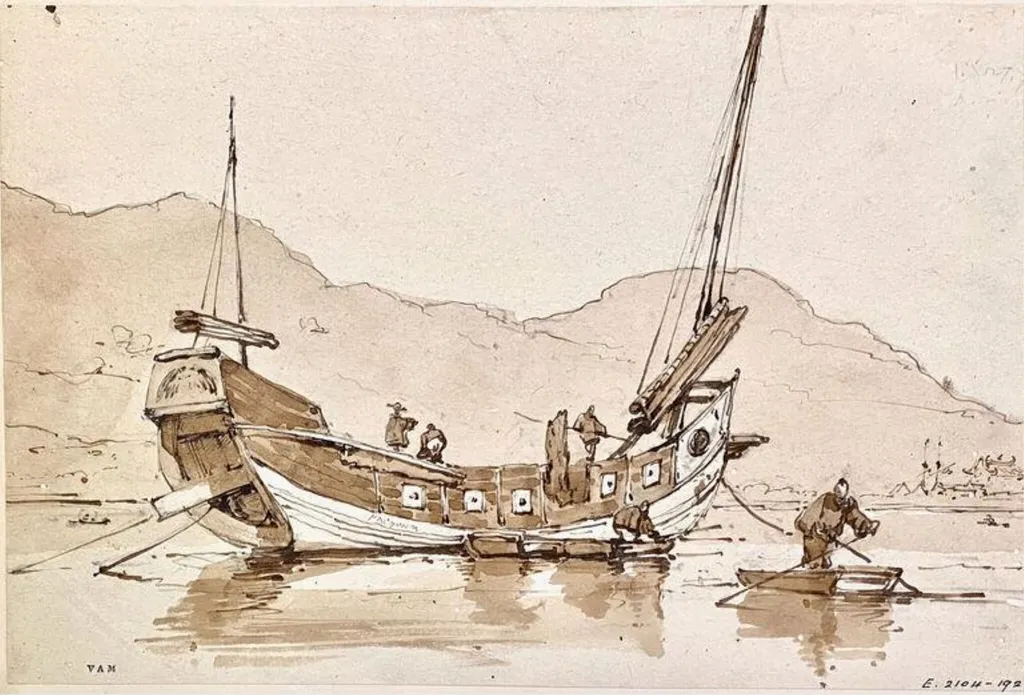
A junk off the south China coast is a drawing by the Romanticist artist George Chinnery. It dates from 19 and is held in the collection of the Victoria and Albert Museum.
About this work
George Chinnery made this ink drawing of a Cantonese junk off the China coast. The ship’s bow has a painted “eye.” The stern shows a bird with spread wings. On shore, a temple stands near Macau.
Chinnery lived in Macau for twenty-seven years after 1825. He sketched the scene on paper with fine lines.
Check out more of Chinnery’s work next time you visit the Victoria and Albert Museum.
Overview
Created during Chinnery’s decades-long stay in the region, the work reflects his direct observation of daily life along the south China coast.
This ink drawing by George Chinnery depicts a two-masted coastal junk sailing near Macau, rendered with delicate, precise lines on paper. The vessel, typical of Cantonese maritime trade, features traditional decorative elements: an eye motif on the bow and a bird with outstretched wings on the stern transom. A temple is visible on the shoreline, suggesting a specific local landmark. Created during Chinnery’s decades-long stay in the region, the work reflects his direct observation of daily life along the south China coast.
Subject & Meaning
The junk represents a common vessel in regional commerce, its painted eye believed to guide the vessel safely through waters, a practice rooted in folk belief. The bird on the stern, likely a swallow or phoenix, may symbolize protection or auspicious travel. The temple on shore, possibly the A-Ma Temple, anchors the scene in a known Macau location, reinforcing the drawing’s documentary character. Together, these elements convey not just a ship, but a cultural landscape shaped by seafaring tradition and spiritual custom.
Technique & Style
Chinnery employed fine, controlled ink lines to capture the junk’s structure and the temple’s silhouette with clarity and restraint. The drawing avoids heavy shading, relying instead on linear precision to suggest form and depth. The composition balances the vessel’s horizontal presence with the verticality of the temple, creating a quiet harmony between sea and land. His approach is observational rather than idealized, reflecting the quiet realism characteristic of his later work in Asia.
History & Provenance
Created between 1825 and 1852, during Chinnery’s residence in Macau, the drawing is one of many works produced as he documented the region’s people, ships, and architecture. It was likely made on-site, as part of his routine sketching practice. The drawing entered institutional collections after his death, eventually finding a home in the Victoria and Albert Museum, where it remains as part of a broader archive of his Asian studies.
Context
Chinnery worked in Macau during a period of heightened foreign presence in southern China, before the Opium Wars reshaped trade and diplomacy. His drawings offer a rare visual record of local maritime life from a Western artist embedded in the community. Unlike many contemporaries who idealized Asian subjects, Chinnery’s work reflects a quiet intimacy with his surroundings, capturing everyday scenes with minimal intervention.
Legacy
Chinnery’s drawings, including this one, provide valuable insight into 19th-century coastal China through the eyes of a resident artist. His technique and subject matter influenced later Western artists working in Asia and remain important references for historians studying maritime culture and cross-cultural exchange. The drawing endures not as a grand statement, but as a quiet, accurate record of a world in transition.
Own this work as a print
Artist & collection

Artist
George Chinnery (Chinese: 錢納利; 5 January 1774 – 30 May 1852) was an English painter who spent most of his life in Asia, especially India and southern China.




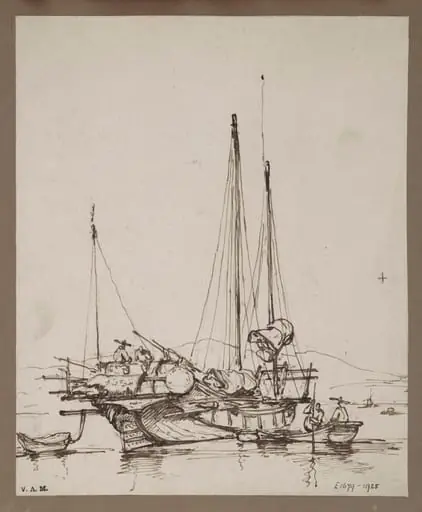 A drawing by George Chinnery of aA Chinese junk, with figures aboard and small craft alongside
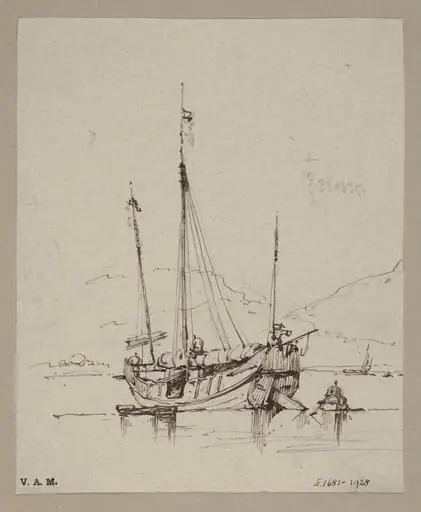 A Chinese junk with sail furled
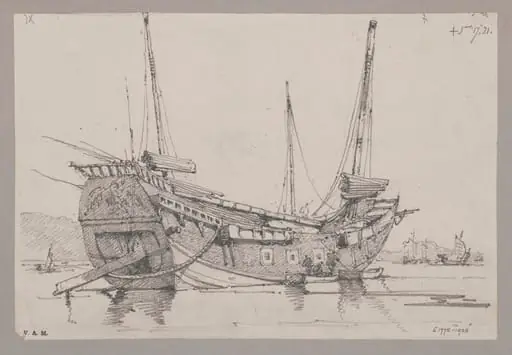 Old Chinese Junk
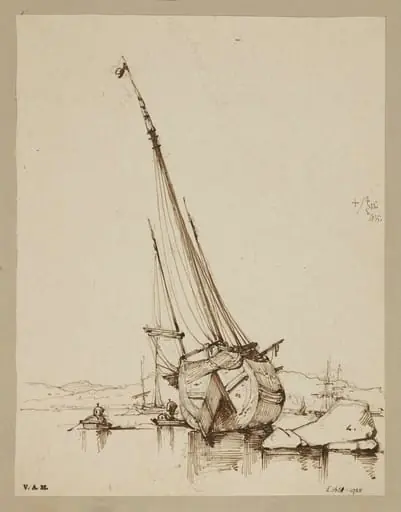 A junk grounded in shallow water, Macau
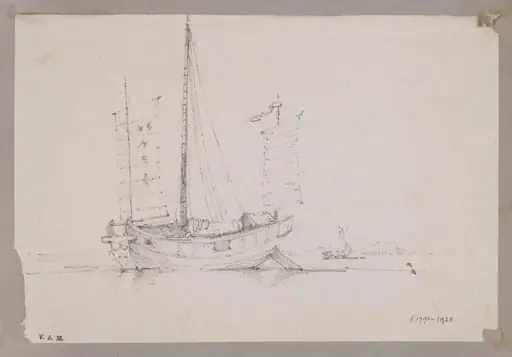 A Chinese junk
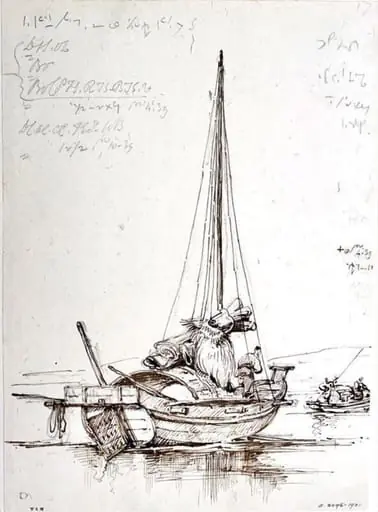 Drawing, Tanka boats off the coast, Macau
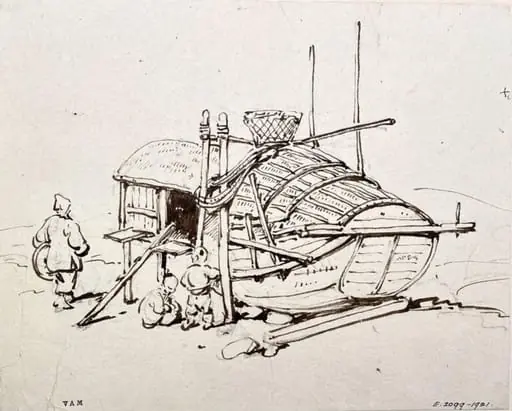 Drawing, a Tanka boat propped up ashore, Macau
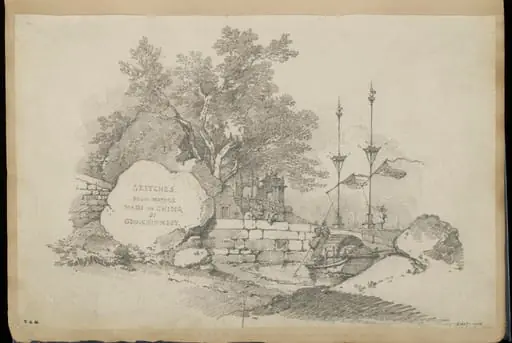 Vignette of the A-Ma Temple, Macau, for a titlepage inscribed 'Sketches from Nature made in China by Geo. Chinnery'