Artwork
Mercury Killing Argus
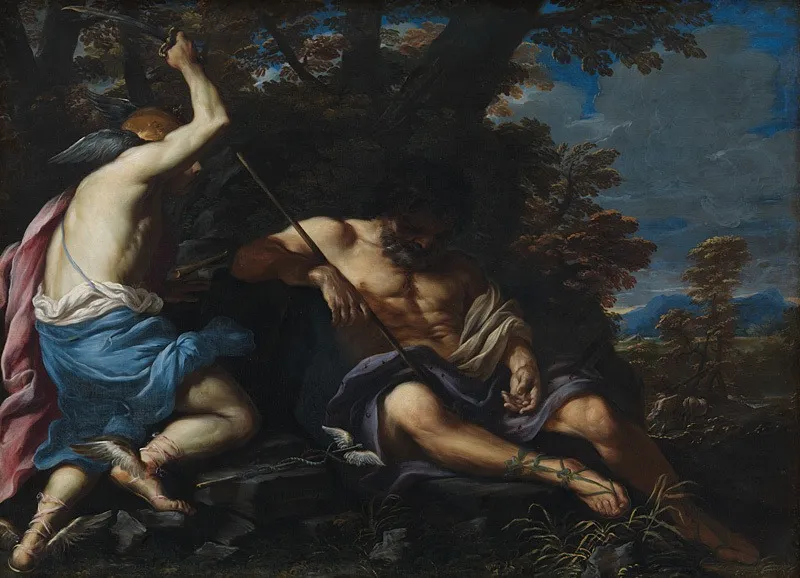
Mercury Killing Argus is an oil painting by the Early Baroque Italian artist Girolamo Troppa. It dates from 1690 and is held in the collection of the Statens Museum for Kunst.
About this work
Overview
The canvas captures a pivotal moment of conflict between the winged god Mercury and the multi-eyed giant Argus, set within a natural landscape.
Girolamo Troppa's 1690 oil painting, Mercury Killing Argus, depicts a dramatic scene from classical mythology. This work showcases the Roman Baroque painter's engagement with narrative subjects, despite his usual focus on sacred themes. The canvas captures a pivotal moment of conflict between the winged god Mercury and the multi-eyed giant Argus, set within a natural landscape. It is currently housed in the Statens Museum for Kunst.
Subject & Meaning
The painting illustrates the mythological account of Mercury's mission to slay Argus, ordered by Jupiter. On the left, Mercury, identifiable by his wings and raised sword, prepares to strike. His pink cloak and blue skirt contrast with the seated Argus on the right, who wears a purple skirt and holds his own sword, appearing to look down in resignation. The tension of the impending confrontation is central to the composition, set against a backdrop of trees and a cloudy sky.
Technique & Style
Troppa executed Mercury Killing Argus in oil, employing techniques characteristic of the late Baroque period in Rome. The artist adopted stylistic elements from Carlo Maratta, a prominent figure of the time. Notably, the painting utilizes chiaroscuro, a strong contrast between light and shadow, to enhance the dramatic intensity and create a sense of three-dimensionality. This approach imbues the scene with depth and underscores the emotional weight of the mythological encounter.
History & Provenance
Created in 1690, Mercury Killing Argus represents Girolamo Troppa's work during his active period in Rome and Umbria. While Troppa was primarily known for his religious commissions, this mythological narrative demonstrates his broader artistic range. The painting has since become part of the collection at the Statens Museum for Kunst, where it provides insight into late 17th-century Italian Baroque painting.
Artist & collection
Artist
Girolamo Troppa (2 October 1636 – October 1711) was an Italian painter of the Baroque period, depicting mainly sacred subjects. A follower of Carlo Maratta, he was active in Rome and Umbria.
