Artwork
Carlo and Ubaldo Resisting the Enchantments of Armida's Nymphs
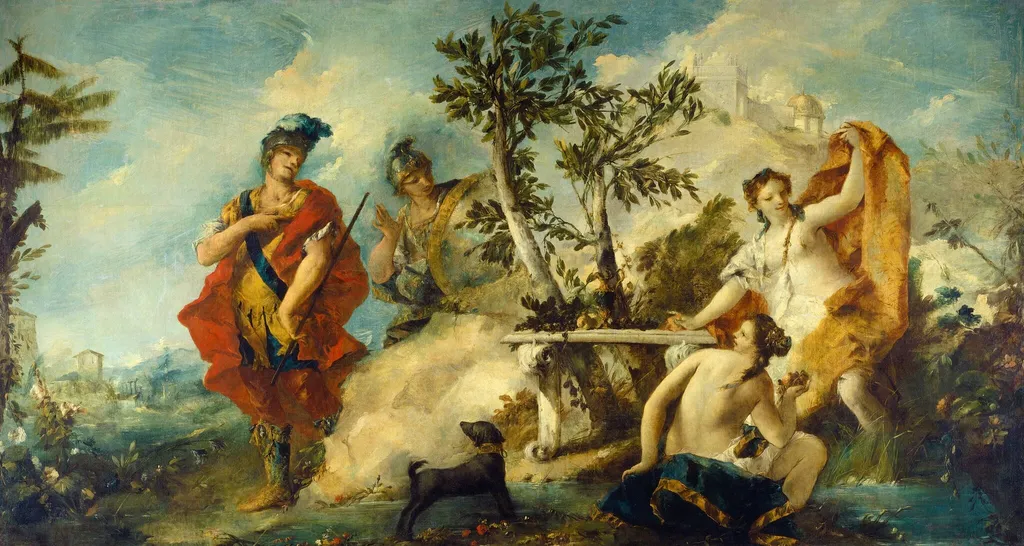
Carlo and Ubaldo Resisting the Enchantments of Armida's Nymphs is an oil painting by the Rococo painting artist Gian Antonio Guardi. It dates from 1752 and is held in the collection of the National Gallery of Art.
About this work
Overview
Guardi sets the scene within a lush, natural landscape featuring trees, a body of water, and a distant horizon, characteristic of the Venetian Rococo style.
Gian Antonio Guardi's 'Carlo and Ubaldo Resisting the Enchantments of Armida's Nymphs,' painted in 1752, illustrates a pivotal episode from Torquato Tasso's epic poem 'Jerusalem Delivered.' The composition depicts the knights Carlo and Ubaldo encountering the seductive nymphs sent by the sorceress Armida to distract them from their mission. On the left, the two armored knights, distinguished by their colorful attire and feathered hats, turn resolutely away from the advances of the three nymphs and a dog positioned on the right. Guardi sets the scene within a lush, natural landscape featuring trees, a body of water, and a distant horizon, characteristic of the Venetian Rococo style. The artist employs a light, fluid brushwork and a vibrant palette to convey the tension between the knights' duty and the nymphs' allure. This work exemplifies Guardi's early career focus on mythological and literary subjects, demonstrating his ability to blend narrative clarity with the decorative elegance typical of mid-18th century Venetian painting.
Subject & Meaning
The painting illustrates a moment of moral resolve from an epic poem, likely Torquato Tasso's Jerusalem Delivered. On the left, two male figures, presumably Carlo and Ubaldo, are richly dressed with feathered hats and appear to turn away, signaling their resistance. Opposite them, three nymphs, associated with the sorceress Armida, are depicted in flowing garments, one seated, with a dog nearby. The verdant setting, featuring trees and a body of water, enhances the narrative of temptation within a natural, idyllic space.
Artist & collection

