Artwork
Silvrettagletscher
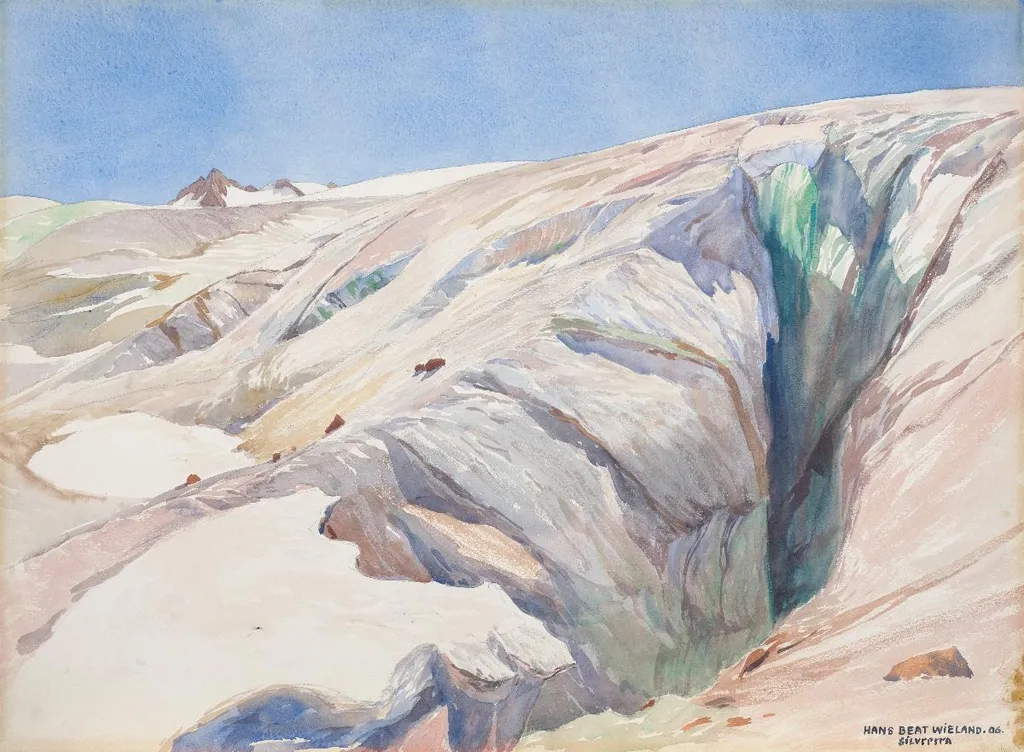
Silvrettagletscher is an unspecified painting by the Post-Impressionist artist Hans Beat Wieland. It dates from 1906 and is held in the collection of the Kunsthaus Zürich.
About this work
Overview
It resides in the Kunsthaus Zürich, where it exemplifies Wieland’s dedication to documenting alpine terrain with observational clarity.
Hans Beat Wieland, a Swiss artist born in 1867, painted *Silvrettagletscher* in 1906 after training in Munich. The work is a precise, unembellished portrayal of the Silvretta Glacier in the Swiss Alps. It resides in the Kunsthaus Zürich, where it exemplifies Wieland’s dedication to documenting alpine terrain with observational clarity. Though associated with post-impressionist tendencies, his approach prioritizes topographic accuracy over expressive brushwork.
Subject & Meaning
The painting depicts the Silvretta Glacier and its surrounding high-alpine environment: snow-covered peaks, rocky outcrops, and a narrow stream winding through the foreground. There is no human presence or narrative element. The composition conveys the scale and stillness of the glacial landscape, emphasizing nature’s endurance and isolation. Wieland’s focus on geological form suggests a quiet reverence for the Alps as a physical and spiritual constant.
Technique & Style
Wieland employed a controlled, detailed brushwork to render the glacier’s icy surfaces, rocky terrain, and distant peaks. Colors are muted—white, pale brown, and muted green—creating a harmonious tonal range that mirrors the natural palette of the region. The sky, rendered in a uniform pale blue without clouds, enhances the sense of atmospheric clarity. His method avoids impressionistic diffusion, favoring structured form and spatial depth.
History & Provenance
Completed in 1906, the painting entered the collection of the Kunsthaus Zürich shortly after its creation. Wieland, known for his systematic study of Alpine regions, produced this work during a period of heightened interest in Swiss landscape documentation. Its continuous presence in the museum’s holdings reflects its significance as a representative example of early 20th-century Swiss realism, preserved without significant alteration or transfer.
Context
In the early 1900s, Swiss artists increasingly turned to their mountainous homeland as a subject of cultural identity. Wieland’s work emerged alongside scientific expeditions and tourism growth in the Alps. Unlike romanticized depictions, his paintings avoided dramatic lighting or sentimentality. Instead, they served as visual records, contributing to a broader movement that valued geographical truth over artistic embellishment.
Legacy
Wieland’s *Silvrettagletscher* remains a reference point for understanding how Swiss painters engaged with their natural environment at the turn of the century. While not widely exhibited beyond regional collections, the painting exemplifies a quiet, persistent tradition of alpine realism. Its endurance in the Kunsthaus Zürich underscores its role as a factual, unadorned testament to a landscape that has since undergone significant glacial change.
Artist & collection

Artist
Hans Beat Wieland (11 June 1867 – 23 August 1945) was a Swiss painter, best known for his realist paintings of Alpine sceneries.

 In the Alps
 Studie zum Rosenlauigletscher
 Marble Quarry, probably at Carrara
 Untitled
 Tomb of the Kings, Thebes
 In the Alps
 Aboo Simbel
 The Gate of the Desert
 Mountainous Landscape in Italy : "Il Resegone"
 Mountain View at Bormio (from Switzerland 1869 Sketchbook)
 Tombs of the kings in Jerusalem. From the journey to Palestine
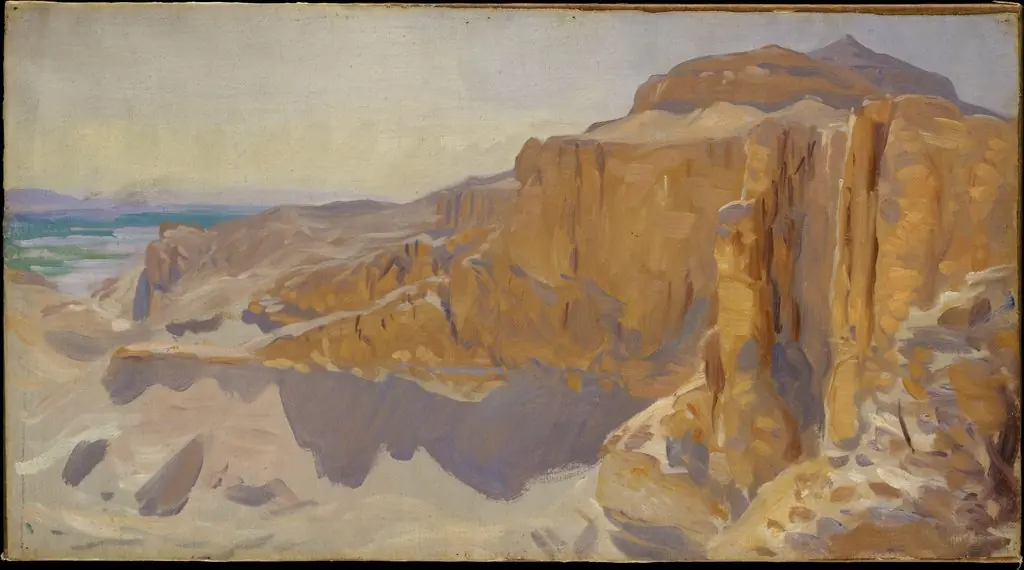 Cliffs at Deir el Bahri, Egypt