Artwork
A Sperm Whale Washed up on the Beach at Noordwijk, 28 December 1614
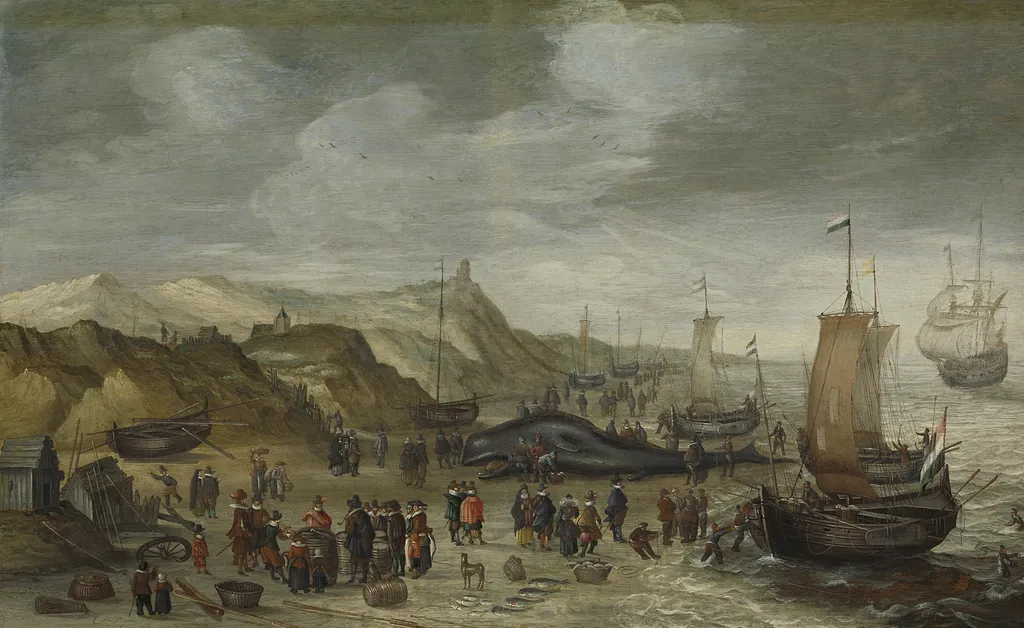
A Sperm Whale Washed up on the Beach at Noordwijk, 28 December 1614 is an oil painting by the Dutch Golden Age artist Hans Savery the Elder. It dates from 1620 and is held in the collection of the Rijksmuseum.
About this work
Overview
Hans Savery the Elder’s oil painting, titled *A Sperm Whale Washed up on the Beach at Noordwijk, 28 December 1614*, was executed around 1620. The work records a striking coastal tableau: a massive sperm whale lies on the sand, surrounded by onlookers and a small fleet of boats under a cloud‑filled sky. The composition is held in the collection of the Rijksmuseum in Amsterdam.
Subject & Meaning
The central focus is the stranded whale, a rare and awe‑inspiring sight for a 17th‑century Dutch community. Figures cluster around the carcass, some examining it, others engaged in the practical task of processing the animal. The scene captures a moment of communal curiosity and labor, reflecting the era’s relationship with the sea’s bounty and its occasional perils.
Technique & Style
Rendered in oil on canvas, Savery employs a muted palette of grays, browns, and muted blues to convey the overcast atmosphere.
Rendered in oil on canvas, Savery employs a muted palette of grays, browns, and muted blues to convey the overcast atmosphere. The brushwork balances fine detail—such as the texture of the whale’s skin and the rigging of the boats—with broader, atmospheric strokes that suggest the wind‑laden sky. The composition follows the Dutch realist tradition of documenting everyday events with observational precision.
History & Provenance
Although the event depicted occurred on 28 December 1614, Savery completed the painting several years later, circa 1620. The work entered the Rijksmuseum’s holdings as part of its Dutch Golden Age collection, where it remains on display as an example of marine genre painting. Its provenance prior to museum acquisition is not extensively documented.
Context
In the early 17th century, the Netherlands’ maritime economy made sea‑related subjects popular among artists. Savery’s depiction aligns with contemporary works that recorded extraordinary natural occurrences—such as whale strandings—while also illustrating daily life on the coast. The painting thus serves both as a historical record of a specific incident at Noordwijk and as a broader commentary on the nation’s seafaring culture.
Own this work as a print
Artist & collection
