Artwork
Independence Hall
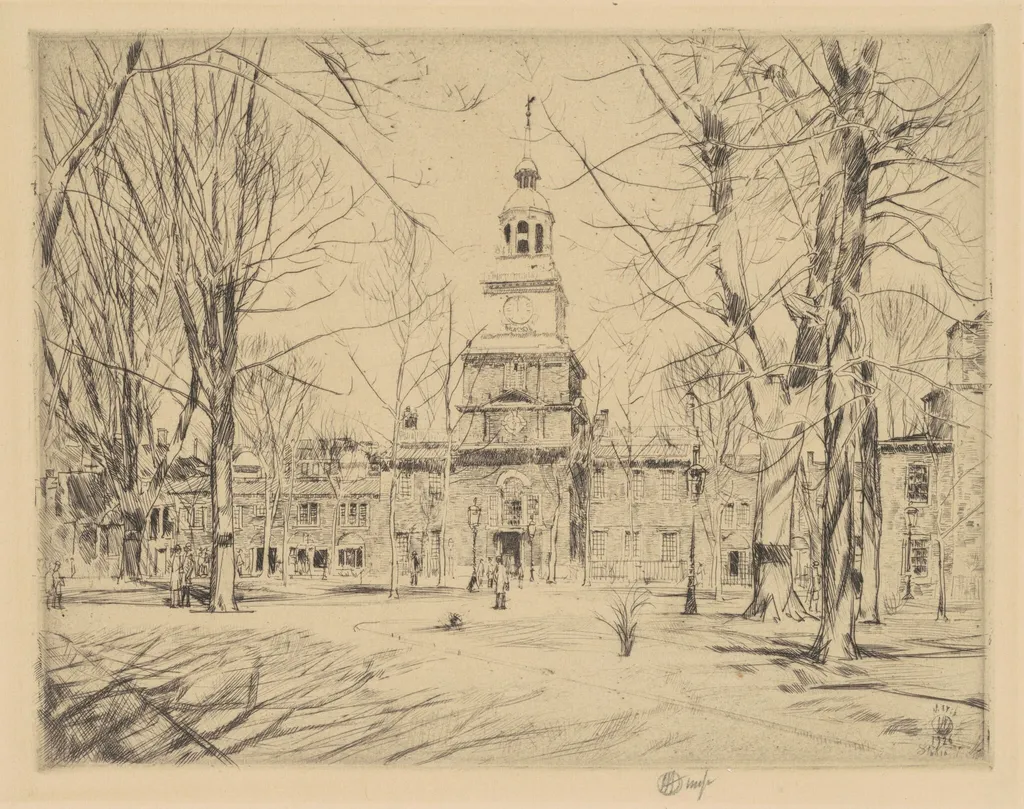
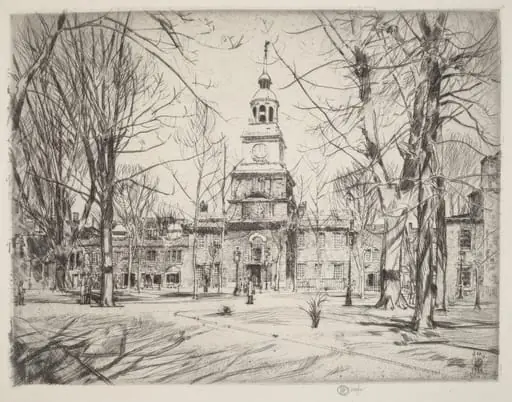
Independence Hall is an ink print by Childe Hassam. It dates from 1926 and is held in the collection of the National Gallery of Art.
About this work
A handful of figures chat on the sidewalk, giving the historic scene a quiet human touch.
Childe Hassam’s 1926 etching shows Independence Hall from street level. The brick building’s clock tower looms above bare winter trees. A handful of figures chat on the sidewalk, giving the historic scene a quiet human touch.
This etching is one of 41 Hassam made while living in Philadelphia. He often used printmaking to capture American landmarks in simple, bold lines.
Look up Hassam, Childe next—he made over 300 etchings just like this one.
Overview
Childe Hassam’s 1926 etching presents a street‑level perspective of Independence Hall in Philadelphia. Rendered in black on wove paper, the image captures the brick façade and its prominent clock tower, set against a backdrop of leafless trees. A few pedestrians linger on the sidewalk, lending a modest human presence to the historic architecture.
Subject & Meaning
The composition focuses on the iconic building’s central tower, complete with its spire and weathervane, emphasizing its civic significance. By placing ordinary figures in conversation nearby, Hassam suggests the continuity between the nation’s foundational past and everyday contemporary life.
Technique & Style
Executed as an etching, the work relies on fine, controlled line work to delineate architectural details and the texture of the surrounding trees. The monochrome palette of sepia tones and deep black creates a stark, atmospheric quality, while the crispness of the lines reflects Hassam’s preference for clear, bold outlines in his printmaking.
History & Provenance
This print is one of a series of forty‑one etchings Hassam produced while residing in Philadelphia, a period during which he turned to printmaking to document American landmarks. The etching forms part of his broader output of over three hundred prints, many of which explore similar themes of urban and historic architecture.
Context
Created in the mid‑1920s, the piece aligns with a broader American interest in historic preservation and national identity. Hassam’s choice of a winter scene, sparse foliage, and subdued lighting reflects contemporary trends toward realism tempered by a modest, decorative sensibility.
Artist & collection
Artist
Frederick Childe Hassam was an American Impressionist painter, noted for his urban and coastal scenes.