Artwork
Bare Knuckles
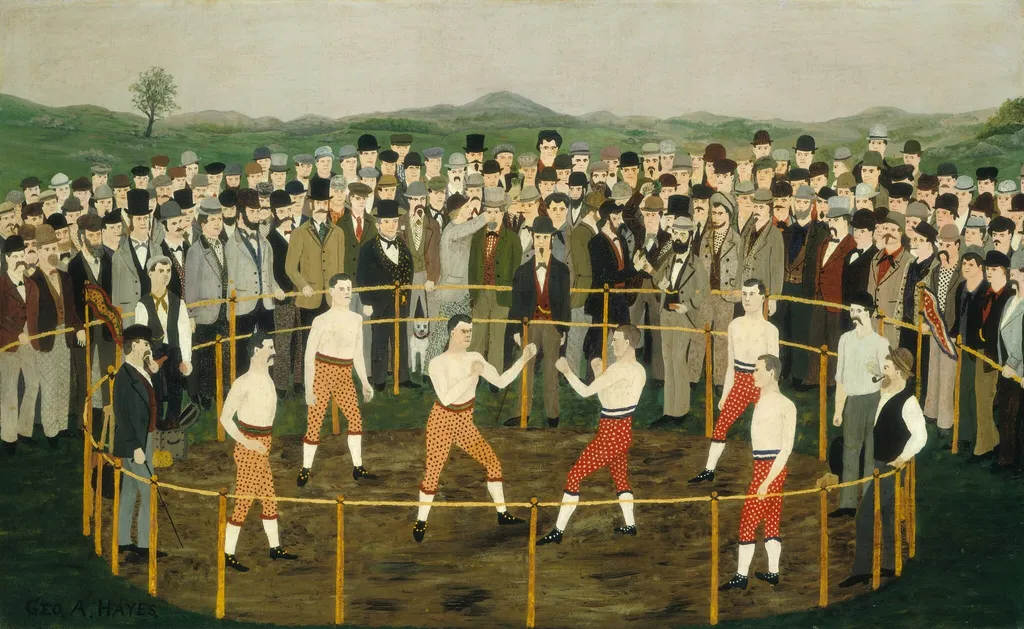
Bare Knuckles is an oil painting by the Impressionist artist George A. Hayes. It dates from 1878 and is held in the collection of the National Gallery of Art. George A.
About this work
Overview
George A. Hayes’s oil painting Bare Knuckles, executed around 1878, depicts a bustling public spectacle. The composition centers on a roped arena where four unclothed men engage in a pugilistic contest, while a dense audience of 19th‑century onlookers fills the surrounding space, their gestures suggesting excitement and commentary.
Subject & Meaning
The work captures a moment of popular entertainment in the late nineteenth century, illustrating the social allure of bare‑knuckle fighting.
The work captures a moment of popular entertainment in the late nineteenth century, illustrating the social allure of bare‑knuckle fighting. By presenting the combatants in stark, unclothed form and surrounding them with a crowd of formally dressed spectators, the painting juxtaposes raw physicality with the decorum of contemporary public life, hinting at the tension between primal sport and genteel society.
Technique & Style
Hayes employs a limited palette of flat, saturated colors outlined in bold lines, giving the scene a graphic, almost illustrative quality. The figures are rendered with simplified anatomy; the fighters’ bodies are dynamic, yet their expressions remain composed. This approach emphasizes movement and crowd density while maintaining a clear, almost schematic visual structure.
History & Provenance
Created circa 1878, Bare Knuckles entered the collection of the National Gallery of Art in Washington, D.C., where it remains on display. The painting’s provenance prior to acquisition by the museum is not extensively documented, but its presence in a major public institution underscores its relevance to American genre painting of the period.
Context
The late 1800s saw a rise in popular street and tavern spectacles, including unsanctioned boxing matches, which attracted mixed‑class audiences. Hayes’s depiction reflects this cultural phenomenon, offering a visual record of how such events were staged and perceived within urban American settings of the era.
Own this work as a print
Artist & collection

