Artwork
Το ασπρο καράβι
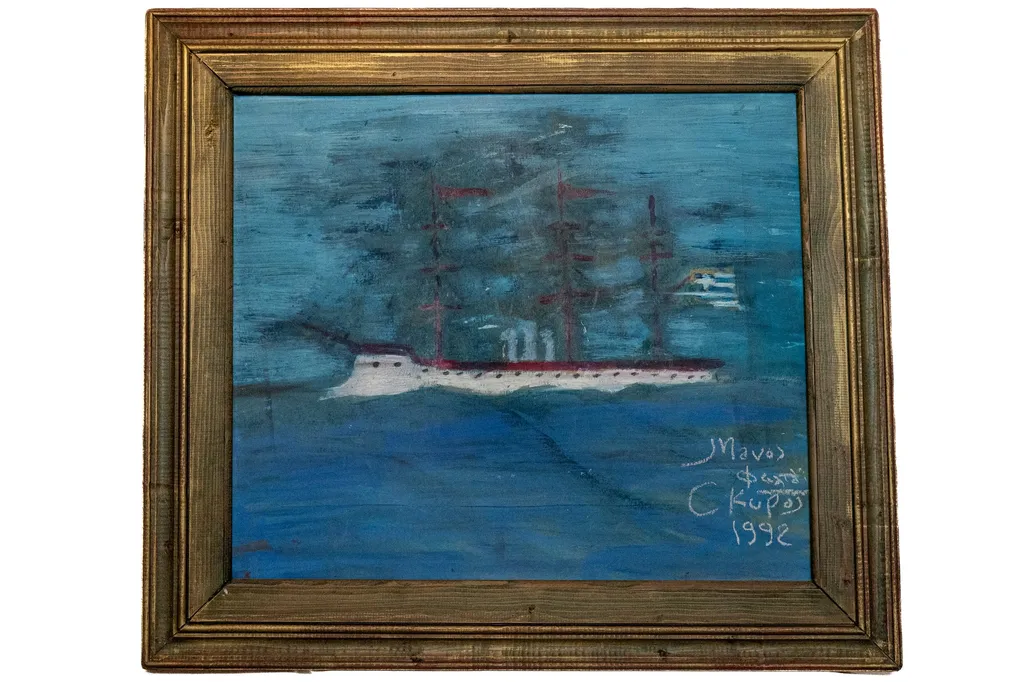
Το ασπρο καράβι is an unspecified painting by Faltaits Manos. It dates from 1992 and is held in the collection of the Manos & Anastasia Faltaits Folk Art & Ethnographic Museum.
About this work
Overview
It resides in the collection of the Museum of Ethnography, where it is presented as part of a broader exploration of maritime imagery in modern Greek art.
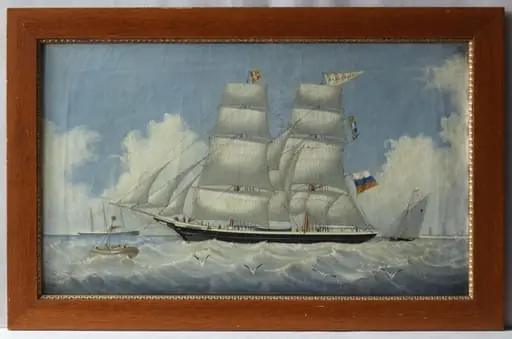
Created in 1992 by Faltaits Manos, Το ασπρο καράβι is a painted representation of a solitary white vessel, its red sails and masts contrasting against a field of blue. The composition centers the ship with minimal detail, emphasizing stillness and isolation. It resides in the collection of the Museum of Ethnography, where it is presented as part of a broader exploration of maritime imagery in modern Greek art.
Subject & Meaning
The painting portrays a single ship, stripped of narrative context, suggesting themes of solitude, journey, or memory. The absence of passengers, cargo, or destination invites contemplation rather than storytelling. The vessel’s purity of form and quiet placement may reflect personal or cultural reflections on the sea as a space of both departure and return, common in Greek coastal traditions.
Technique & Style
Faltaits employs flat, unmodulated planes of color—white for the hull, red for the rigging, and blue for the sea—creating a stylized, almost symbolic representation. Brushwork is restrained, with no texture or shading to suggest realism. The composition is deliberately sparse, aligning with modernist simplification rather than traditional marine painting’s detail-oriented approach.
History & Provenance
The work was completed in 1992 and entered the Museum of Ethnography’s collection shortly thereafter. No public record details its prior ownership or exhibition history. Its inclusion in an ethnographic institution suggests its value lies not in artistic fame but in its resonance with cultural motifs of seafaring life in Greece during the late 20th century.
Context
In post-1970s Greece, artists increasingly turned to simplified forms to explore national identity and memory. Το ασπρο καράβι reflects this trend, using the ship—a recurring symbol in Greek folk art and poetry—as a quiet emblem of continuity. Its placement in an ethnographic museum situates it within a broader effort to document everyday visual culture beyond fine art conventions.
Legacy
While not widely reproduced or studied, the painting contributes to a quieter lineage of Greek modernist works that prioritize emotional tone over narrative. Its presence in an ethnographic setting signals a shift in how maritime imagery is valued—not as grand historical record, but as a subtle, personal expression of cultural belonging.
Artist & collection
Artist
Greek painter whose bold, flat-color portraits put actors on parade. His three-panel “Περιοδεύων θίασος 1” shows a traveling troupe of masks in rhythm across red, green and ochre. The same cast reappears in “Περιοδεύων…
Museum
Manos & Anastasia Faltaits Folk Art & Ethnographic Museum
Continue through works from the same source collection.