Artwork
Raja Bikram Singh of Guler (r. 1661–75) Smoking a Hookah
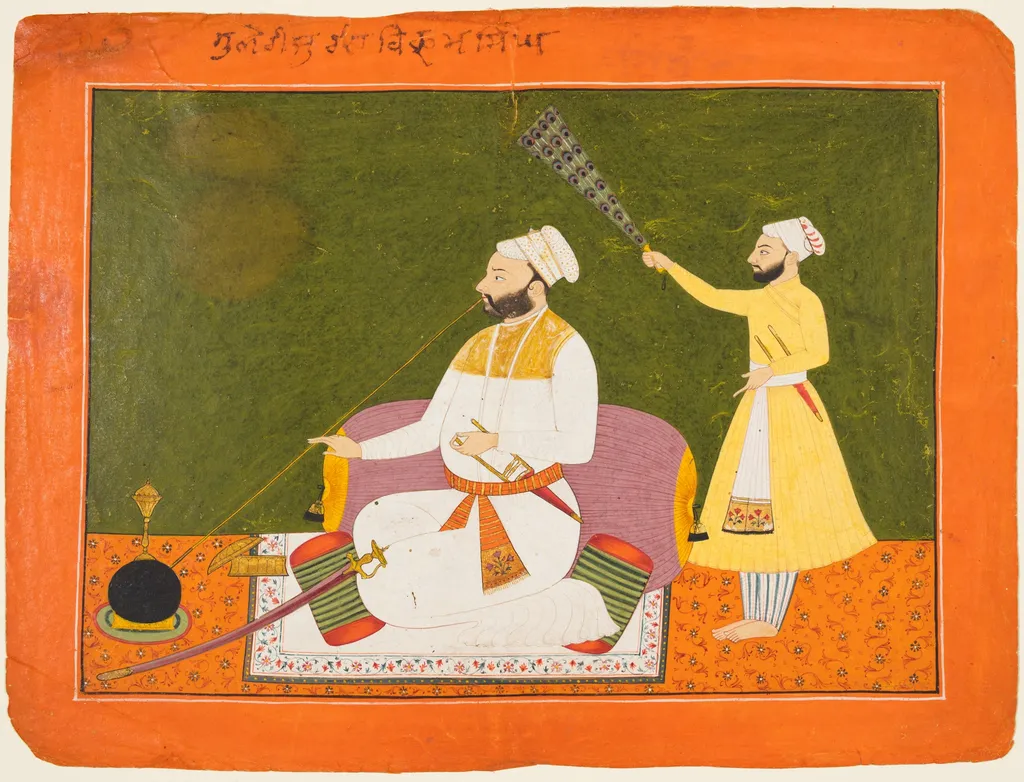
Raja Bikram Singh of Guler (r. 1661–75) Smoking a Hookah is an unspecified painting. It dates from 1675 and is held in the collection of the Cleveland Museum of Art.
About this work
Overview
The work portrays a seated figure, identified as Raja Bikram Singh of Guler, reclining on a padded platform while drawing on a curved hookah. A second figure stands nearby, brandishing a feathered fan. The composition is framed by a red, floral border and set against a uniform green backdrop, emphasizing the vivid attire and objects that populate the scene.
Subject & Meaning
The central figure, the Guler ruler, is depicted in white turban and yellow robes, suggesting regal status and leisure. The act of smoking a hookah, accompanied by the attendant with a fan, conveys a moment of courtly relaxation and the cultural practices of the Himalayan princely courts in the mid‑17th century.
Technique & Style
Executed in bright, saturated pigments, the painting employs bold coloration to delineate garments and accessories. Fine detailing renders the feather fan, hookah, and weaponry, while the flat green field and decorative border reflect the stylized aesthetic typical of Pahari court paintings.
History & Provenance
Attributed to the Guler school of painting, the piece dates to the reign of Raja Bikram Singh (1661–1675). It likely originated in the royal atelier of Guler, a Himalayan kingdom known for its synthesis of Mughal influences and local artistic traditions.
Context
During the 17th century, Guler artists produced intimate court scenes that highlighted the patron’s refined tastes. The inclusion of luxurious items such as a jeweled sword, a black helmet, and a decorative box underscores the material culture surrounding the Guler court.
Legacy
The painting exemplifies the regional adaptation of Mughal miniature techniques within the Pahari tradition, contributing to the broader understanding of North Indian courtly visual culture in the early modern period.
Artist & collection
