Artwork
Pampas Grass
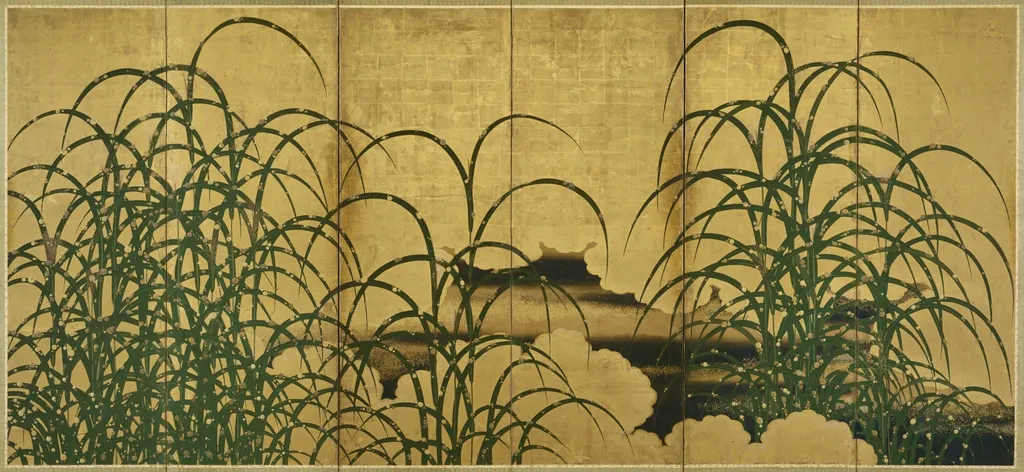
Pampas Grass is an unspecified painting by Unknown. It dates from 1615 and is held in the collection of the Detroit Institute of Arts.
About this work
Overview
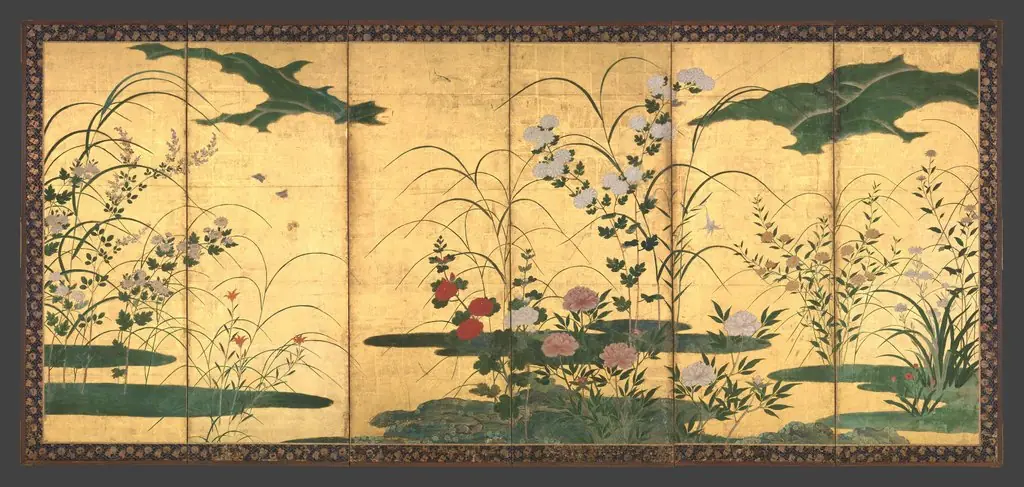
This painting presents a quiet, minimalist composition centered on tall pampas grass rising vertically against a flat, golden background.
This painting presents a quiet, minimalist composition centered on tall pampas grass rising vertically against a flat, golden background. The scene avoids narrative detail, focusing instead on the interplay of form and tone. Dark-hued grasses and soft clouds contrast with the pale wall, creating a meditative atmosphere. The artist emphasizes spatial depth through subtle gradations of color rather than perspective or shading.
Subject & Meaning
The subject is the pampas grass, rendered not as a botanical study but as a quiet symbol of natural stillness. Its elongated forms suggest movement caught mid-sway, while the absence of horizon or context isolates the plant in a timeless space. The clouds, faint and distant, reinforce a sense of calm detachment. The work invites contemplation rather than interpretation, favoring mood over story.
Technique & Style
The artist employs a restrained palette of muted greens and grays to model the grass and clouds, using layered washes to suggest texture and volume. Brushwork is deliberate but unobtrusive, avoiding sharp outlines in favor of soft transitions. The flat, gold background functions as both ground and light source, flattening space while enhancing the three-dimensionality of the foreground elements through tonal contrast.
History & Provenance
The painting’s origins are undocumented in public records, with no known exhibition history or collector lineage prior to its current location. Its style suggests a late 20th-century sensibility, possibly influenced by East Asian ink traditions or modernist abstraction. No signature or date is visible, and the artist’s identity remains unconfirmed in available sources.
Context
Emerging from a period when many artists turned to elemental forms and subdued palettes, this work aligns with a broader interest in nature as a vessel for stillness. It shares affinities with post-war Japanese and American minimalist practices that favored simplicity and material presence over representation. The absence of human figures or architectural elements reflects a deliberate withdrawal from narrative conventions.
Legacy
Though not widely reproduced or studied, the painting contributes to a quiet lineage of works that explore nature through abstraction and tonal nuance. Its influence, if any, is indirect—seen in later artists who favor atmospheric restraint over detail. It remains a quiet example of how minimal means can evoke presence without spectacle.
Artist & collection

 Domestic Scene
 Giacomo and Cardinal Marco, investing Andrea, Abbot of San Zeno, with his Benefice
 The Nymph of Fontainebleau
 Portrait of a Woman
 Madonna and Child with Saints in the Enclosed Garden
 Venus and Minerva
 Family Group of Four on Sofa
 Wall painting from Room H of the Villa of P. Fannius Synistor at Boscoreale