Artwork
Three Hounds on the Chase (from Stodmarsh Court, Kent)
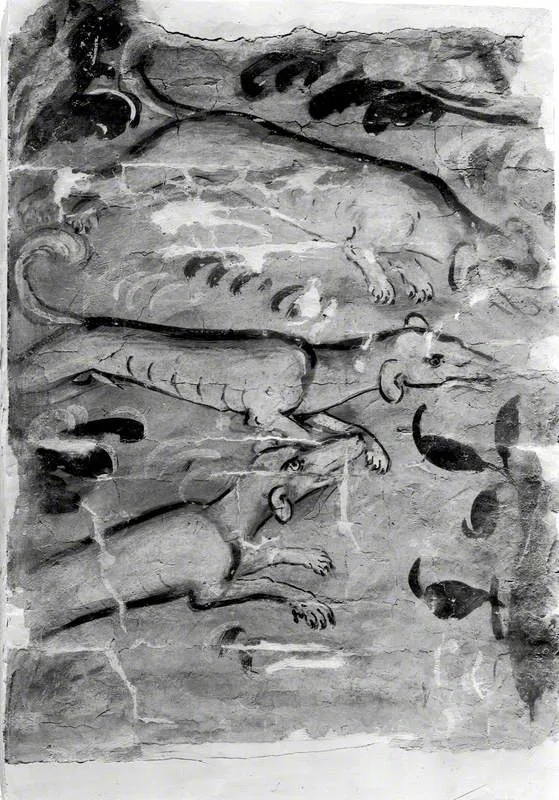
Three Hounds on the Chase (from Stodmarsh Court, Kent) is an unspecified painting by Unknown. It dates from 1600 and is held in the collection of the Victoria and Albert Museum. This oil painting depicts three hounds in active pursuit during a hunt, captured mid-motion across a sparse landscape.
About this work
Overview
This oil painting depicts three hounds in active pursuit during a hunt, captured mid-motion across a sparse landscape. The composition centers on the animals, with one prominently placed in the foreground and two receding into the background. A restrained palette of browns and grays dominates, minimizing environmental detail and focusing attention on the dogs’ dynamic postures and dynamic energy.
Subject & Meaning
The subject reflects the tradition of hunting as a rural pastime among the English gentry, rendered without romanticism or narrative embellishment. The dogs are portrayed not as symbols of nobility but as working animals in motion, their intensity conveyed through posture and tension. The absence of human figures or overt symbolism suggests an interest in the raw physicality of the chase itself.
Technique & Style
Brushwork is loose yet deliberate, emphasizing movement through fluid lines and overlapping forms. The muted tones are applied with subtle gradations to suggest depth and texture without vivid contrast. Background elements are softened, allowing the dogs’ musculature and directional motion to guide the viewer’s eye, reinforcing a sense of momentum through compositional flow.
History & Provenance
No record of the artist’s identity survives, and the work remained within the estate’s collection until its later documented appearance in public archives.
The painting originated at Stodmarsh Court in Kent, a country estate associated with landed families who maintained hunting grounds. Its presence there suggests commissioning or acquisition by a local landowner with interest in sporting subjects. No record of the artist’s identity survives, and the work remained within the estate’s collection until its later documented appearance in public archives.
Context
Created during a period when sporting art was popular among the British elite, this work aligns with a broader trend of depicting animals in action, though it diverges by omitting human figures and elaborate settings. Unlike more ornate hunting scenes of the era, its quiet tone and limited palette reflect a regional or personal aesthetic preference, possibly influenced by local artistic circles in southeast England.
Legacy
Though unsigned and largely unattributed, the painting contributes to the understudied corpus of provincial British sporting art. Its focus on canine movement without anthropomorphism offers a counterpoint to more theatrical depictions of the hunt. It remains a quiet example of how rural life and animal behavior were observed and recorded outside major artistic centers.
Artist & collection

 Domestic Scene
 Giacomo and Cardinal Marco, investing Andrea, Abbot of San Zeno, with his Benefice
 The Nymph of Fontainebleau
 Portrait of a Woman
 Madonna and Child with Saints in the Enclosed Garden
 Venus and Minerva
 Family Group of Four on Sofa
 Wall painting from Room H of the Villa of P. Fannius Synistor at Boscoreale
 Hounds from Nubia, Tomb of Rekhmire
 Untitled
 Provisions from Nubia Stored in the Temple, Tomb of Rekhmire
 Playing Card
 Untitled
 Quadruped with Fleur-de-lis from Boí
 Small coffered ceiling panel with a dog pursuing a hare
 Small coffered ceiling panel with four-legged animals and plant motifs
 A pig lying on its side
 A Forest Animal