Artwork
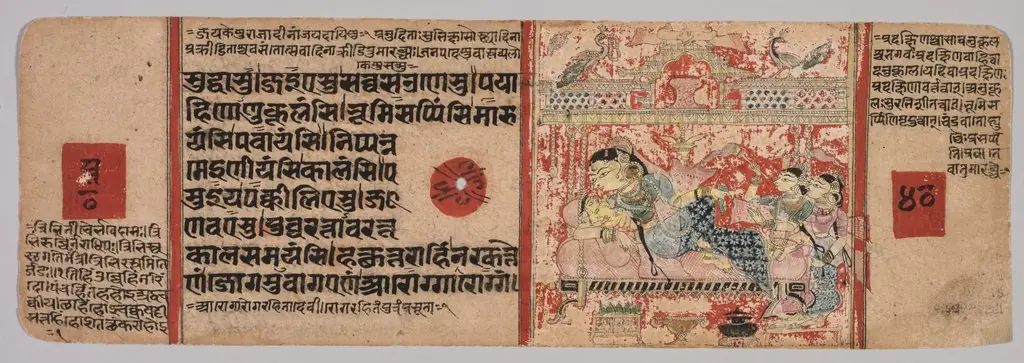
Text describing the pregnancy of Queen Trishala, folio 40 (recto) from a Kalpa-sutra
Text describing the pregnancy of Queen Trishala, folio 40 (recto) from a Kalpa-sutra is an unspecified painting. It dates from 1400 and is held in the collection of the Cleveland Museum of Art. Folio 40 (recto) from a Kalpa‑sūtra manuscript illustrates the narrative of Queen Trishala’s pregnancy.
About this work
Overview
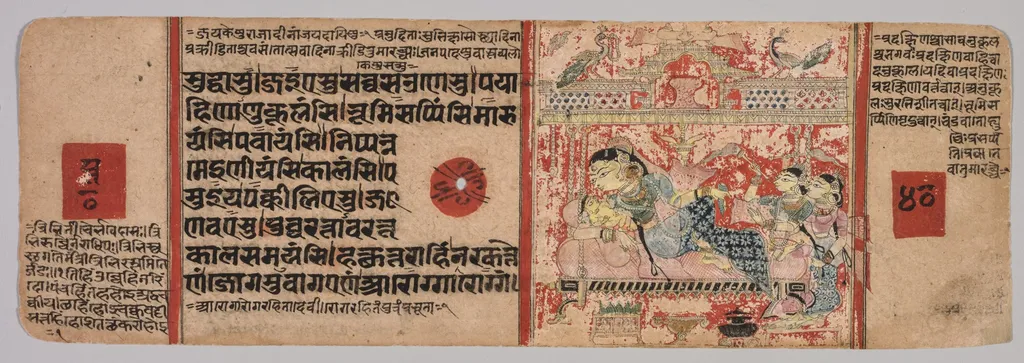
Folio 40 (recto) from a Kalpa‑sūtra manuscript illustrates the narrative of Queen Trishala’s pregnancy. Executed as a miniature painting on paper, the image occupies a single page within a larger religious text and is characterized by vivid chromatic contrasts and decorative framing.
Subject & Meaning
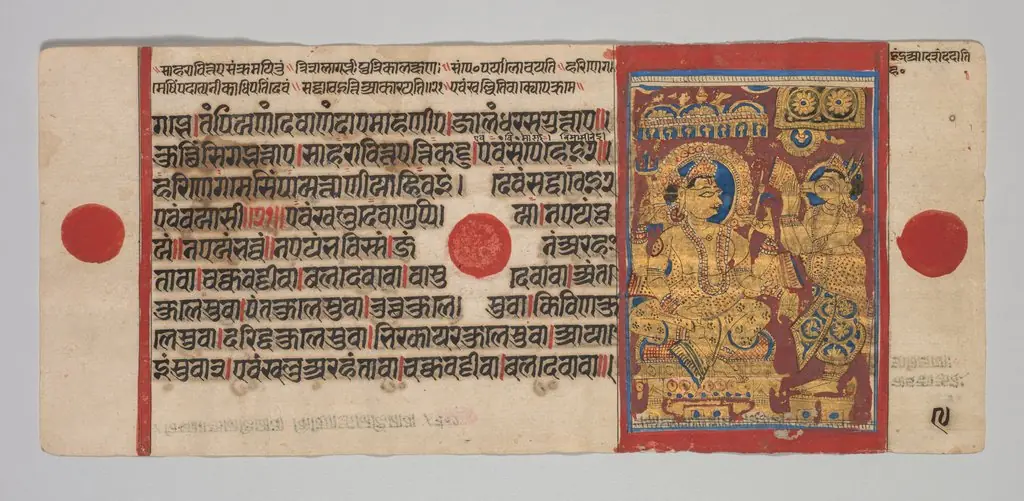
The scene presents the expectant queen seated on a couch, holding a fan, while a standing male figure—identified by a pronounced nose—appears to address or attend to her. The composition conveys a moment of royal intimacy and anticipation, reflecting the sutra’s focus on auspicious events in the Buddha’s lineage.
Technique & Style
Rendered in bold reds, blues, and yellows, the miniature employs flat areas of pigment and defined outlines typical of Indian manuscript illumination. A red border encloses the image, and miniature vignettes adorn the walls within the depicted interior, adding narrative depth. Small red dots, likely stamp seals, mark the page’s completion.
History & Provenance
The folio is part of a Kalpa‑sūtra collection now held by the Cleveland Museum of Art. Its precise date and place of production are not recorded in the supplied information, but the stylistic features align with medieval Indian Buddhist manuscript traditions.
Context
Kalpa‑sūtras are canonical texts recounting the lives of the Buddha and his predecessors. Illustrations such as this one served both devotional and didactic purposes, providing visual reinforcement of the textual narrative for monastic and lay audiences.
Legacy
As an example of narrative miniature painting, the folio contributes to the understanding of how religious stories were visually transmitted in South Asian manuscript culture. Its preservation in a major museum collection enables comparative study with other contemporaneous illustrated sutras.
Artist & collection