Artwork
Khadgaroma, Son of Ravana
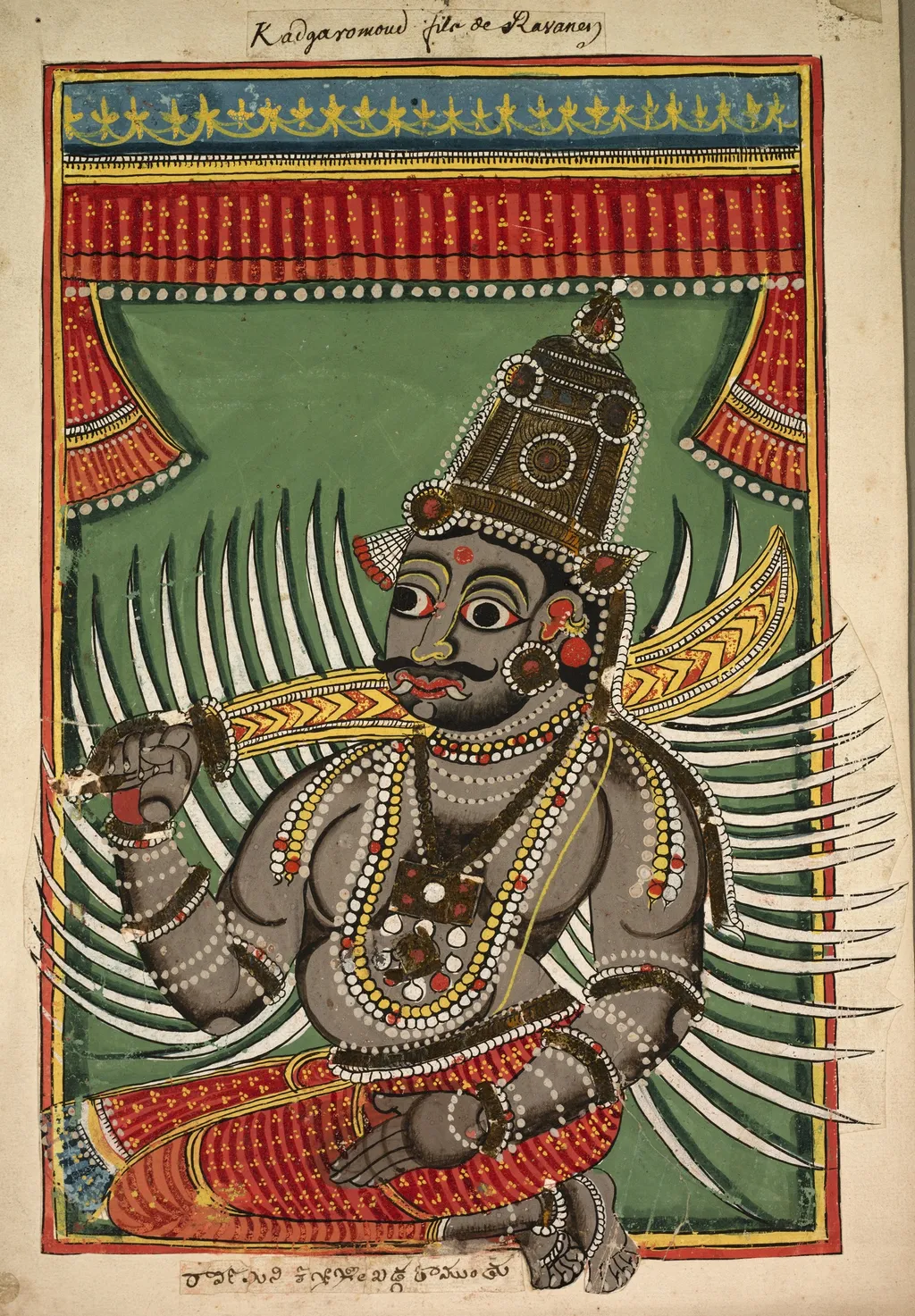
Khadgaroma, Son of Ravana is an unspecified painting. It dates from 1720 and is held in the collection of the Cleveland Museum of Art. The painting portrays a seated figure on an ornate red‑and‑gold throne, adorned with abundant jewelry and a jeweled belt.
About this work
Overview
The painting portrays a seated figure on an ornate red‑and‑gold throne, adorned with abundant jewelry and a jeweled belt. He wears a tall, spiked crown, his dark face marked by striking red dots for eyes, and holds a club in one hand and a snake in the other. A small animal lies beneath his feet, while a green canopy with red stripes frames the composition.
Subject & Meaning
The inscription at the top identifies the figure as Khadgaroma, son of Ravana, a character drawn from Hindu mythology. The presence of a club and a snake, traditional symbols of power and danger, underscores his mythic lineage, while the lavish attire emphasizes his royal or divine status within the narrative.
Technique & Style
Executed with vivid pigments and bold, clean outlines, the work employs a decorative aesthetic typical of South Asian manuscript illustration. The use of contrasting reds, greens, and gold creates a striking visual impact, and the flat treatment of space focuses attention on the figure rather than on realistic depth.
History & Provenance
The painting is catalogued as a decorative illustration, likely produced for a religious or courtly manuscript. Its exact date and origin are not specified, but the style aligns with traditional Indian artistic conventions that flourished in the pre‑colonial period. The piece is currently held in the collection of the Cleveland Museum of Art.
Artist & collection
