Artwork
Equestrian Portrait of Maharana Raj Singh II of Mewar (r. 1755–62)
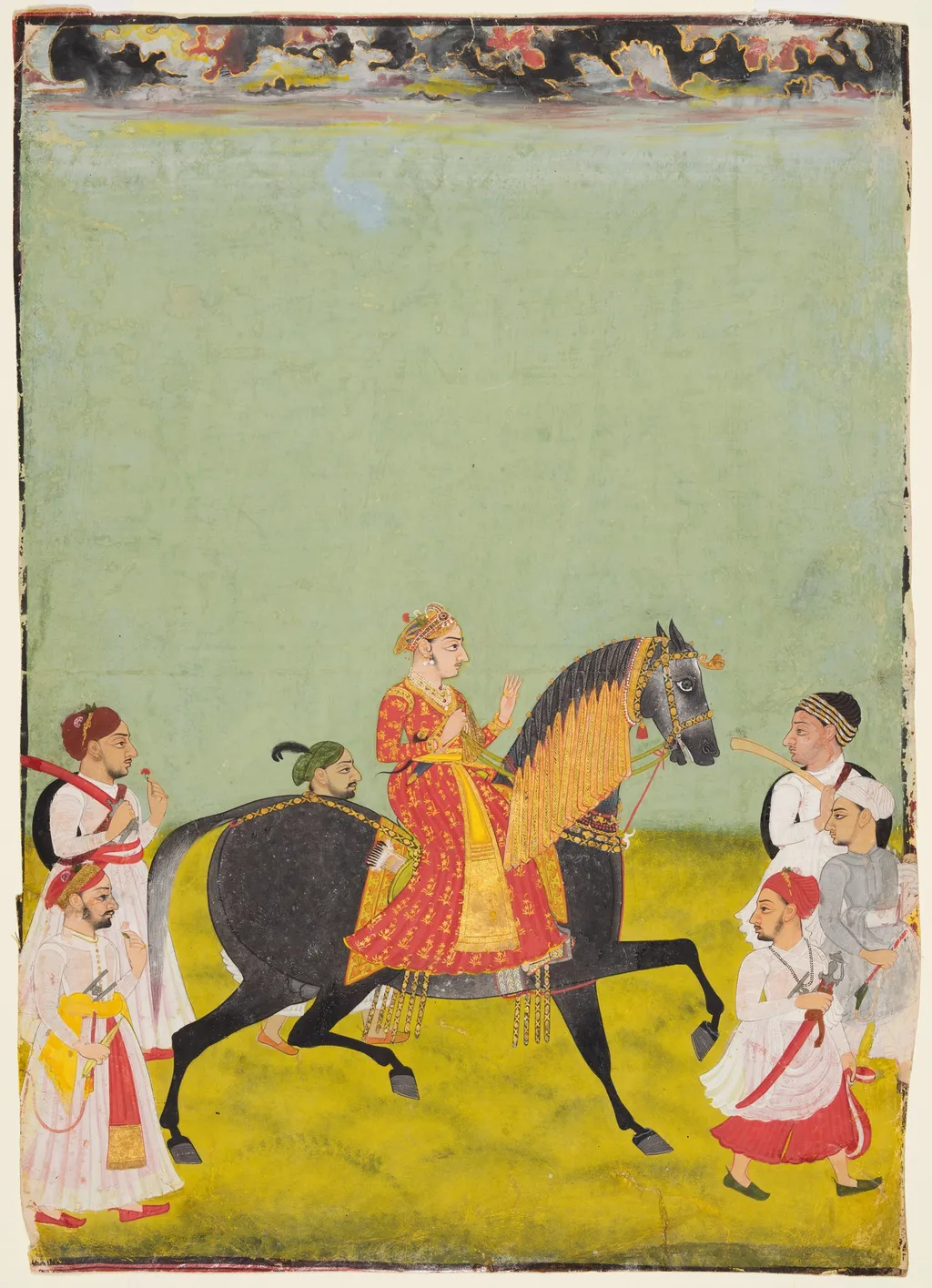
Equestrian Portrait of Maharana Raj Singh II of Mewar (r. 1755–62) is an unspecified painting. It dates from 1760 and is held in the collection of the Cleveland Museum of Art. The work depicts a ceremonial procession centered on a black horse adorned with gold chains.
About this work
Overview
A man and a woman sit astride the animal; the woman wears a vivid red garment trimmed in gold, while the male figure holds the reins.
The work depicts a ceremonial procession centered on a black horse adorned with gold chains. A man and a woman sit astride the animal; the woman wears a vivid red garment trimmed in gold, while the male figure holds the reins. Six additional figures in loose white and red attire, each with a turban, stand or walk nearby. The backdrop consists of muted green and yellow tones with a subtle sky and cloud formation.
Subject & Meaning
The composition presents Maharana Raj Singh II of Mewar, ruler from 1755 to 1762, alongside his consort, emphasizing royal authority and martial prestige. The surrounding attendants, dressed in traditional courtly dress, reinforce the image of a well‑ordered court and the importance of the horse as a symbol of power and status within Rajput culture.
Technique & Style
Executed in a painted medium, the piece employs a flat, decorative approach typical of 18th‑century Indian court art. Gold leaf or pigment highlights the saddle and garment trim, while intricate patterning on the clothing creates texture without relying on deep modeling. The limited perspective and stylized landscape background focus attention on the figures and their regalia.
History & Provenance
The portrait originates from the Mewar court during the mid‑18th century, a period when Rajput rulers commissioned works to document lineage and ceremonial events. The painting entered the Cleveland Museum of Art’s collection through acquisition in the late 20th century, where it is displayed among other South Asian artworks that illustrate regional courtly traditions.
Artist & collection