Artwork
The Emperor's Attendance at the Horse Race: Episode from the Tale of Eiga (Eiga Monogatari)
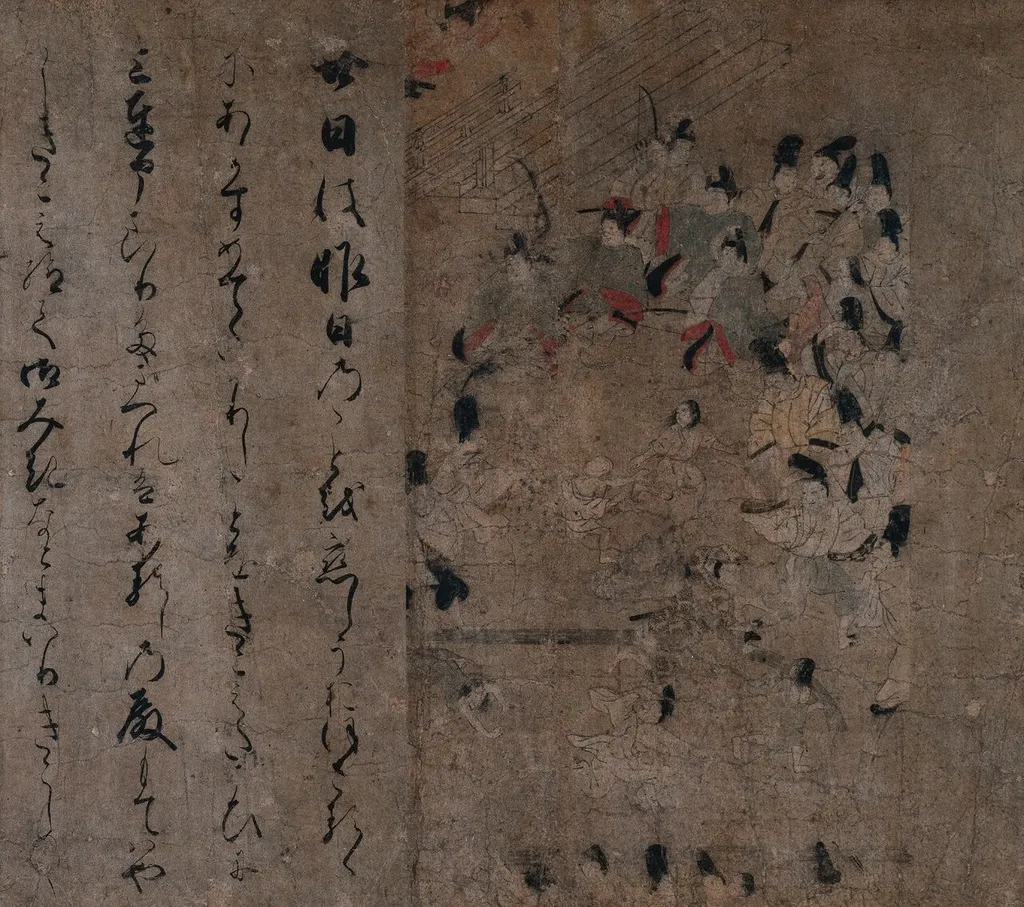
The Emperor's Attendance at the Horse Race: Episode from the Tale of Eiga (Eiga Monogatari) is an unspecified painting. It dates from 1200 and is held in the collection of the Cleveland Museum of Art.
About this work
Overview
A multitude of diminutive figures on horseback populate the composition, set against a backdrop of trees and a low fence.
The work, titled *The Emperor’s Attendance at the Horse Race: Episode from the Tale of Eiga (Eiga Monogatari)*, is a narrative painting that captures a bustling equestrian event. A multitude of diminutive figures on horseback populate the composition, set against a backdrop of trees and a low fence. The scene is animated, with several horses shown in mid‑leap, suggesting the speed and excitement of a race.
Subject & Meaning
The image illustrates a passage from the *Eiga Monogatari*, a Heian‑period chronicle of court life. It portrays the emperor himself among the spectators, emphasizing the royal patronage of public spectacles. The inclusion of a vertical strip of calligraphic text on the left links the visual narrative directly to the literary source, reinforcing the painting’s role as a visual commentary on the story.
Technique & Style
Executed in a traditional Japanese painting style, the work employs fine, linear brushwork to render the numerous figures and horses with clarity despite their small scale. Muted, earth‑toned pigments dominate the robes, while the foliage and fence are rendered with delicate ink outlines. The composition balances dense activity in the foreground with a relatively open, atmospheric background.
History & Provenance
The painting is part of a series that visualized episodes from the *Eiga Monogatari*, likely produced for a courtly audience during the late Heian or early Kamakura period. It has been preserved in a Japanese museum collection, where it remains an example of narrative scroll painting used to accompany literary texts.
Context
During the Heian era, aristocratic patronage of the arts often involved the creation of illustrated handscrolls that combined text and image. This piece reflects that tradition, merging calligraphic excerpts with a continuous visual narrative, a format designed for private viewing and contemplation rather than public display.
Legacy
The painting exemplifies how visual art was employed to reinforce and disseminate literary narratives in pre‑modern Japan. Its detailed depiction of courtly spectatorship and public entertainment offers scholars insight into the social rituals surrounding imperial events in the period.
Artist & collection