Artwork
Painted Panel of Character "Recite"
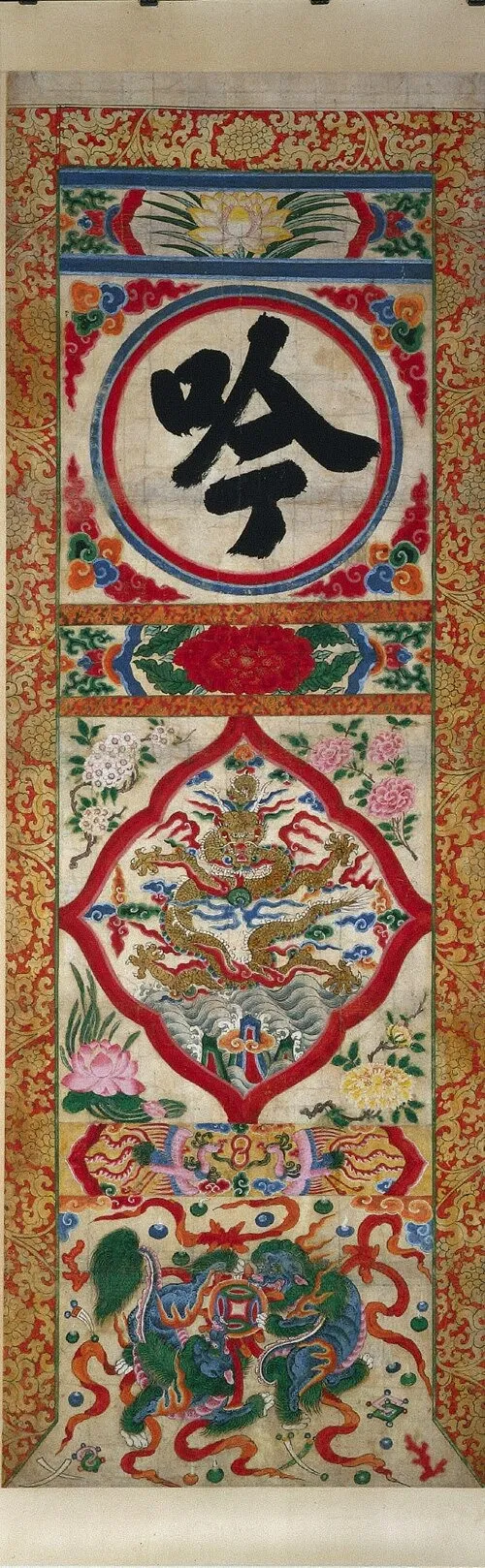
Painted Panel of Character "Recite" is an unspecified painting by Unknown. It dates from 1920 and is held in the collection of the Cleveland Museum of Art. The painted panel, titled “Recite,” presents a vivid composition of saturated hues and stark geometric forms.
About this work
Overview
A dominant white circle at the upper section contains black brushstrokes that form a single Chinese character.
The painted panel, titled “Recite,” presents a vivid composition of saturated hues and stark geometric forms. A dominant white circle at the upper section contains black brushstrokes that form a single Chinese character. Beneath, a red diamond-shaped frame encloses a stylized dragon amid clouds, surrounded by floral motifs and diminutive creatures, while the border is filled with swirling red and gold ornamentation.
Subject & Meaning
The central black inscription represents the Chinese character for “recite,” a word often associated with oral transmission of poetry or teachings. The accompanying dragon, a traditional symbol of power and auspice, is positioned on clouds—a visual cue linking the character to celestial or scholarly aspirations. Supporting flora and tiny animals reinforce the decorative, auspicious nature of the piece.
Technique & Style
Executed in bright mineral pigments, the panel combines bold, flat color fields with fluid brushwork. The black strokes are rendered in a calligraphic manner, contrasting sharply with the white background. The surrounding motifs employ repetitive, swirling patterns in red and gold, reflecting decorative conventions found in Chinese sign‑painting and folk art.
History & Provenance
The work belongs to a tradition of painted panels used as signage or ornamental objects in Chinese visual culture. Its design aligns with decorative panels that marked shops, temples, or private spaces, though specific provenance details are not recorded in the available information.
Context
Within the broader spectrum of Chinese decorative painting, panels such as this served both functional and aesthetic purposes, communicating textual information while embellishing interiors or exteriors. The integration of calligraphic characters with mythic imagery mirrors common practices in vernacular art from various dynastic periods.
Artist & collection

 Domestic Scene
 Giacomo and Cardinal Marco, investing Andrea, Abbot of San Zeno, with his Benefice
 The Nymph of Fontainebleau
 Portrait of a Woman
 Madonna and Child with Saints in the Enclosed Garden
 Venus and Minerva
 Family Group of Four on Sofa
 Wall painting from Room H of the Villa of P. Fannius Synistor at Boscoreale
 Painted Panel of Character "Recite"
 Set of Four Painted Characters
 Painted Panel of Character "Whistle"
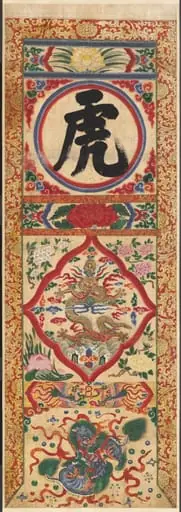 Painted Panel of Character "Tiger"
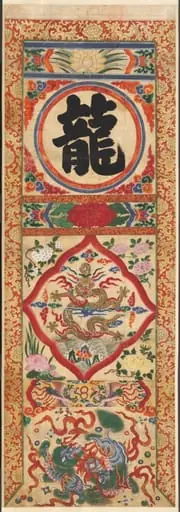 Painted Panel of Character "Dragon"
![The Guardian Generals of the Directions (Lokapalas) Dhritarashtra (East) [top] and Virudhaka (South) [bottom], by Unknown](https://artifactworldgallery.com/img/unknown--the-guardian-generals-of-the-directions-lokapalas-dhritarash--26a8da85b3fb4c5a-w320.webp) The Guardian Generals of the Directions (Lokapalas) Dhritarashtra (East) [top] and Virudhaka (South) [bottom]
The Guardian Generals of the Directions (Lokapalas) Dhritarashtra (East) [top] and Virudhaka (South) [bottom] Buddhist Panel
 Buddhist Panel