Artwork
Shri Raga, from a Ragamala
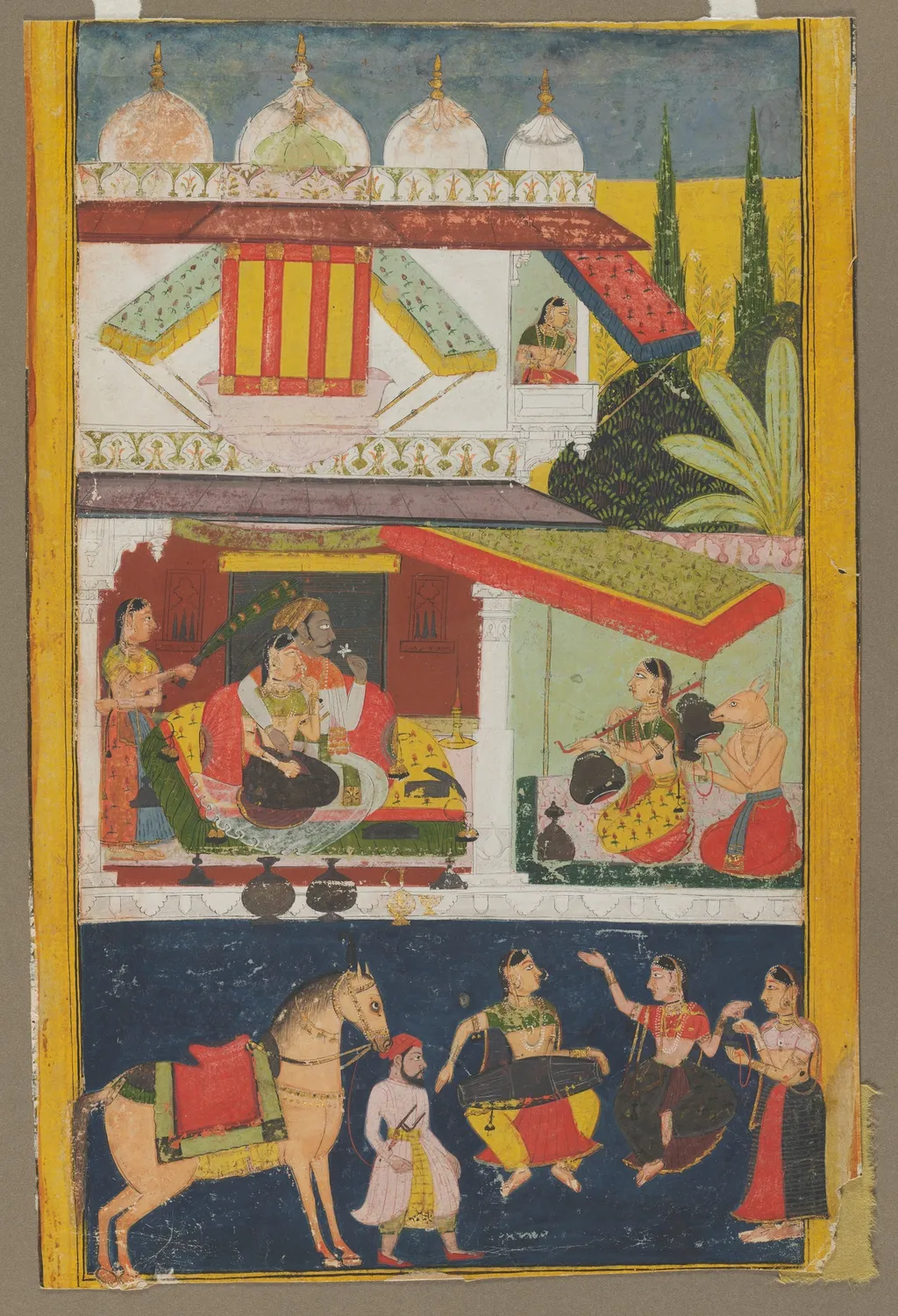
Shri Raga, from a Ragamala is an unspecified painting. It dates from 1698 and is held in the collection of the Cleveland Museum of Art. Shri Raga, part of a Ragamala series, is a painted panel in the collection of the Cleveland Museum of Art.
About this work
Overview
Shri Raga, part of a Ragamala series, is a painted panel in the collection of the Cleveland Museum of Art.
Shri Raga, part of a Ragamala series, is a painted panel in the collection of the Cleveland Museum of Art. The work is composed of two vertically stacked scenes. The upper register depicts an interior setting with a couple amid vivid red walls and gold detailing, while an exterior scene shows a woman playing a musical instrument beside a monkey, accompanied by a fan‑holding man. The lower register presents a mounted rider surrounded by three figures engaged in dance and music.
Subject & Meaning
The composition illustrates a narrative linked to the Indian ragamala tradition, where each visual tableau corresponds to a specific musical mode and its associated emotional tone. The indoor couple and the outdoor musicians together evoke the intimate and celebratory aspects of the Shri Raga, while the equestrian scene with accompanying performers suggests a more expansive, festive expression of the same mode.
Technique & Style
Executed in bright pigments, the painting employs a rich palette of reds, golds, and contrasting hues to delineate space and ornamentation. Fine linear work defines architectural elements and textile patterns, while the figures are rendered with stylized gestures typical of Indian courtly art. The layered composition and detailed iconography reflect the meticulous brushwork characteristic of ragamala panels.
History & Provenance
The panel originates from a series of ragamala paintings produced for a princely patronate in northern India, likely during the 17th‑18th centuries. It entered the Cleveland Museum of Art’s collection through a mid‑20th‑century acquisition, though earlier ownership records remain sparse. The museum’s cataloguing identifies it as a representative example of the genre’s narrative and musical symbolism.
Context
Ragamala paintings visually interpret the twelve principal ragas of Indian classical music, pairing each mode with a mythic or pastoral scene. Shri Raga, associated with auspiciousness and devotion, is traditionally linked to courtly festivities and divine love, themes that the dual scenes of domestic intimacy and public celebration embody. The work thus functions both as a decorative object and as a pedagogical illustration of musical theory.
Legacy
As an exemplar of the ragamala tradition, the painting contributes to scholarly understanding of the interplay between visual art and music in pre‑colonial India. Its preservation in a major American museum facilitates comparative study with other South Asian artworks, highlighting the transmission of aesthetic concepts across cultures and the enduring relevance of ragamala iconography.
Artist & collection
