Artwork
Portrait of Pierre de Moucheron (1508-1567) and Isabeau de Gerbier, their 18 children, son-in-law Allard de la Dale and first grandchild
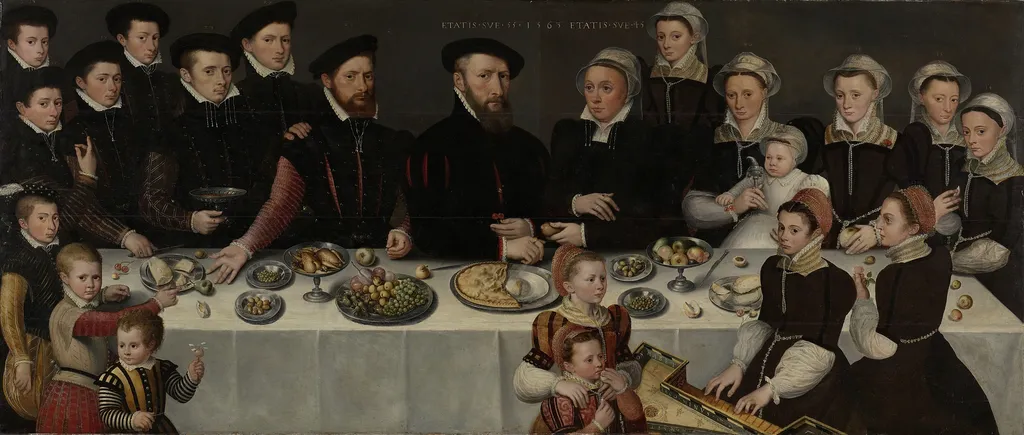
Portrait of Pierre de Moucheron (1508-1567) and Isabeau de Gerbier, their 18 children, son-in-law Allard de la Dale and first grandchild is an oil painting. It dates from 1563 and is held in the collection of the Rijksmuseum. The oil painting presents Pierre de Moucheron (1508‑1567) together with his wife Isabeau de Gerbier, surrounded by their extensive family.
About this work
Overview
The oil painting presents Pierre de Moucheron (1508‑1567) together with his wife Isabeau de Gerbier, surrounded by their extensive family. Seated around a long banquet table, the composition includes their twelve children, the son‑in‑law Allard de la Dale, and the couple’s first grandchild. The work records a moment of domestic abundance, with foodstuffs and lively interaction among the figures.
Subject & Meaning
The gathering functions as both a family portrait and a visual testament to lineage and prosperity. By placing the parents centrally and surrounding them with offspring and relatives, the artist emphasizes continuity and social standing. The inclusion of a grandchild underscores the generational reach of the Moucheron household.
Technique & Style
Executed in oil on canvas, the painting employs a pronounced chiaroscuro, lighting the faces from one side to create strong shadows and a three‑dimensional effect. The adults are dressed in dark garments with white collars, while the children wear brighter, patterned attire, providing visual contrast and drawing attention to the younger figures.
History & Provenance
The work originates from the 16th‑century Northern European tradition of large family group portraits, a genre often commissioned by affluent merchants. While specific ownership records are limited, the painting has remained associated with the Moucheron family lineage and has been referenced in genealogical studies of the household.
Context
Pierre de Moucheron was a prominent merchant in the early modern period, and his marriage to Isabeau de Gerbier linked two influential families. The inclusion of Allard de la Dale, a son‑in‑law, reflects the practice of documenting marital alliances within such portraits, reinforcing social networks among the mercantile elite.
Legacy
The portrait offers scholars insight into domestic attire, interior furnishings, and the material culture of a prosperous 16th‑century household. Its detailed rendering of food items and tableware contributes to the study of contemporary consumption patterns and the visual representation of wealth.
Artist & collection
