Artwork
Portrait of a young man
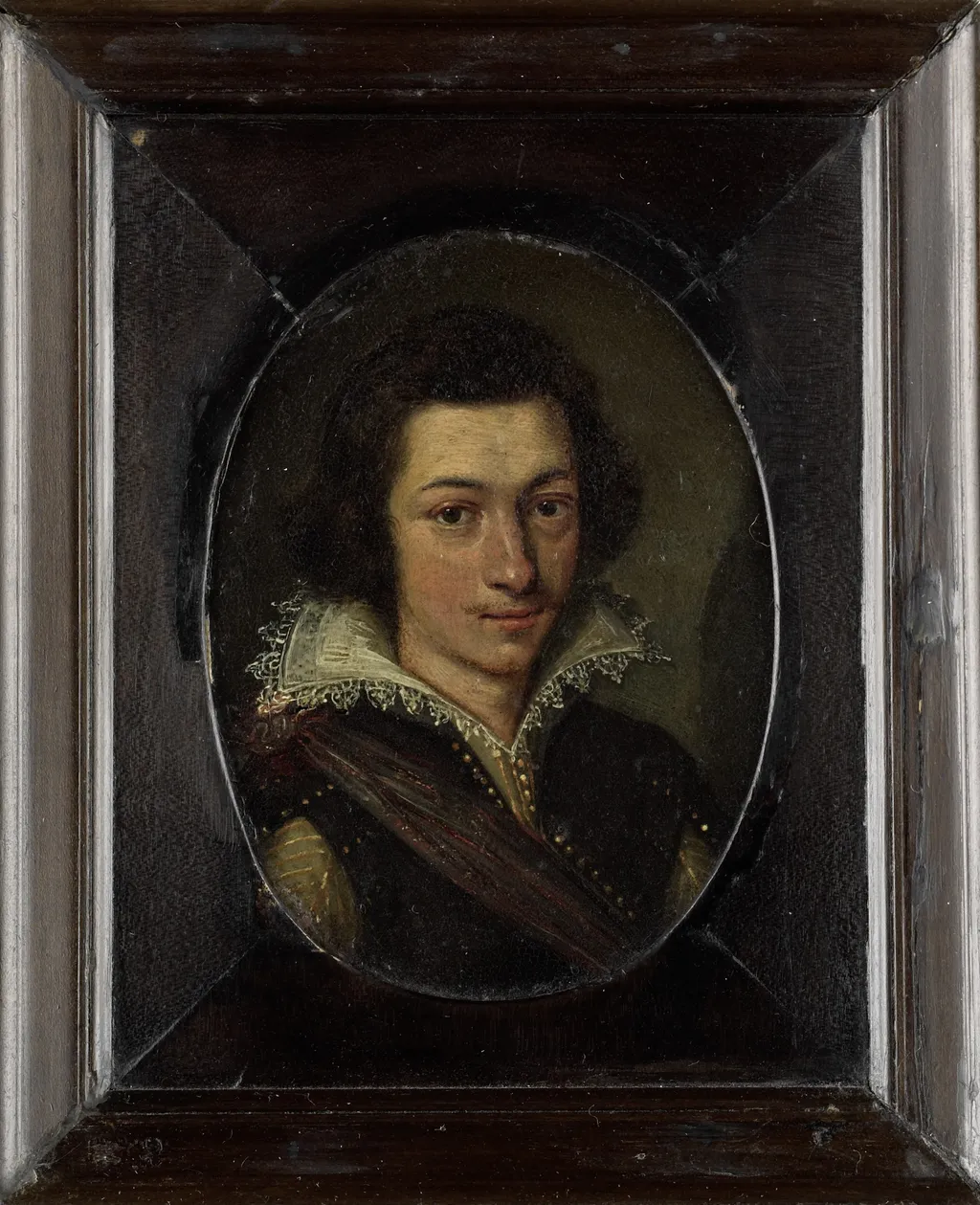
Portrait of a young man is an oil painting. It dates from 1614 and is held in the collection of the Rijksmuseum. The work is an oval-shaped portrait executed on copper, depicting a young man with dark hair and a solemn expression.
About this work
Overview
The work is an oval-shaped portrait executed on copper, depicting a young man with dark hair and a solemn expression. He is dressed in a black doublet fastened with gold buttons and a white, ruffled collar. The background is uniformly dark, directing attention to the sitter’s face. The composition is compact, with the figure filling the central space of the oval.
Subject & Meaning
The sitter appears to be a youthful male, likely of some social standing, as indicated by his fine clothing and the presence of gold buttoning. His serious demeanor and the restrained setting suggest a formal representation intended to convey dignity and perhaps a sense of personal resolve. No overt symbols are present to clarify his identity or profession.
Technique & Style
The handling of light and shade aligns with chiaroscuro principles, emphasizing volume within a limited palette.
Painted on copper, the artist exploits the metal’s smooth surface to achieve fine detail and a luminous finish. Light falls across the face, accentuating the jawline and creating a subtle shadow beneath the eyes, while gentle gradations of tone render the skin and fabric with a three‑dimensional quality. The handling of light and shade aligns with chiaroscuro principles, emphasizing volume within a limited palette.
Context
The portrait belongs to a tradition of early modern European portraiture in which copper panels were occasionally chosen for their durability and capacity for fine brushwork. The plain, dark background and the focus on individual likeness reflect a period interest in personal representation, though specific information about the artist, date, or patron remains undocumented.
Artist & collection