Artwork
Rape of Europa
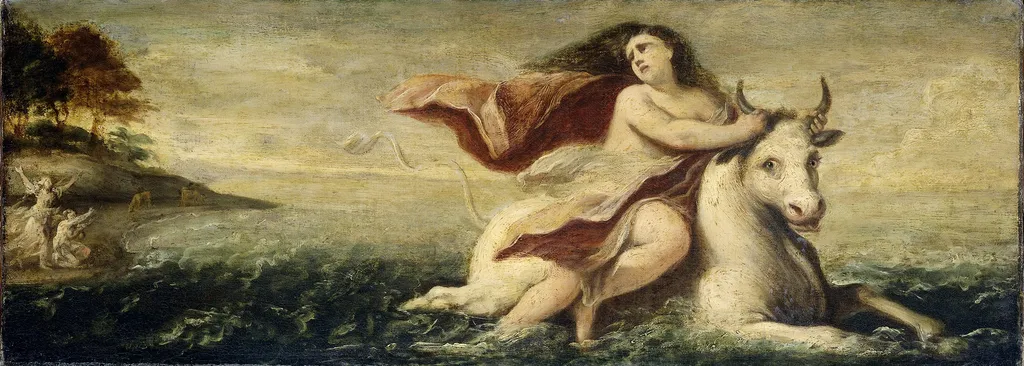
Rape of Europa is an oil painting. It dates from 1550 and is held in the collection of the Rijksmuseum. The work is an oil painting that portrays the mythological episode of Europa’s abduction.
About this work
Overview
The work is an oil painting that portrays the mythological episode of Europa’s abduction. A white bull with brown horns carries the figure of Europa, who is wrapped in a red cloth, her dark hair streaming behind her as she clutches the animal’s horns. The scene unfolds against a cloudy sky, with trees and water visible in the distance, creating a sense of movement and unrest.
Subject & Meaning
The composition illustrates the ancient tale in which Zeus, disguised as a bull, transports Europa across the sea. The artist emphasizes Europa’s vulnerability and the forceful nature of the encounter, underscored by her grasp on the bull’s horns and the turbulent atmosphere that surrounds them.
Technique & Style
The painter employs chiaroscuro, juxtaposing deep shadows with illuminated areas to heighten the drama and give the figures a three‑dimensional presence. The contrast between the bright red of Europa’s cloth and the muted greys of the sky and water further accentuates the focal action.
History & Provenance
The piece is catalogued simply as an oil painting titled “Rape of Europa.” No additional details about its creation date, artist, or ownership history are provided in the source material.
Context
The subject derives from classical mythology, a frequent source for European art. By depicting the moment of Europa’s forced passage, the work aligns with a tradition of visualizing mythic narratives to explore themes of power, transformation, and the intersection of the divine with the mortal.
Artist & collection
