Artwork
Babur receives booty and Humayun’s salute after the victory over Sultan Ibrahim in 1526, from an Akbar-nama (Book of Akbar) of Abu’l Fazl (Indian, 1551–1602)
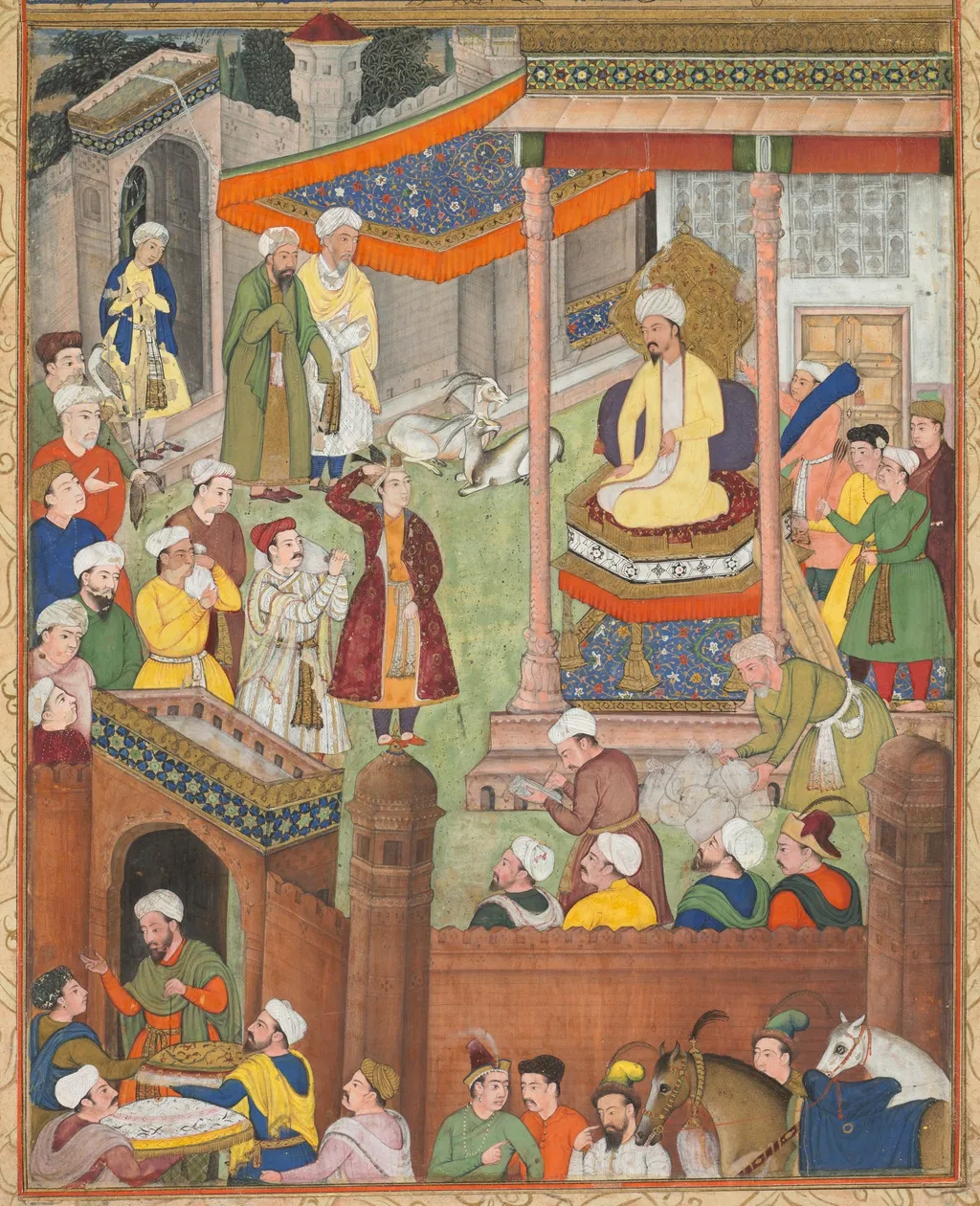
Babur receives booty and Humayun’s salute after the victory over Sultan Ibrahim in 1526, from an Akbar-nama (Book of Akbar) of Abu’l Fazl (Indian, 1551–1602) is an unspecified painting. It dates from 1600 and is held in the collection of the Cleveland Museum of Art.
About this work
Overview
The scene unfolds in a richly decorated courtyard, populated by courtiers in vivid garments, suggesting a ceremonial celebration of the victory.
The miniature illustrates the moment after Babur’s triumph over Sultan Ibrahim in 1526, as recorded in the Akbar‑nama compiled by Abu’l‑Fazl. Central to the composition is Babur seated on an elevated platform, receiving the spoils of war while Humayun offers a salute. The scene unfolds in a richly decorated courtyard, populated by courtiers in vivid garments, suggesting a ceremonial celebration of the victory.
Subject & Meaning
The work commemorates the consolidation of Babur’s authority in India, emphasizing the transfer of wealth and the acknowledgment of his son Humayun’s loyalty. By portraying the emperor surrounded by attentive officials and animals, the image conveys both the political legitimacy of the new ruler and the harmonious order of his court.
Technique & Style
Executed in the Mughal miniature tradition, the painting employs fine brushwork and a bright palette of yellows, greens, reds and blues. Delicate detailing on textiles, jewelry and architectural arches reflects the Persian‑influenced aesthetic that characterized early Mughal court art, while the flattened perspective focuses attention on the central figure.
History & Provenance
Created for the Akbar‑nama, a chronicle commissioned by Emperor Akbar in the late 16th century, the miniature was produced under the supervision of Abu’l‑Fazl (1551–1602). The manuscript later entered various private collections before being acquired by a museum, where it now serves as a primary visual source for early Mughal historiography.
Context
The depiction follows Babur’s decisive victory at the Battle of Panipat, which opened the way for Mughal rule in northern India. The painting reflects the early Mughal court’s effort to legitimize its rule through visual narratives that blend Persian courtly conventions with Indian motifs, reinforcing the empire’s emerging identity.
Legacy
As one of the earliest surviving Mughal miniatures, the image informs scholars about the development of imperial portraiture and narrative painting in South Asia. Its composition and iconography have influenced subsequent generations of court artists, establishing visual conventions for depicting royal ceremonies and triumphs.
Artist & collection
