Artwork
Leaf from a Jain Manuscript: Kalpa-sutra

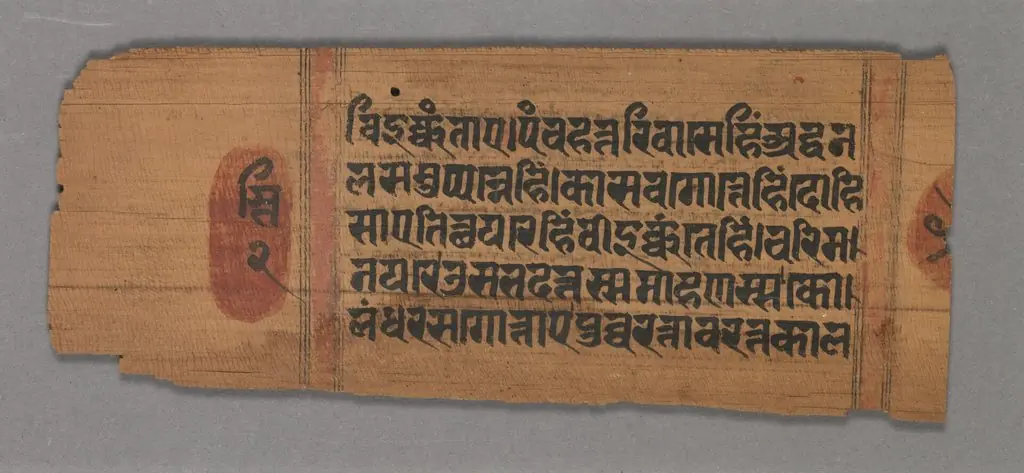
Leaf from a Jain Manuscript: Kalpa-sutra is an unspecified painting. It dates from 1290 and is held in the collection of the Cleveland Museum of Art. This object is a single leaf from a Jain manuscript known as the Kalpa‑sūtra, dated to the year 1279.
About this work
If you want to learn more about this kind of painting, you could look up the museum, The Cleveland Museum of Art.
This painting is a leaf from a Jain manuscript, titled "Kalpa-sutra". It's painted on a long, thin piece of material that's broken at both ends. The painting has black text in a foreign language, with some red circles and lines. The text is written in rows, with some of the rows broken up by the red circles. The circles have some black lines and shapes inside them.
The painting is very old, from 1279. It's held at The Cleveland Museum of Art. The painting doesn't show any people or objects, just the text and the red circles.
If you want to learn more about this kind of painting, you could look up the museum, The Cleveland Museum of Art.
Overview
This object is a single leaf from a Jain manuscript known as the Kalpa‑sūtra, dated to the year 1279. Executed on a narrow, elongated support that is broken at both ends, the leaf consists solely of black script arranged in horizontal lines, interspersed with red circular motifs that contain additional black markings. The piece is preserved in the collection of the Cleveland Museum of Art.
Subject & Meaning
The leaf contains a portion of the Kalpa‑sūtra, a Jain religious text that records the lives and teachings of the Tīrthaṅkaras. The black inscription represents the sacred verses, while the red circles function as visual separators or emphatic markers, a common practice in Jain manuscript illumination to guide the reader’s attention and indicate textual divisions.
Technique & Style
The manuscript page was painted on a thin, possibly paper or palm‑leaf substrate, using black ink for the script and red pigment for the circular devices. The red circles are outlined and filled with fine black lines and geometric shapes, demonstrating a disciplined hand and a restrained decorative scheme typical of 13th‑century Jain codices.
History & Provenance
Created in 1279, the leaf reflects the manuscript production practices of medieval Jain communities in western India. It entered the Cleveland Museum of Art’s collection through acquisition (specific donor or purchase details are not provided), where it now serves as a representative example of Jain textual art from the late 13th century.
Context
Jain manuscripts of this period were often produced in monastic workshops, intended for ritual reading and scholarly study. The Kalpa‑sūtra, as a canonical work, was frequently copied and illustrated with modest ornamentation, balancing devotional function with aesthetic restraint, a balance evident in this leaf’s simple yet purposeful design.
Artist & collection

 Leaf from a Jain Manuscript: Kalpa-sutra (recto)
 Leaf from a Jain Manuscript: Kalpa-sutra (verso)
 Leaf from a Jain Manuscript: Kalpa-sutra: The Monk Gautama, Enthroned (recto)
 Leaf from a Jain Manuscript: The Story of Kalakacharya of Devachandra: Text (recto)
 Leaf from a Jain Manuscript: Kalpa-sutra: Enthroned Monk (recto); Leaf from a Jain Manuscript: Kalpa-sutra: Text (verso)
 Leaf from a Jain Manuscript: The Story of Kalakacharya of Devachandra: Brahmanshanti Yaksha (verso)
 Leaf from a Jain Manuscript: Kalpa-sutra: Text (verso)
 Kalpa-sutra
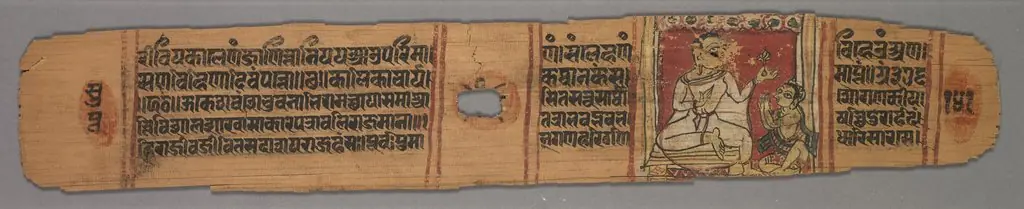 Leaf from a Jain Manuscript: The Story of Kalakacharya: Colophon Page, Text (recto)
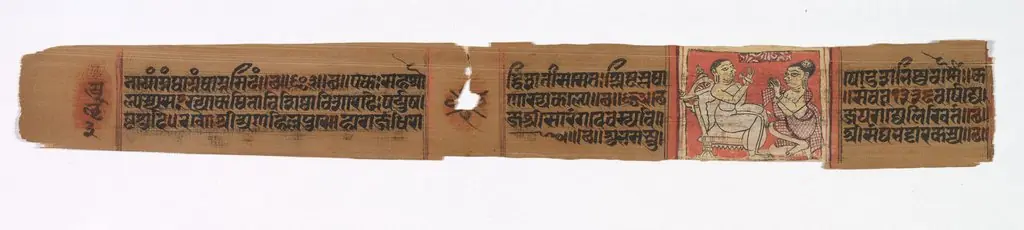 Leaf from a Jain Manuscript: Colophon page, Kalpa-sutra and The Story of Kalakacharya of Devachandra: Monk Teaching Lay Disciple