Artwork
The Marriage of Pradyumna and Rukmavati, page from a Bhagavata Purana
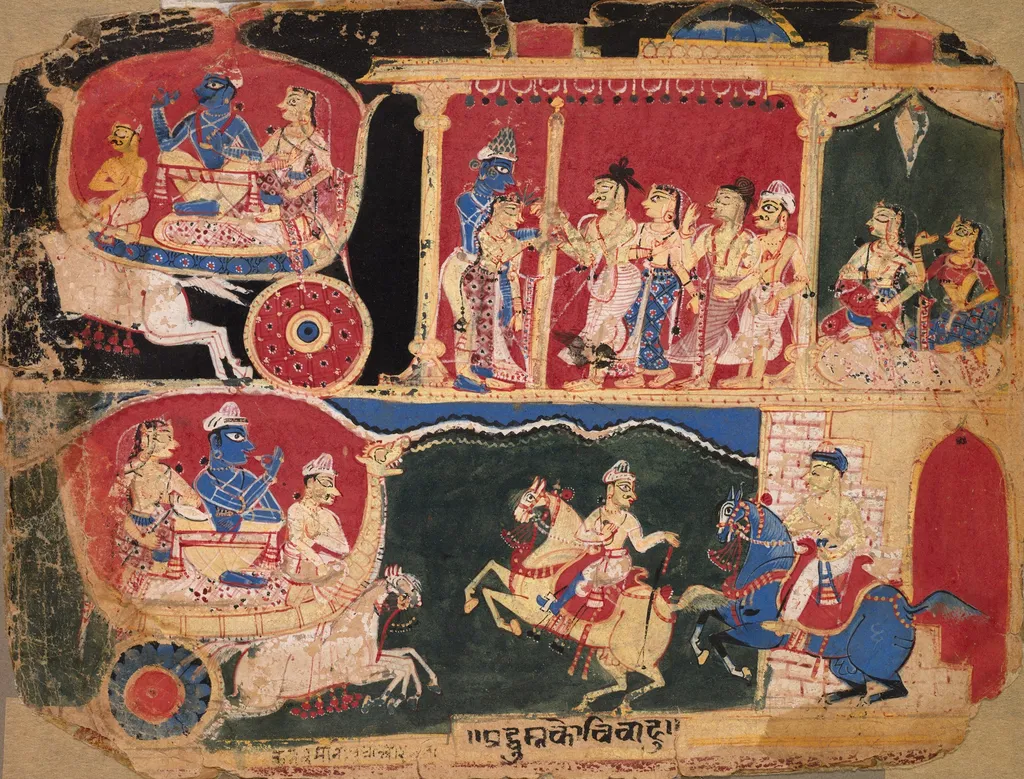
The Marriage of Pradyumna and Rukmavati, page from a Bhagavata Purana is an unspecified painting. It dates from 1537 and is held in the collection of the Cleveland Museum of Art. The work is a painted page taken from the Bhagavata Purana, illustrating the marriage of Pradyumna and Rukmavati.
About this work
Overview
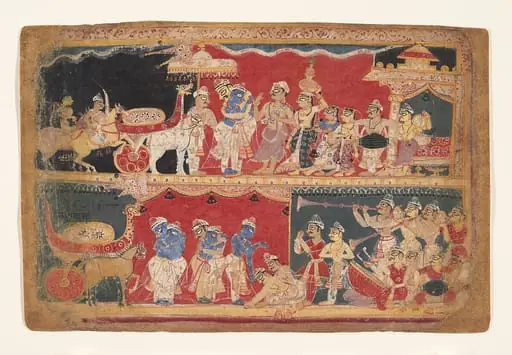
The work is a painted page taken from the Bhagavata Purana, illustrating the marriage of Pradyumna and Rukmavati. It is divided into four distinct panels, each rendered in vivid, flat areas of colour and populated by stylised figures that convey narrative episodes in a sequential format.
Subject & Meaning
The upper left panel presents the bride and groom seated on a red platform beneath a blue wheel, symbolising auspiciousness.
The upper left panel presents the bride and groom seated on a red platform beneath a blue wheel, symbolising auspiciousness. The upper right shows attendants in red robes and blue headgear, one brandishing a spear, suggesting ceremonial preparation. The lower left depicts a chariot drawn by a blue‑wheeled cart with two seated figures, while the lower right illustrates a battle scene with mounted riders and a dragon‑like creature, alluding to mythic conflict surrounding the union.
Technique & Style
The painting employs bold primary hues—predominantly reds, blues, and whites—applied in flat, unmodulated washes that emphasize decorative pattern over naturalistic modelling. Figures are rendered with stiff, linear outlines, characteristic of manuscript illumination in early Indian art, and the composition is organized into clear, compartmentalised registers.
History & Provenance
The page originates from a manuscript of the Bhagavata Purana, a key devotional text in the Vaishnavite tradition. The script at the bottom is an early form of Sanskrit, indicating the work’s production in a medieval Indian workshop. The piece now belongs to the collection of the Cleveland Museum of Art, where it is displayed among other South Asian illuminated manuscripts.
Context
Illustrated manuscripts of the Bhagavata Purana were used to accompany oral recitations and ritual performances, providing visual reinforcement of the stories. The marriage of Pradyumna, an incarnation of the god Krishna, and Rukmavati is a celebrated episode, and its depiction reflects the devotional emphasis on divine romance prevalent in the period’s religious art.
Artist & collection