Artwork
Mandala of Chakrasamvara and Vajravarahi
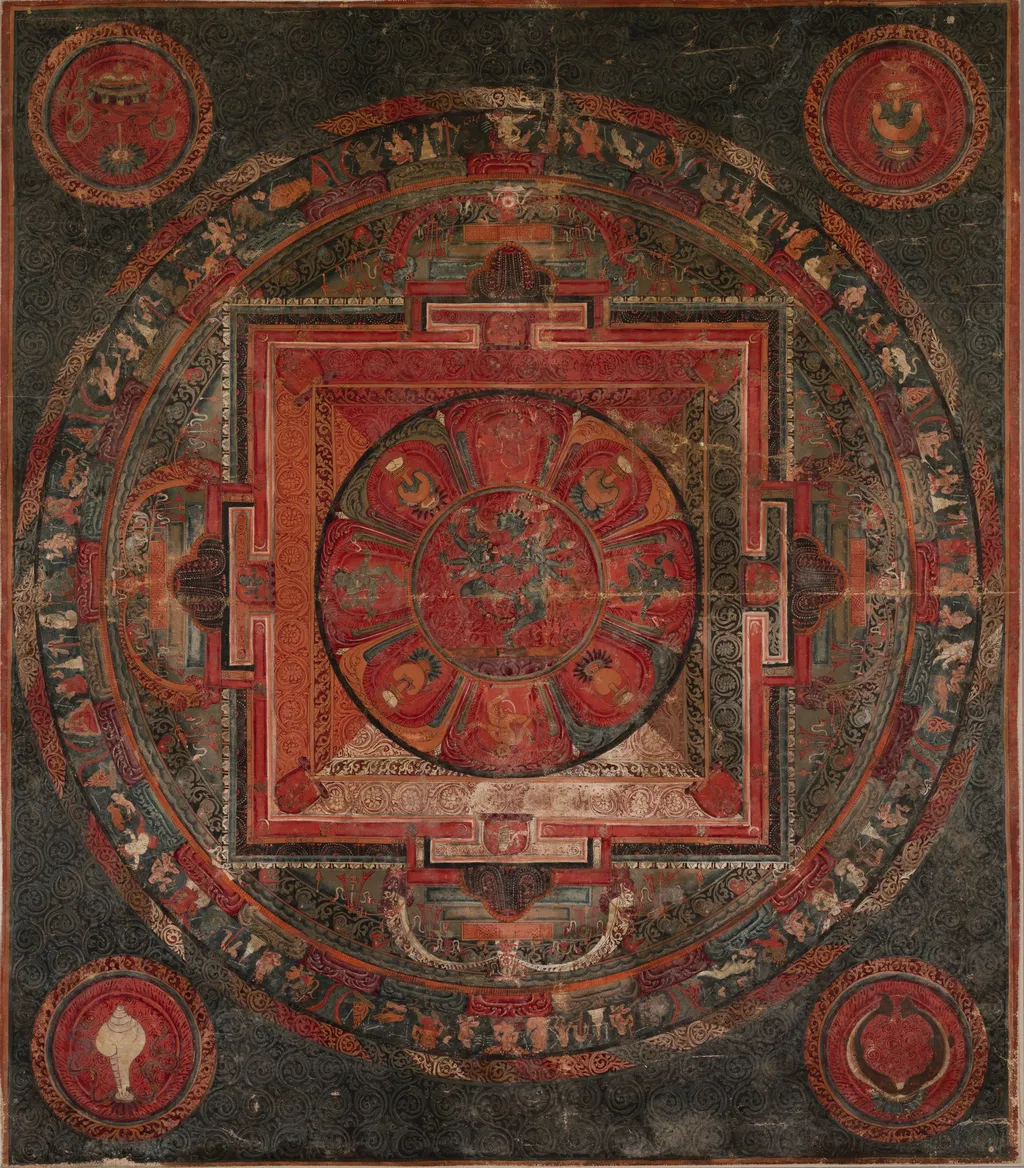
Mandala of Chakrasamvara and Vajravarahi is an unspecified painting. It dates from 1474 and is held in the collection of the Cleveland Museum of Art.
About this work
Overview
The work is a circular thangka depicting a mandala of Chakrasamvara and Vajravarahi. Dominated by vivid reds, deep blacks and luminous golds, the composition is densely packed with symbolic figures and intricate patterns that radiate outward from a central focal point.
Subject & Meaning
At its heart lies a red square containing swirling motifs and diminutive deities, representing the sacred union of the male deity Chakrasamvara and his consort Vajravarahi. The surrounding concentric circles convey the progressive stages of tantric practice, each populated with attendant figures and iconographic elements.
Technique & Style
Executed in the traditional Tibetan thangka technique, the painting employs mineral pigments on a cloth support, allowing for intense coloration and fine detailing. The use of gold leaf accentuates divine aspects, while the precise line work and repetitive geometric forms reflect the disciplined aesthetic of Buddhist mandala art.
History & Provenance
The thangka is part of the collection of the Cleveland Museum of Art, acquired through a mid‑20th‑century donation that expanded the museum’s holdings of Asian religious artworks. Its provenance traces back to a monastic workshop in the Himalayas, where such mandalas were created for ritual use.
Context
Mandala paintings like this served as visual aids for meditation, guiding practitioners through complex spiritual concepts. The depiction of Chakrasamvara and Vajravarahi is central to the Anuttarayoga Tantra, a highest class of Buddhist practice that emphasizes the union of wisdom and compassion.
Artist & collection