Artwork
Saints Apollonia, Barbara, and Agatha
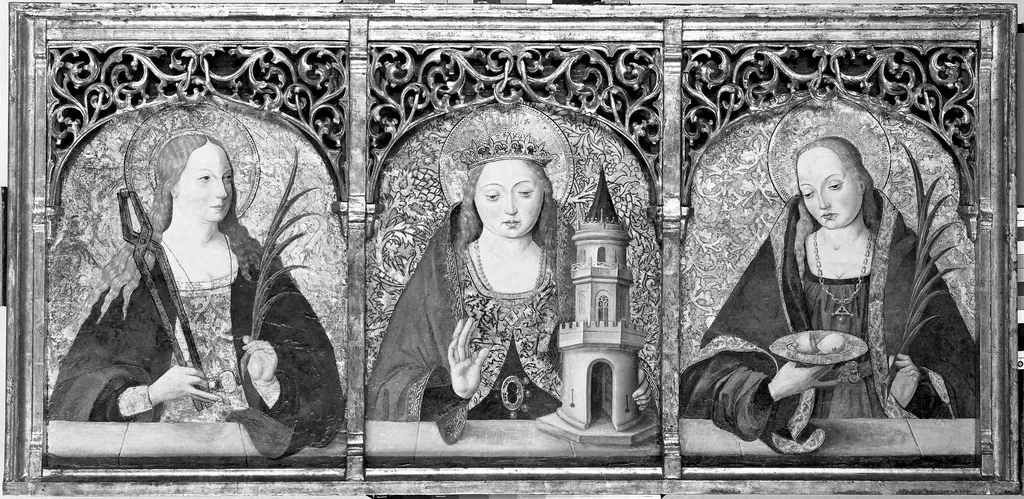
Saints Apollonia, Barbara, and Agatha is an unspecified painting. It dates from 1494 and is held in the collection of the Art Institute of Chicago.
About this work
Overview
This triptych painting depicts three Christian martyrs, Saints Apollonia, Barbara, and Agatha, each in a separate panel, distinguished by the unique objects they hold and symbolic attributes.
Subject & Meaning
Their calm expressions contrast with the ominous connotations of their objects.
The subjects are identified by their characteristic attributes: Apollonia with tongs and a tooth (referencing her dental martyrdom), Barbara pointing to a tower (likely a church, symbolizing her refuge and martyrdom site), and Agatha with a plate of bread (possibly alluding to her nourishment in prison or martyrdom by dismemberment). Their calm expressions contrast with the ominous connotations of their objects.
Technique & Style
The painting exhibits a rigid, antiquated style, characterized by flat, non-gradient colors, minimal spatial depth, and ornate, leafy borders framing the saints' faces. The overall aesthetic appears intentionally traditional, eschewing contemporary techniques of perspective or realism.
Context
The inclusion of Saint Barbara with a tower, a common motif in her iconography, suggests the artist's adherence to established hagiographical representations. This triptych likely served a devotional purpose, possibly for a church or a private chapel, given its thematic unity and traditional style.
Legacy
While the painting's stiff, old-fashioned technique may have been intentional to convey timelessness or reverence, it also positions the work within a conservative artistic trajectory, potentially limiting its influence on later, more innovative artistic movements.
Artist & collection