Artwork
A dancing dervish and three musicians, from a Divan (Collected Poems) of Urfi (Persian, 1555–1591)
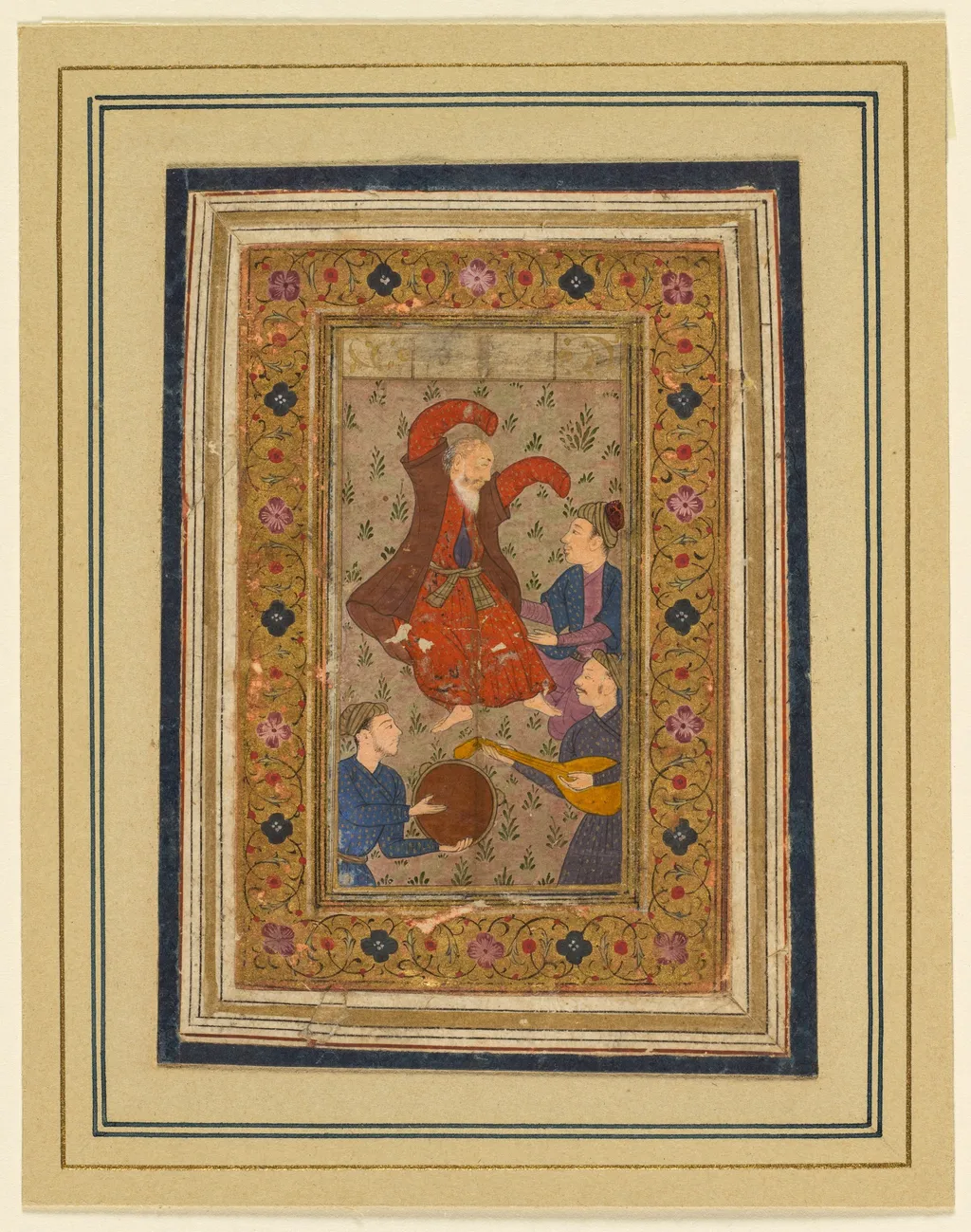
A dancing dervish and three musicians, from a Divan (Collected Poems) of Urfi (Persian, 1555–1591) is an unspecified painting. It dates from 1637 and is held in the collection of the Cleveland Museum of Art.
About this work
Overview
The work portrays a central dervish in motion, his red robe and brown cloak contrasting with a bright red cap, while three seated musicians accompany him. Each musician dons a blue robe and plays a distinct instrument—a drum, a stringed lute, and a wind flute—creating a lively ensemble set against a backdrop of stylised floral vines.
Subject & Meaning
The composition captures a moment of Sufi celebration, where the whirling dervish embodies spiritual ecstasy, and the musicians provide the auditory backdrop for the ritual. The inclusion of multiple instruments highlights the communal nature of the performance, suggesting a synthesis of music and dance within a devotional context.
Technique & Style
Executed in the Mughal painting tradition, the piece employs fine brushwork and intricate detailing, especially in the patterned foliage that frames the scene. The vivid colour palette—reds, blues, and earthy tones—combined with delicate line work, reflects the courtly aesthetic of the period, emphasizing both realism and ornamental elegance.
History & Provenance
The painting originates from a illustrated manuscript of the Divan of Urfi, a Persian poet active between 1555 and 1591. It was produced under the patronage of the Mughal court, where Persian literary works were frequently commissioned for lavishly illustrated editions.
Context
During the Mughal era, Persian poetry and Sufi themes were popular subjects for miniature painting, serving both literary and decorative purposes. This work exemplifies the cultural exchange between Persian literary traditions and Indian artistic practices, merging poetic narrative with visual opulence.
Artist & collection
