Artwork
Hare, Spoonbill, and Fish
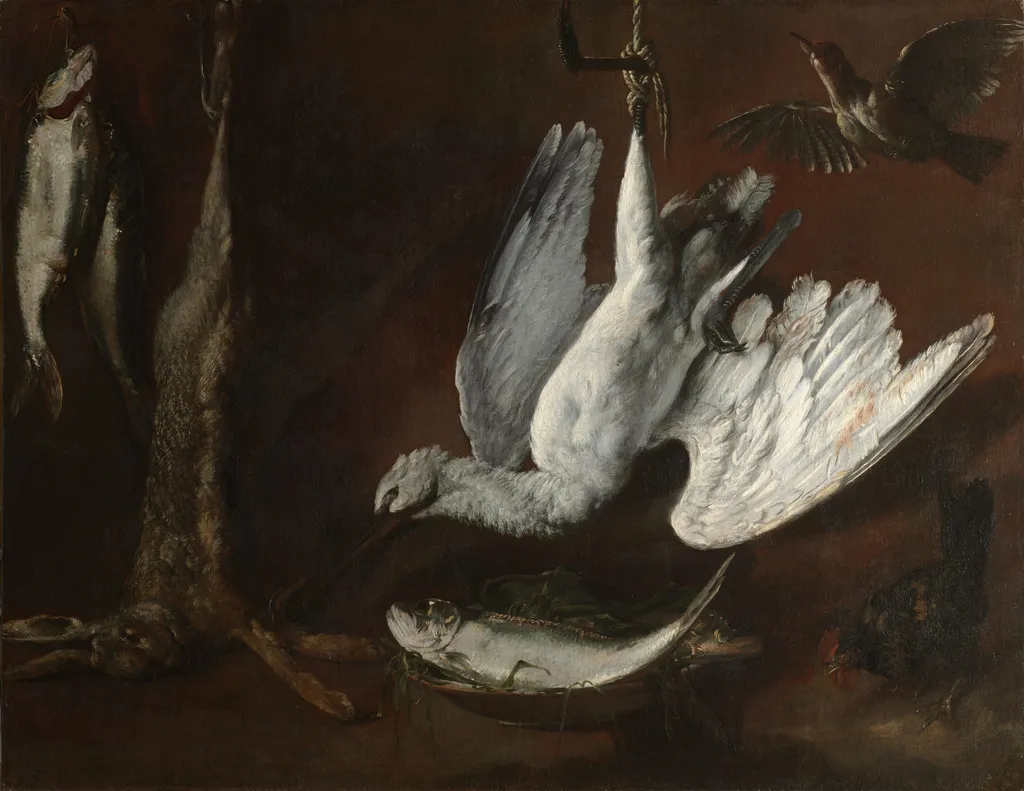
Hare, Spoonbill, and Fish is an oil painting. It dates from 1650 and is held in the collection of the Cleveland Museum of Art.
About this work
Overview
The oil painting titled *Hare, Spoonbill, and Fish* presents a dark‑toned tableau in which a white bird, likely a spoonbill, lies on its back with wings outstretched beside a sizable fish and a hare, all rendered as lifeless forms. The composition is set against a deep background that isolates the subjects, creating a stark visual focus.
Subject & Meaning
The work groups three distinct animal forms—a bird, a mammal, and a fish—each depicted after death, suggesting themes of mortality and the natural order. By arranging the creatures together, the artist invites contemplation of the fleeting nature of life and the quiet stillness that follows, without overt symbolic narrative.
Technique & Style
Employing chiaroscuro, the painter contrasts illuminated surfaces with surrounding darkness, giving the figures a three‑dimensional presence. Fine brushwork captures the texture of the spoonbill’s plumage and the fish’s scales, while the hare’s fur is rendered with comparable precision. The overall handling recalls the dramatic lighting associated with 17th‑century Dutch still lifes.
Context
The painting aligns with a tradition of European still‑life that emphasizes realism and the study of light. Its focus on dead animal subjects places it within a lineage of works that explore vanitas motifs, wherein the depiction of perishable items serves as a reminder of life's transience.
Artist & collection
