Artwork
Goddess Mangala, from a Devi Series
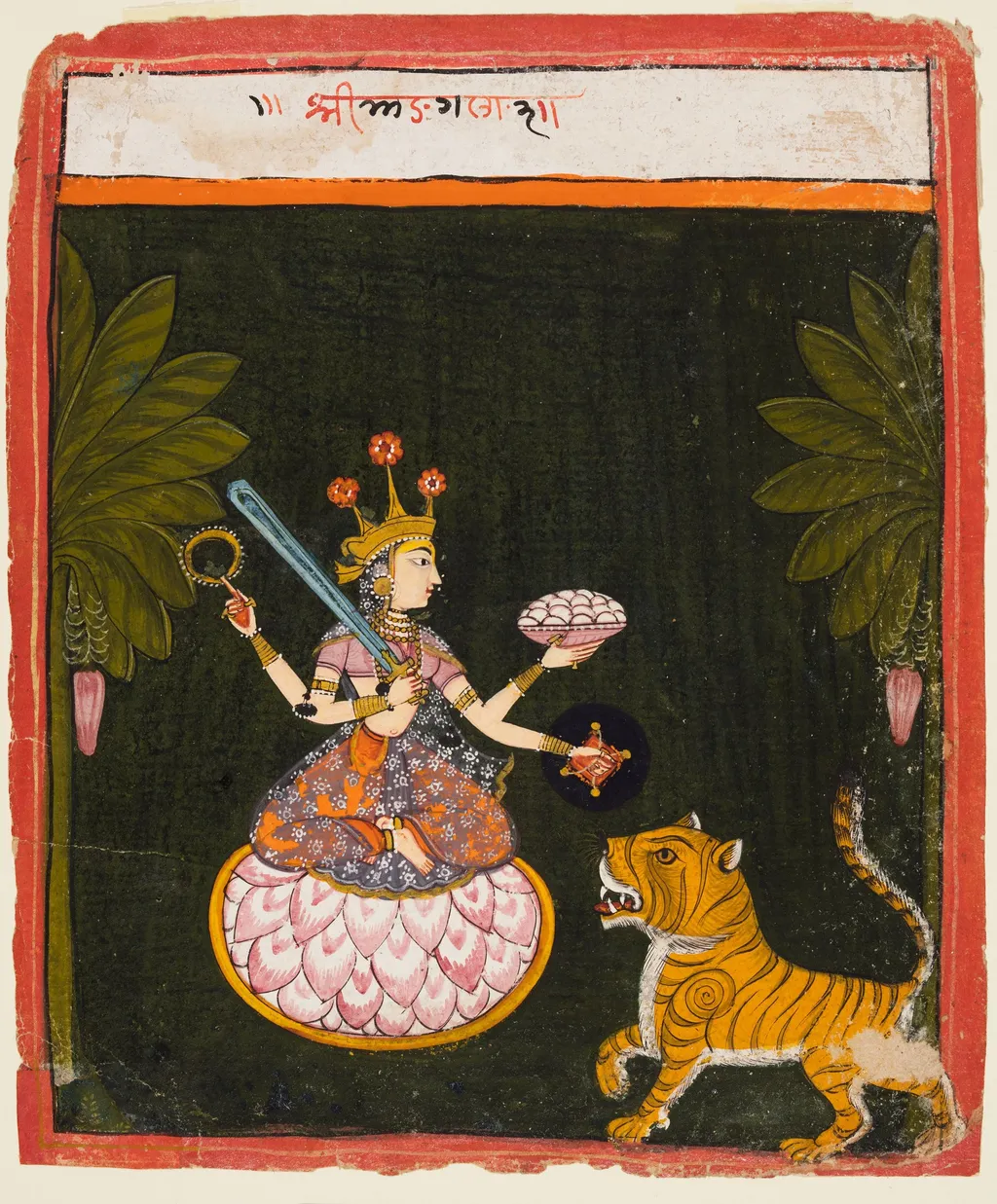
Goddess Mangala, from a Devi Series is an unspecified painting. It dates from 1660 and is held in the collection of the Cleveland Museum of Art. The work depicts a four‑armed female figure seated on a lotus‑shaped throne, flanked by a crouching tiger.
About this work
Overview
She is adorned in an orange garment patterned with white dots, a crown of red blossoms, and elaborate jewelry.
The work depicts a four‑armed female figure seated on a lotus‑shaped throne, flanked by a crouching tiger. She is adorned in an orange garment patterned with white dots, a crown of red blossoms, and elaborate jewelry. In her hands she holds a sword, a lotus, a ring and a dark object, while the tiger’s striped coat is rendered in bright yellow and white against a dark backdrop edged with green foliage and a red border.
Subject & Meaning
The figure represents the Hindu goddess Mangala, associated with auspiciousness and martial power. The sword signifies her protective aspect, the lotus denotes purity, and the ring may allude to cosmic cycles. The presence of the tiger, a traditional vehicle of the deity, reinforces her fierce yet benevolent nature.
Technique & Style
Executed in a vivid palette, the painting combines flat decorative patterns with detailed rendering of the tiger’s fur. The use of bold outlines and stylized forms reflects the conventions of Indian court painting, while the contrasting dark background emphasizes the luminous colors of the central figures.
History & Provenance
The piece belongs to a series of depictions of Hindu deities, likely produced in the 18th‑century Indian subcontinent for a princely patron. It entered the Cleveland Museum of Art’s collection through a mid‑20th‑century acquisition of South Asian works, though specific prior ownership details remain undocumented.
Context
Within the broader Devi series, this image illustrates the syncretic visual language that blended religious symbolism with courtly aesthetics. Such paintings were used in devotional settings and as status objects, communicating the patron’s piety and cultural sophistication.
Artist & collection
