Artwork
Rati, the Goddess of Erotic Love, Takes Aim at Krishna, from a Rasikapriya
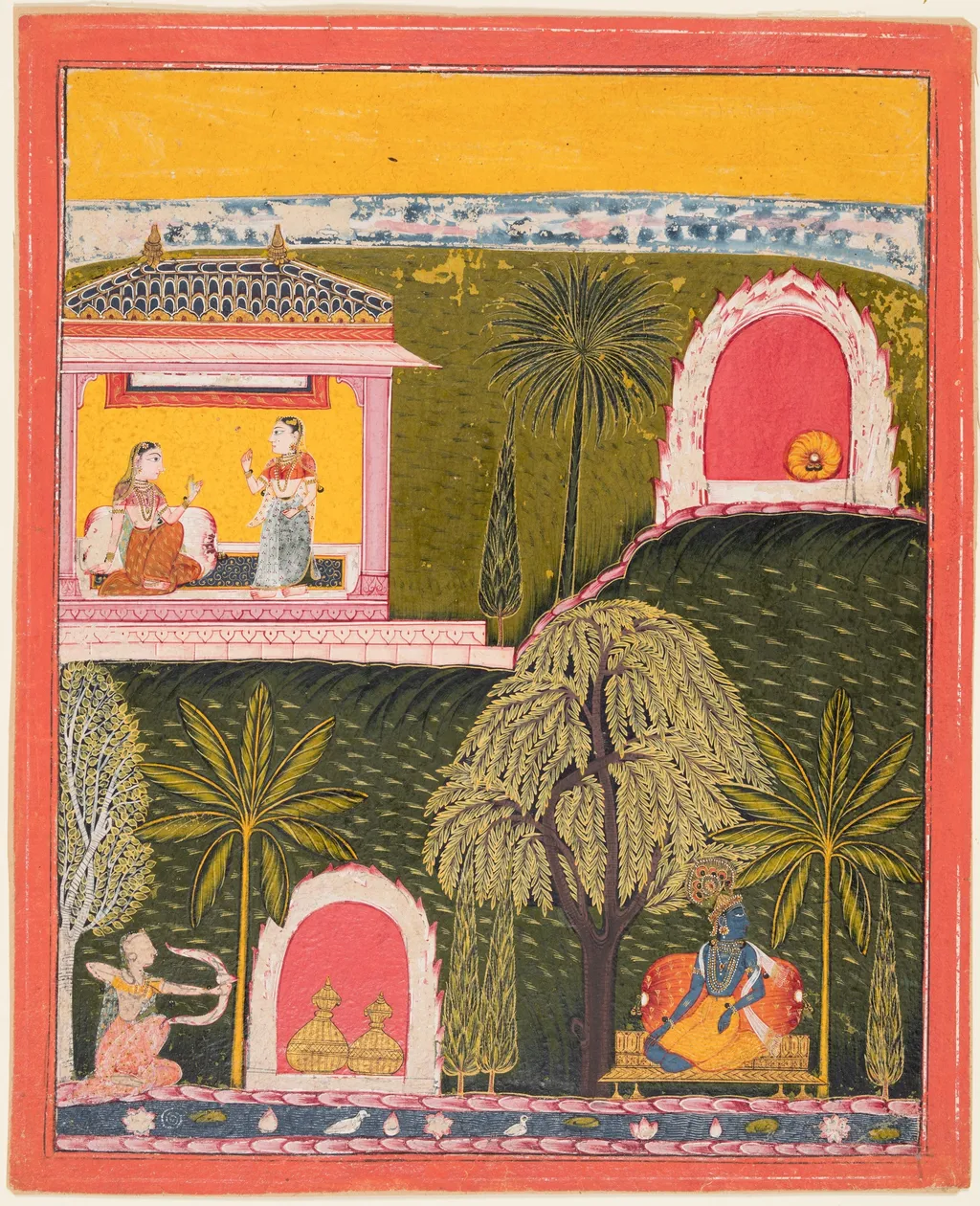
Rati, the Goddess of Erotic Love, Takes Aim at Krishna, from a Rasikapriya is an unspecified painting. It dates from 1660 and is held in the collection of the Cleveland Museum of Art. The work depicts two juxtaposed scenes rendered in vivid hues and decisive outlines.
About this work
Overview
The right panel shows a man dressed in blue and gold reclining beneath a tree, directing an object toward a distant figure positioned on a balcony.
The work depicts two juxtaposed scenes rendered in vivid hues and decisive outlines. In the left panel a woman is seated within a yellow interior while a male figure stands nearby; beyond the doorway a winged being kneels before a red archway framed by twin golden domes. The right panel shows a man dressed in blue and gold reclining beneath a tree, directing an object toward a distant figure positioned on a balcony.
Subject & Meaning
The composition draws on a narrative from the Rasikapriya, presenting the goddess of erotic love, Rati, confronting the deity Krishna. The presence of the winged attendant suggests divine mediation, while the contrasting interior and exterior settings may symbolize the interplay of desire and divine play.
Technique & Style
Executed in a painting medium, the piece employs flat, saturated colors and bold linear contours characteristic of Indian courtly art. Architectural elements such as arches and domes are stylized rather than perspectival, emphasizing decorative pattern over realistic space.
History & Provenance
The artwork is catalogued under the title "Rati, the Goddess of Erotic Love, Takes Aim at Krishna, from a Rasikapriya" and is part of the collection of the Cleveland Museum of Art. Its acquisition details and earlier ownership remain undocumented in the available sources.
Context
The scene reflects themes from the Rasikapriya, a treatise on love and aesthetics, and aligns with a broader tradition of illustrating mythological episodes in Indian painting. The depiction of deities in intimate or playful scenarios was common in courtly visual culture, serving both devotional and literary functions.
Artist & collection
