Artwork
Stenciled Scenes of Lion and Gazelle (verso)
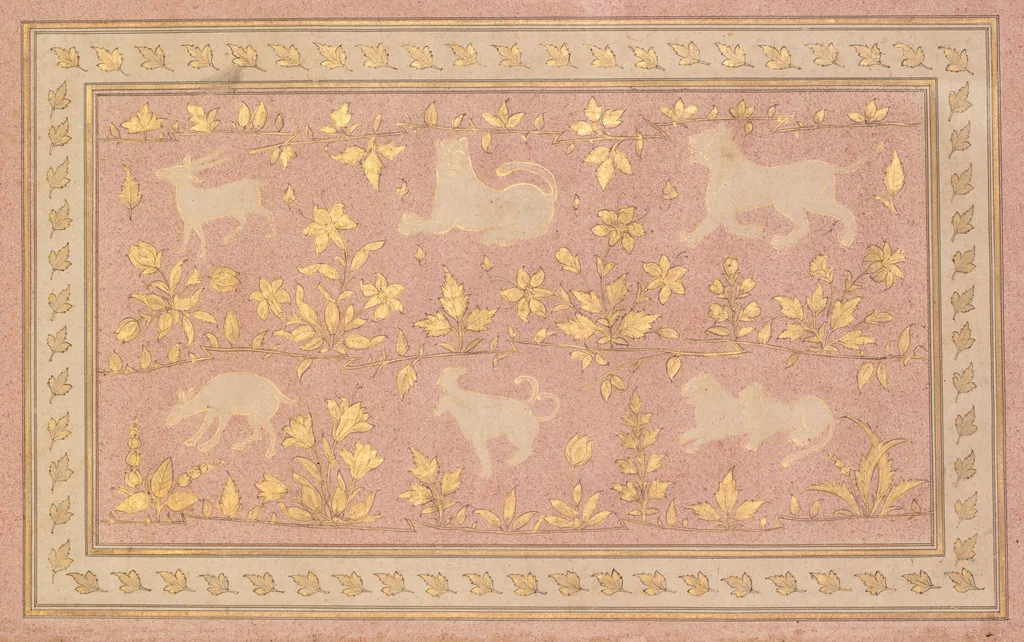
Stenciled Scenes of Lion and Gazelle (verso) is an unspecified painting. It dates from 1710 and is held in the collection of the Cleveland Museum of Art.
About this work
The whole scene is drawn in a light color, with some darker lines to show the shapes.
This painting shows a scene with a lion and a gazelle. The lion is in the top right corner, and the gazelle is in the top left. There are also some plants and leaves around them. The lion and gazelle are drawn in a simple style, with not many details. The plants and leaves are also not very detailed. The whole scene is drawn in a light color, with some darker lines to show the shapes. The painting is from 1710.
Overview
The work, dated 1710, presents a modestly rendered tableau in which a lion occupies the upper right quadrant while a gazelle appears in the upper left. Between the two figures, stylized foliage and leaves provide a simple natural backdrop. The composition relies on a restrained palette of light tones, punctuated by darker line work that defines the basic shapes of the animals and vegetation.
Subject & Meaning
The juxtaposition of predator and prey suggests a narrative of the natural order, a theme common in early eighteenth‑century visual culture. By placing the lion and gazelle at opposite corners, the artist creates a visual tension that hints at the inevitable encounter between the two, while the surrounding plant motifs soften the scene, perhaps alluding to the broader ecosystem in which such interactions occur.
Technique & Style
Executed with a stenciled method, the image relies on flat areas of color and minimal detailing. The figures are outlined with darker lines that serve to delineate form rather than model volume, giving the piece a graphic quality. The foliage is rendered in a similarly simplified manner, emphasizing pattern over naturalistic representation and reflecting a decorative aesthetic typical of the period's applied arts.
History & Provenance
The painting originates from the early eighteenth century, a time when stencil techniques were employed for both decorative and instructional purposes. Although specific ownership records are scarce, the work’s date and stylistic attributes align it with European workshop practices of the era, suggesting it may have been produced for a domestic or educational setting rather than a formal gallery.
Context
In the early 1700s, depictions of wildlife were often used to convey moral lessons or to illustrate natural history texts. The lion and gazelle motif, a classic emblem of strength versus vulnerability, appears in a range of contemporary prints and tapestries. This piece reflects that tradition, translating a didactic subject into a modestly scaled painted format suitable for interior decoration.
Artist & collection
