Artwork
A View in a Park with the Seated Figure of a Lady
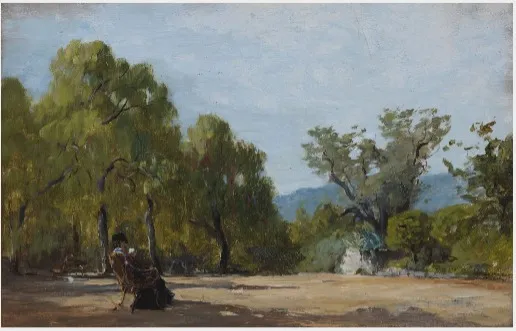
A View in a Park with the Seated Figure of a Lady is an oil painting by Unknown. It dates from 1900 and is held in the collection of the National Gallery of Ireland. This oil painting presents a quiet outdoor scene centered on a lone figure seated in a park.
About this work
Overview
The composition balances natural elements—trees, sky, and open ground—with the stillness of the woman, who occupies the foreground.
This oil painting presents a quiet outdoor scene centered on a lone figure seated in a park. The composition balances natural elements—trees, sky, and open ground—with the stillness of the woman, who occupies the foreground. The artist employs oil paint to build subtle layers of texture, enhancing the sense of atmosphere without overt detail. The mood is contemplative, emphasizing solitude rather than narrative.
Subject & Meaning
The seated woman, facing away from the viewer, avoids direct engagement, reinforcing a sense of introspection. Her simple attire—a dark skirt and white blouse—suggests modesty and anonymity, allowing the landscape to dominate the emotional tone. The figure functions less as a portrait and more as an anchor within nature, inviting reflection on quietude and the human presence within natural settings.
Technique & Style
Visible brushwork lends dynamism to otherwise still elements, particularly in the rendering of foliage and sky. The artist uses layered oil paint to create depth, with cooler tones in the background receding gently behind warmer midground hues. The texture of the paint captures light and air, avoiding idealized smoothness. This approach prioritizes sensory immediacy over polished finish, aligning with observational realism.
History & Provenance
The painting is held in the collection of the National Gallery of Ireland, though its full provenance remains undocumented in public records. It was likely created in the 19th century, during a period when landscape painting with human figures gained popularity among artists seeking to capture everyday serenity. Its acquisition by the gallery suggests early recognition of its quiet aesthetic value.
Context
This work reflects broader 19th-century European trends in landscape painting, where nature was increasingly viewed as a space for personal reflection rather than grandeur. Artists moved away from dramatic narratives toward intimate, atmospheric scenes. The inclusion of a solitary figure aligns with Romantic and early Impressionist interests in mood and transient light, though without the movement or color experimentation of later movements.
Legacy
Though not widely reproduced or studied, the painting contributes to a quieter strand of 19th-century art that valued stillness and subtle observation. Its presence in the National Gallery of Ireland ensures continued access for viewers seeking contemplative works. It stands as an example of how modest compositions, without dramatic tension, can sustain emotional resonance through restraint and careful handling of light and form.
Artist & collection

 Domestic Scene
 Giacomo and Cardinal Marco, investing Andrea, Abbot of San Zeno, with his Benefice
 The Nymph of Fontainebleau
 Portrait of a Woman
 Madonna and Child with Saints in the Enclosed Garden
 Venus and Minerva
 Family Group of Four on Sofa
 Wall painting from Room H of the Villa of P. Fannius Synistor at Boscoreale
 A View of the Maritime Alps
 A Woodland Stream
 View of Asia Minor. From the journey to Constantinople
 Trees in Phoenix Park, Dublin
 Peisaj cu turmă
 Figures by a Woodland Pool
 On the Road to Brummana
 Souvenir of Roquemaure in the Gard
 Intrare în pădurea Fontainebleau
 The Terrace of Villa Monticello, Nice
 Hills, South of France
 Rocky Ravine