Artwork
Matsya, Fish Avatara of Vishnu
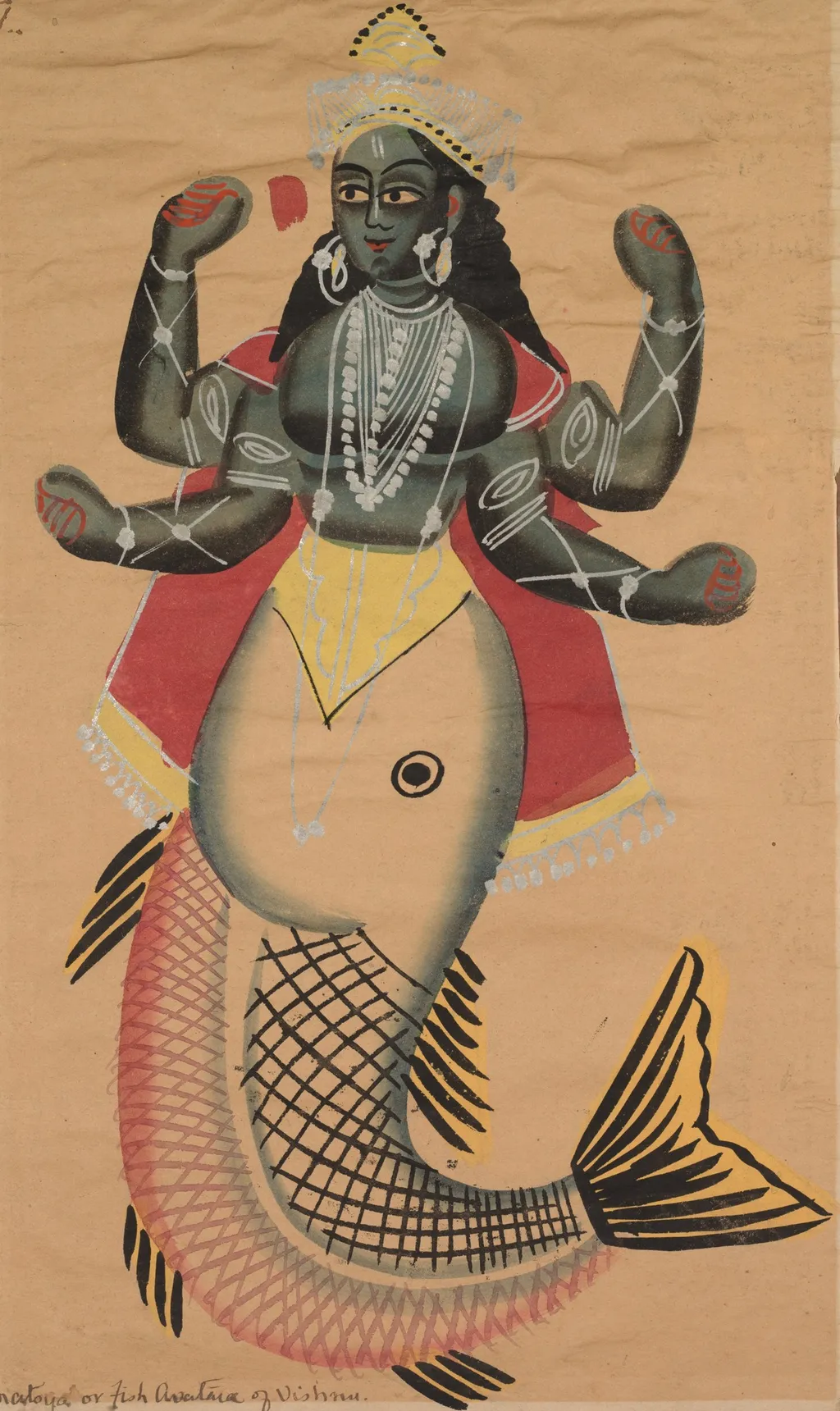
Matsya, Fish Avatara of Vishnu is an unspecified painting. It dates from 1896 and is held in the collection of the Cleveland Museum of Art. The work depicts a dark‑skinned deity with four arms seated upon a fish’s tail.
About this work
Overview
The work depicts a dark‑skinned deity with four arms seated upon a fish’s tail. He is dressed in a red skirt accented by a yellow sash, and his limbs are adorned with white ornamental jewelry. One hand clasps a red object, another gestures upward, while his face is rendered with a composed expression outlined in bold lines.
Subject & Meaning
The figure represents Matsya, the fish incarnation of the Hindu god Vishnu, who is traditionally shown emerging from the ocean to rescue sacred texts. The upward pointing hand suggests divine guidance, and the red object may symbolize the cosmic weapon or a ritual implement associated with the avatar’s protective role.
Technique & Style
Executed in a manner reminiscent of Kalighat painting, the piece combines flat, vivid coloration with strong contour lines. The fish tail features black scales and a contrasting yellow fin, illustrating the synthesis of human and animal forms typical of folk visual language. The overall composition relies on simplified forms and decorative detailing rather than realistic modeling.
History & Provenance
The painting belongs to the broader tradition of 19th‑century Indian folk art that flourished around the Kalighat region of Kolkata. Works of this genre were often produced for devotional purposes and circulated among local communities, though specific information about the artist or original patron is not recorded.
Context
Matsya narratives are central to Hindu myth, recounting the god’s role in preserving the Vedas during a great flood. Within Indian visual culture, the avatar is frequently portrayed in folk styles that emphasize narrative clarity and accessibility, allowing the story to be communicated to a wide audience.
Artist & collection
