Artwork
Sugriva challenges his brother Vali, King of the Forest Dwellers, to a duel, folio 10 from the Kishkindha Kanda (Book of Kishkindha) of a Ramayana (Rama’s Journey)
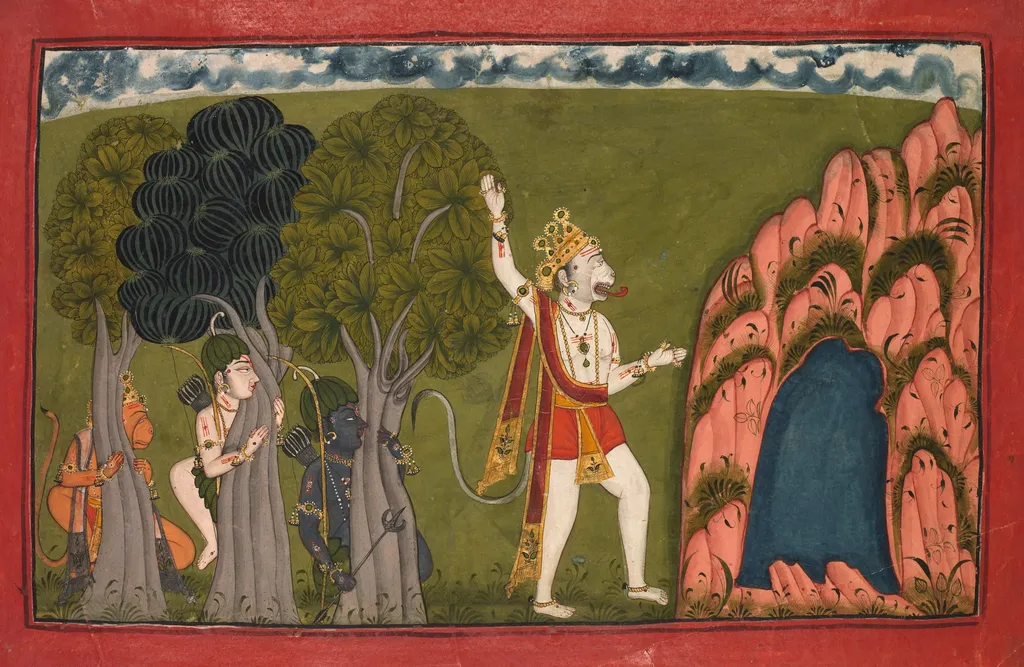
Sugriva challenges his brother Vali, King of the Forest Dwellers, to a duel, folio 10 from the Kishkindha Kanda (Book of Kishkindha) of a Ramayana (Rama’s Journey) is an unspecified painting. It dates from 1720 and is held in the collection of the Cleveland Museum of Art.
About this work
Overview
Behind him stands a dark‑skinned figure with a blue face and a serpentine tail, observing the scene.
The work depicts a dramatic confrontation in a forest setting, centered on a white‑skinned, crowned figure with a red sash who raises his arms in a challenging gesture. Behind him stands a dark‑skinned figure with a blue face and a serpentine tail, observing the scene. To the left a woman in green holds a branch while a child looks up at her, and to the right a group of red‑skinned, horned beings with large eyes sit on rocks, some bearing weapons.
Subject & Meaning
The composition illustrates the episode from the Kishkindha Kanda of the Ramayana in which Sugriva confronts his brother Vali, the king of the forest dwellers. The central figure represents Sugriva, while the blue‑faced, tail‑bearing figure alludes to Vali. The surrounding characters—female attendant, child, and the grotesque onlookers—serve to emphasize the mythic tension and the moral stakes of the duel.
Technique & Style
Executed in vivid pigments, the painting employs exaggerated proportions and bright, contrasting colors to heighten the narrative drama. Gold jewelry on the central figure and the use of red and blue tones for the secondary characters create visual hierarchy. The stylized, almost caricatured rendering of faces and bodies reflects a traditional Indian illustrative approach to epic storytelling.
History & Provenance
The piece is a folio from the Kishkindha Kanda, a manuscript of the Ramayana, and forms part of a larger illustrated cycle that visualizes Rama’s journey. Its exact date and origin are not specified, but such folios were commonly produced in South Asian courts for devotional and literary purposes, often commissioned by patrons interested in preserving the epic’s visual heritage.
Artist & collection