Artwork
Raja Hari Sen of Mandi (r. 1604–1623/37)
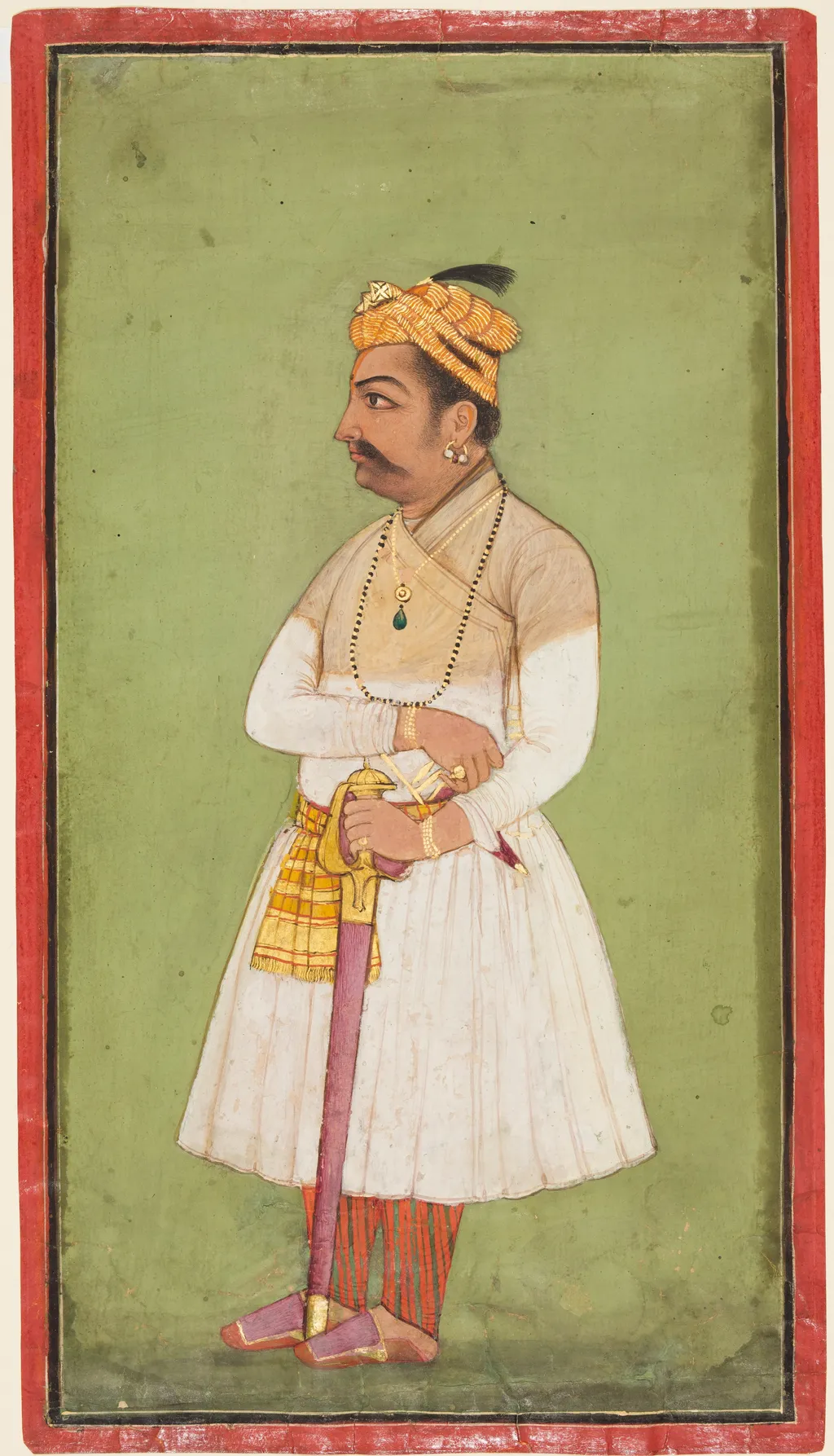
Raja Hari Sen of Mandi (r. 1604–1623/37) is an unspecified painting. It dates from 1650 and is held in the collection of the Cleveland Museum of Art. The work is a portrait of Raja Hari Sen, the ruler of the princely state of Mandi in the early seventeenth century.
About this work
Overview
The work is a portrait of Raja Hari Sen, the ruler of the princely state of Mandi in the early seventeenth century. The figure is presented against a uniform green field, framed by a red and black border. Dressed in a white garment edged with gold, a multicoloured sash, and a tall, patterned turban, he places both hands on his chest and wears a simple necklace with a single pendant.
Subject & Meaning
The portrait serves as a visual assertion of the Raja’s authority and status. The opulent attire and jewelry emphasize his royal rank, while the direct, frontal pose and hand placement suggest a dignified, perhaps ceremonial, self‑presentation typical of courtly portraiture in the Himalayan region.
Technique & Style
Executed in a flat, brightly coloured palette, the painting lacks modelling through chiaroscuro, giving the surface a decorative quality. The composition relies on linear outlines and solid colour fields, a style common in regional court paintings of the period, where emphasis is placed on costume and emblematic detail rather than naturalistic depth.
History & Provenance
The portrait dates to the early 1600s, corresponding to Raja Hari Sen’s reign from 1604 to roughly 1623–1637. Its provenance traces to the royal archives of Mandi before entering the collection of a Western museum, where it is catalogued as a representative example of early modern Himalayan court portraiture.
Artist & collection
