Artwork
Maharana Sangram Singh II of Mewar (r. 1710–34) and Stages a Boar Hunt with Tigers at Sadri
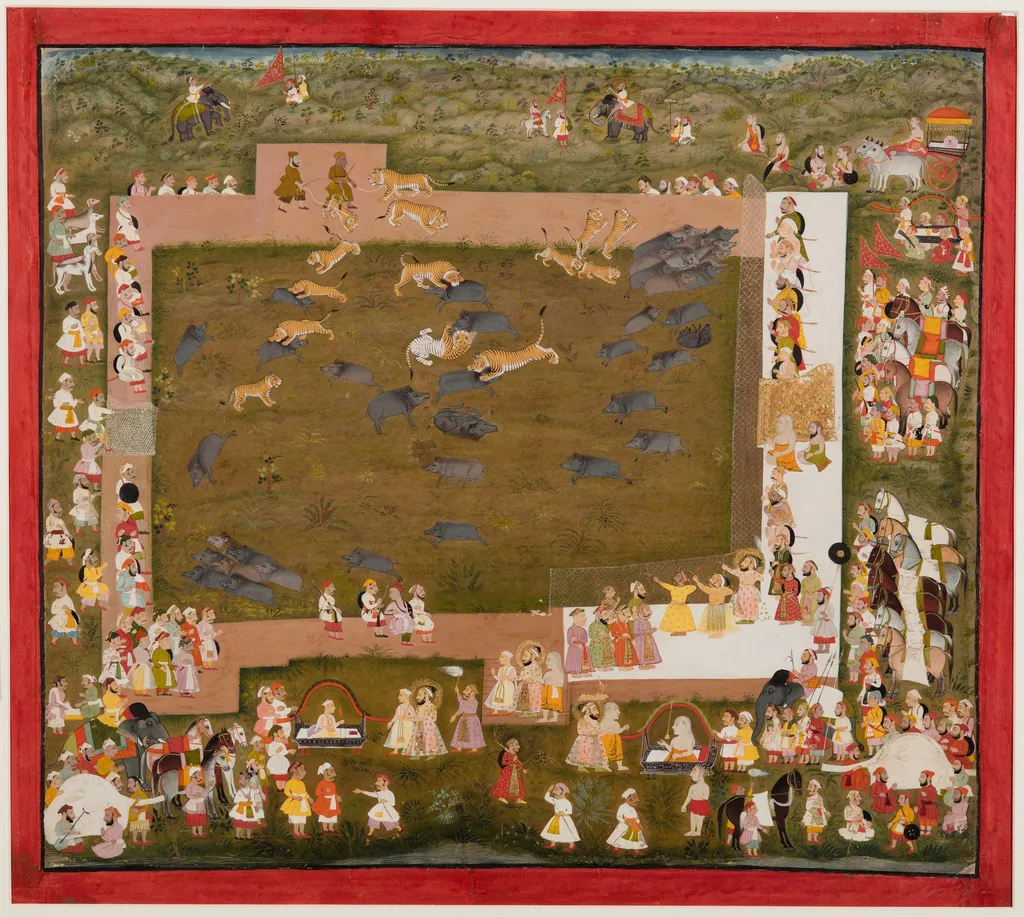
Maharana Sangram Singh II of Mewar (r. 1710–34) and Stages a Boar Hunt with Tigers at Sadri is an unspecified painting. It dates from 1720 and is held in the collection of the Cleveland Museum of Art. The work depicts a lively hunting tableau set in an open landscape, framed by a vivid red border.
About this work
Overview
The work depicts a lively hunting tableau set in an open landscape, framed by a vivid red border.
The work depicts a lively hunting tableau set in an open landscape, framed by a vivid red border. Central to the composition is Maharana Sangram Singh II of Mewar, mounted on horseback, observing a chaotic chase in which tigers and boars surge across the grass. Peripheral figures—riders, onlookers, and attendants—populate the edges, some gathered near structures, others seated on the ground, creating a sense of communal spectacle.
Subject & Meaning
The painting records a royal boar hunt augmented by the presence of tigers, an event likely staged to demonstrate the ruler’s martial prowess and the court’s capacity to orchestrate elaborate spectacles. By placing the Maharana as a calm observer amid the tumult, the image underscores his authority and composure while celebrating the vigor of Mewar’s aristocratic traditions.
Technique & Style
Executed in bright pigments, the artist employs a flattened spatial arrangement typical of early‑18th‑century Rajput court painting. Figures and animals are rendered with bold outlines and stylised gestures, emphasizing narrative over naturalistic detail. The red border functions both as a decorative frame and a visual device that unifies the bustling scene.
History & Provenance
Created during the reign of Maharana Sangram Singh II (1710–1734), the piece originates from the Mewar court’s workshop, where artists documented royal activities. The work entered a public collection in the United States in the late 20th century, now residing in the Cleveland Museum of Art, where it is displayed among other examples of Rajput miniature and court painting.
Context
Royal hunts were a central motif in Rajput visual culture, serving both as a record of elite leisure and as a symbolic assertion of power over nature. The inclusion of tigers—a creature associated with danger and royalty—alongside boars reflects the heightened drama favored by court patrons during the early modern period in Rajasthan.
Artist & collection
