Artwork
Marshlands
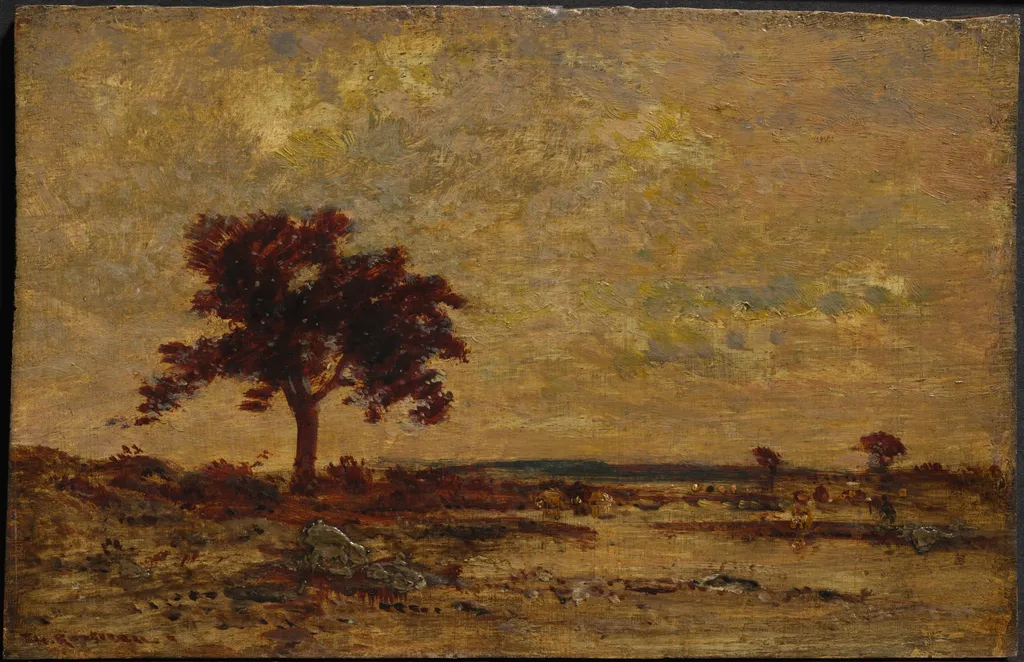
Marshlands is an unspecified painting. It dates from 1850 and is held in the collection of the Cleveland Museum of Art. The work presents a solitary tree set against an expansive, flat terrain that appears saturated with mud.
About this work
Overview
The work presents a solitary tree set against an expansive, flat terrain that appears saturated with mud. The sky is rendered in a muted yellow that merges indistinctly with the horizon, giving the scene a seamless, horizonless quality. The overall composition is stark, emphasizing the isolation of the tree within a muted, earthy environment.
Subject & Meaning
At the center of the canvas, a lone tree with dark, contorted branches rises from the wet, brown ground. The twisted limbs suggest resilience amid a desolate landscape, inviting contemplation of endurance in a barren setting. The sparse setting and muted palette focus attention on the tree’s solitary presence, hinting at themes of solitude and survival.
Technique & Style
The surface is built up with thick, uneven brushstrokes that give the paint a palpable texture, characteristic of an impasto approach. Colors are applied in a raw, unrefined manner, avoiding smooth blending and instead emphasizing the natural, tactile quality of the medium. This method creates a sense of immediacy, as if the artist worked swiftly and directly on the canvas.
Context
The painting’s emphasis on a single, weathered tree within a bleak, muddy plain aligns with traditions that explore the relationship between humanity and the natural world through simplified, elemental forms. Its use of impasto and a limited, earthy palette situates it within a broader 20th‑century interest in expressive surface treatment and landscape abstraction.
Artist & collection