Artwork
Barber Cleaning a Woman’s Ear
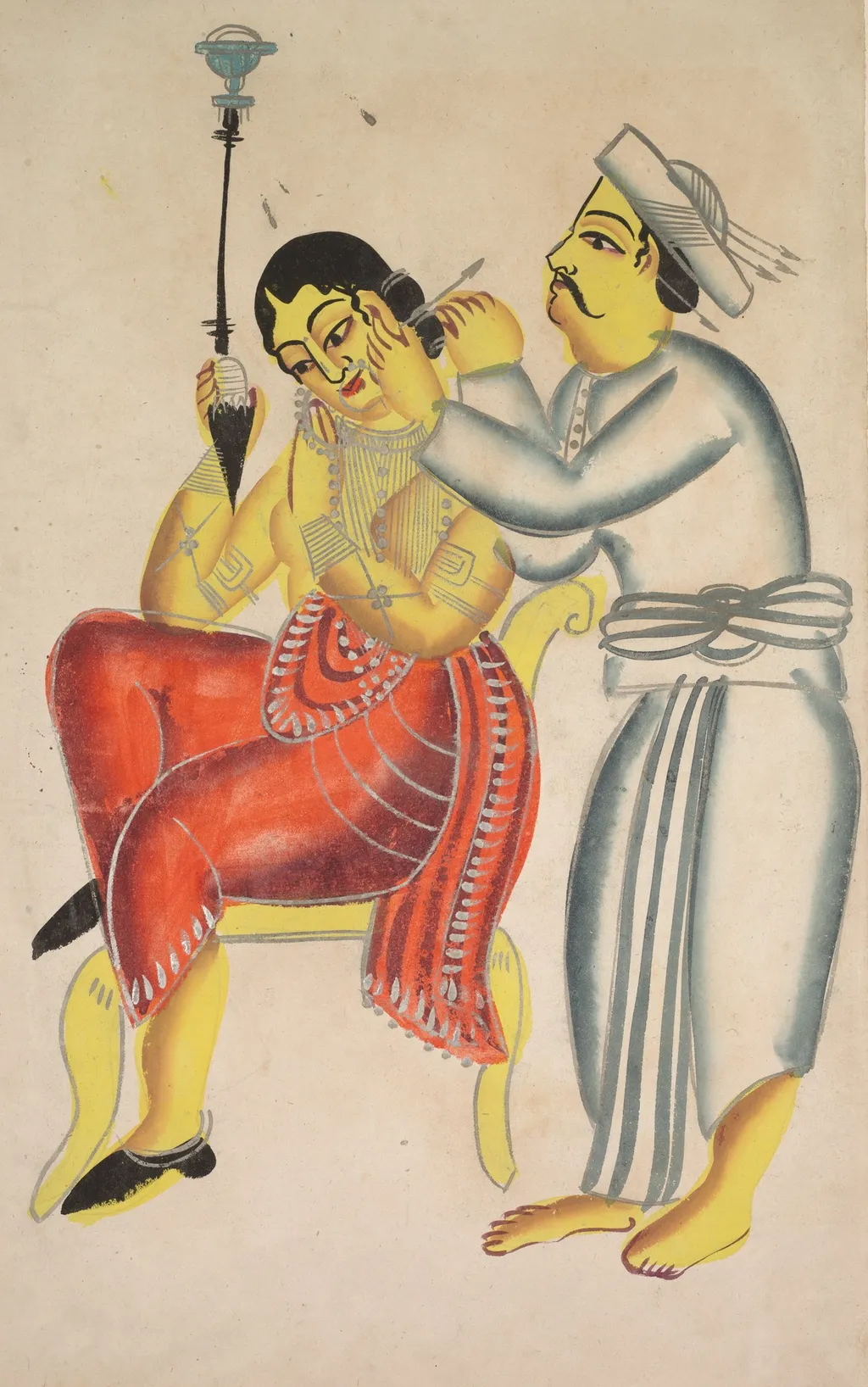
Barber Cleaning a Woman’s Ear is an unspecified painting. It dates from 1896 and is held in the collection of the Cleveland Museum of Art. The work depicts a barber attending to a seated woman, scissors in hand, as she rests on a low stool.
About this work
Overview
The work depicts a barber attending to a seated woman, scissors in hand, as she rests on a low stool. She is clothed in a vivid red sari edged with gold, while the barber is wrapped in a plain white cloth around his waist. The composition is rendered with clear outlines and uniform areas of colour, emphasizing the intimate, everyday action.
Subject & Meaning
The scene captures a moment of personal care, highlighting the ritual of hair grooming within a domestic setting. The woman's adornments and the barber’s concentrated posture lend the episode a sense of quiet significance, suggesting respect for the routine exchange between client and service provider.
Technique & Style
Executed in the kalighat tradition, the painting employs bold contour lines and flat, saturated hues. Facial features and hands are rendered in warm yellow tones, contrasting with the barber’s pale skin. The overall visual language favors simplicity over depth, characteristic of the 19th‑century Bengali folk art movement.
History & Provenance
Created within the kalighat school of painting, which flourished in the vicinity of Kolkata’s Kalighat temple during the colonial era, the piece reflects the genre’s focus on everyday urban life. Its provenance traces back to regional collectors who valued such depictions of ordinary scenes.
Context
Kalighat artists responded to the social changes of British‑ruled India, producing affordable prints for a growing middle class. Their subjects often included street vendors, performers, and domestic activities, offering a visual record of contemporary customs and attire, as seen in the woman’s red sari and jewelry.
Legacy
Works like this continue to inform scholars about the visual culture of 19th‑century Bengal, illustrating how folk artists merged local traditions with emerging market demands. The painting remains a reference point for studies of gendered labor and the aesthetic conventions of kalighat art.
Artist & collection