Artwork
Noli me tangere
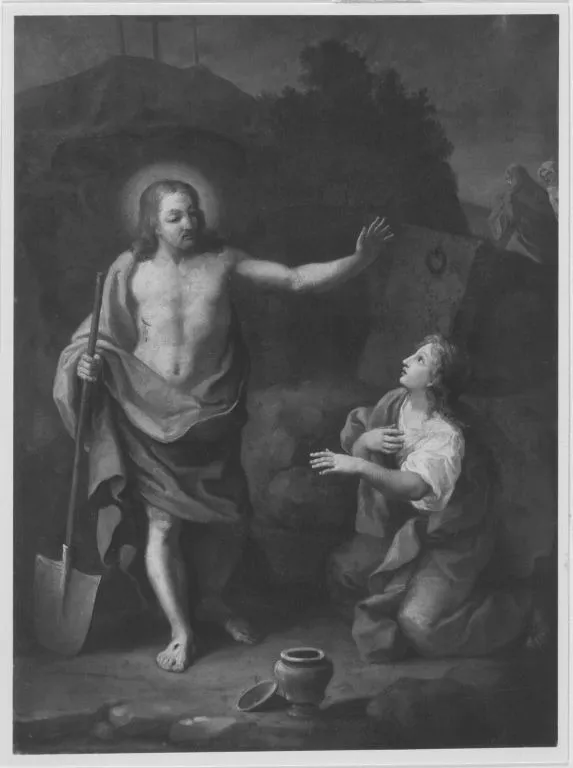
Noli me tangere is an unspecified painting by the Rococo painting artist Ignazio Stern. It dates from 1713 and is held in the collection of the Bavarian State Painting Collections.
About this work
Overview
Ignazio Stern’s *Noli me tangere*, painted in 1713, presents a biblical encounter between the risen Christ and Mary Magdalene.
Ignazio Stern’s *Noli me tangere*, painted in 1713, presents a biblical encounter between the risen Christ and Mary Magdalene. The composition places a barefoot male figure in a simple robe at the center, his right hand raised and left hand gripping a staff, while a kneeling woman looks upward with clasped hands. A modest pot rests near her feet, and a faint halo encircles the man’s head against a rocky hillside backdrop.
Subject & Meaning
The scene derives from the Gospel narrative in which the resurrected Jesus appears to Mary Magdalene in the garden, urging her not to cling to him. The raised hand and luminous aura convey his divine presence, while Mary’s supplicatory posture reflects her devotion and the moment’s emotional tension between earthly longing and spiritual revelation.
Technique & Style
Executed during the early Rococo phase, the work retains Stern’s Baroque training through its dramatic chiaroscuro and dynamic pose. The palette is restrained, emphasizing soft flesh tones and muted earth colors, while the delicate handling of light around the figure’s head hints at the emerging Rococo taste for subtle elegance and gentle illumination.
History & Provenance
After its completion in Rome, the painting entered the collection of the Alte Pinakothek in Munich, where it remains on display. Its acquisition reflects the museum’s 19th‑century effort to assemble representative works of Italian Baroque and early Rococo art, preserving Stern’s contribution to religious painting.
Artist & collection
Artist
Ignazio Stern (or Ignaz Stern) (January 17, 1679 – May 28, 1748), born in Mauerkirchen in Upper Austria in the Archduchy of Austria, was a Baroque painter who worked in Rome, dying there in 1748.
