Artwork
HNLMS Steam Warship Medusa Forcing Passage through the Shimonoseki Strait
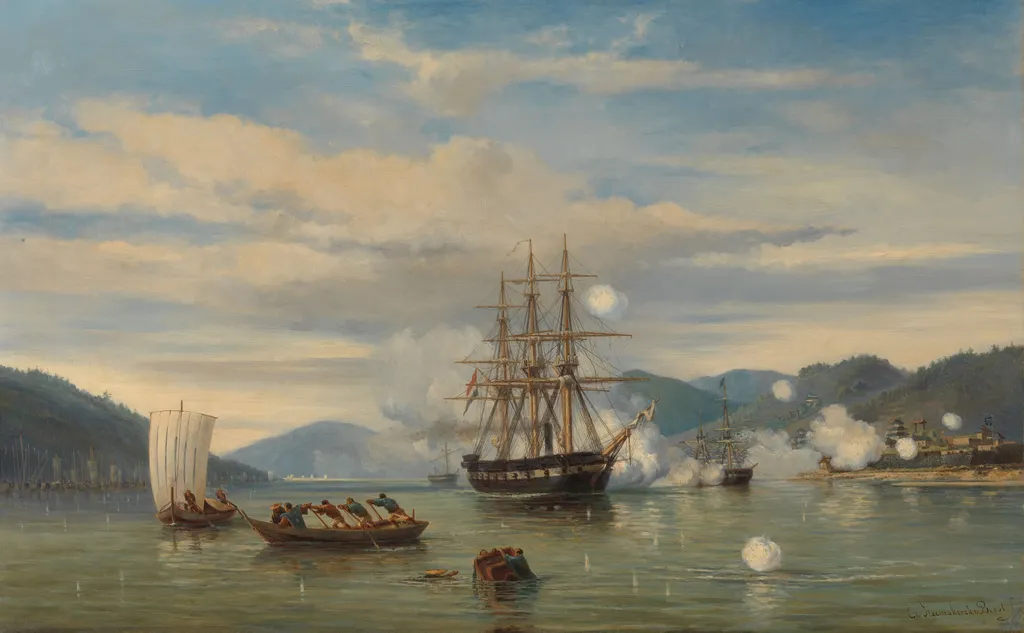
HNLMS Steam Warship Medusa Forcing Passage through the Shimonoseki Strait is an oil painting by the Realist artist Jacob Eduard van Heemskerck van Beest. It dates from 1864 and is held in the collection of the Rijksmuseum.
About this work
Overview
Jacob Eduard van Heemskerck van Beest’s 1864 oil painting, *HNLMS Steam Warship Medusa Forcing Passage through the Shimonoseki Strait*, records a Dutch warship navigating a confined channel. The canvas captures the vessel amid a burst of cannon fire, its smoke mingling with a mist‑laden sea and a softly clouded sky. The work is part of the Rijksmuseum’s permanent collection.
Subject & Meaning
The composition centers on the steam warship Medusa as it forces its way through the narrow Shimonoseki Strait, a strategic waterway in Japan. Smaller rowing boats flee the scene, emphasizing the ship’s dominance and the tension of naval power in a foreign landscape. The juxtaposition of military might against a tranquil shoreline suggests both conquest and the precariousness of the encounter.
Technique & Style
Executed in the realist tradition, van Heemskerck van Beest employs a restrained palette of muted blues, grays, and ochres to convey atmospheric conditions.
Executed in the realist tradition, van Heemskerck van Beest employs a restrained palette of muted blues, grays, and ochres to convey atmospheric conditions. Precise brushwork renders the ship’s iron hull and cannon details, while looser strokes suggest smoke and water spray. The contrast between the crisp rendering of the warship and the softer treatment of sky and hills creates depth and dynamism.
History & Provenance
Painted in 1864, the work reflects contemporary European interest in East Asian maritime affairs. After its creation, the canvas entered the Dutch national collection and was eventually acquired by the Rijksmuseum, where it remains on display as part of the museum’s 19th‑century Dutch painting holdings.
Context
The Shimonoseki Strait was the site of several mid‑19th‑century confrontations between Western powers and the Tokugawa shogunate. Van Heemskerck van Beest’s depiction aligns with a broader European fascination with the opening of Japan and the technological shift from sail to steam. The painting thus documents a moment of geopolitical transition and the visual culture surrounding it.
Own this work as a print
Artist & collection

Artist
Jacob Eduard van Heemskerck van Beest
Jkhr. Jacob Eduard van Heemskerck van Beest (Dutch pronunciation: ; 28 February 1828 – 24 December 1894) was a Dutch painter.
