Artwork
The Children of the Planet Mercury
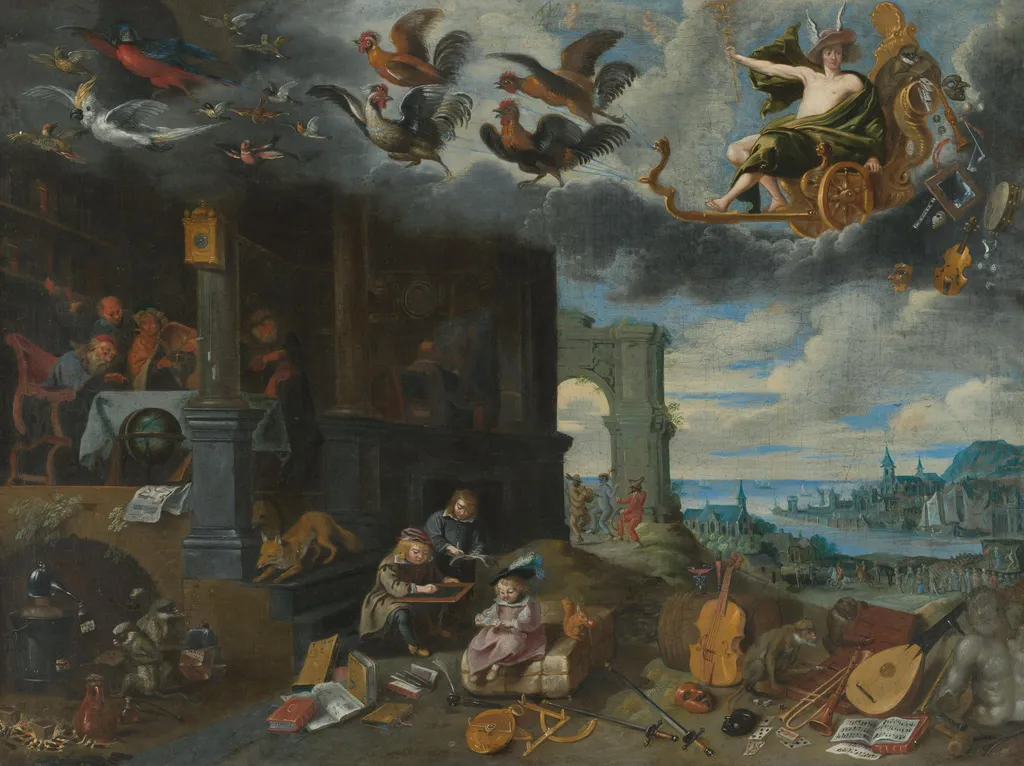
The Children of the Planet Mercury is an unspecified painting by the Baroque artist Jan Brueghel the Younger. It dates from 1645 and is held in the collection of the Rijksmuseum. The canvas presents a bustling coastal scene where commerce and learning are intertwined.
About this work
Overview
The canvas presents a bustling coastal scene where commerce and learning are intertwined. A ruined structure overlooks a town, while a procession of Mercury’s triumphal car drawn by four roosters sweeps across the sky. Below, a diverse group of figures—children, scholars, animals, and performers—populate the landscape, each engaged in activities that reference trade, science, and entertainment.
Subject & Meaning
At the centre, three youths are absorbed in reading and writing, surrounded by piles of books and geometric instruments, symbolising the pursuit of knowledge.
At the centre, three youths are absorbed in reading and writing, surrounded by piles of books and geometric instruments, symbolising the pursuit of knowledge. Nearby, scientists gather around a globe within a stone chamber, suggesting scholarly inquiry. The inclusion of foxes eyeing alchemical monkeys, and a troupe of entertainers, may satirise misguided or superficial approaches to learning, contrasting earnest study with folly.
Technique & Style
The work employs a densely layered composition characteristic of late Baroque allegory, with vivid detail rendered in a crowded, almost narrative tableau. Figures are delineated with precise brushwork, while the varied textures of stone, fabric, and animal fur create visual contrast. The use of bright, varied colours and dynamic diagonal lines guides the eye through the multiple scenes.
History & Provenance
Created to commemorate the virtues of trade and scientific advancement, the painting reflects contemporary civic pride. Its provenance traces back to a municipal collection where it was displayed in a public hall, serving both decorative and didactic purposes. Documentation indicates it remained in the city’s archives through the 18th century before entering a regional museum’s holdings.
Context
The composition aligns with a broader European tradition of allegorical works that celebrate mercantile prosperity and intellectual progress. By integrating mythological elements—such as Mercury’s triumphal car—with everyday scholarly activity, the artist links classical patronage of trade to contemporary civic ideals. The presence of animals as symbolic commentators echoes similar motifs in Dutch and Flemish genre painting.
Own this work as a print
Artist & collection
Artist
Jan Brueghel (also Bruegel or Breughel) the Younger ( BROY-gəl, US also BROO-gəl; Dutch: ; 13 September 1601 – 1 September 1678) was a Flemish Baroque painter.