Artwork
De schelpenvisser
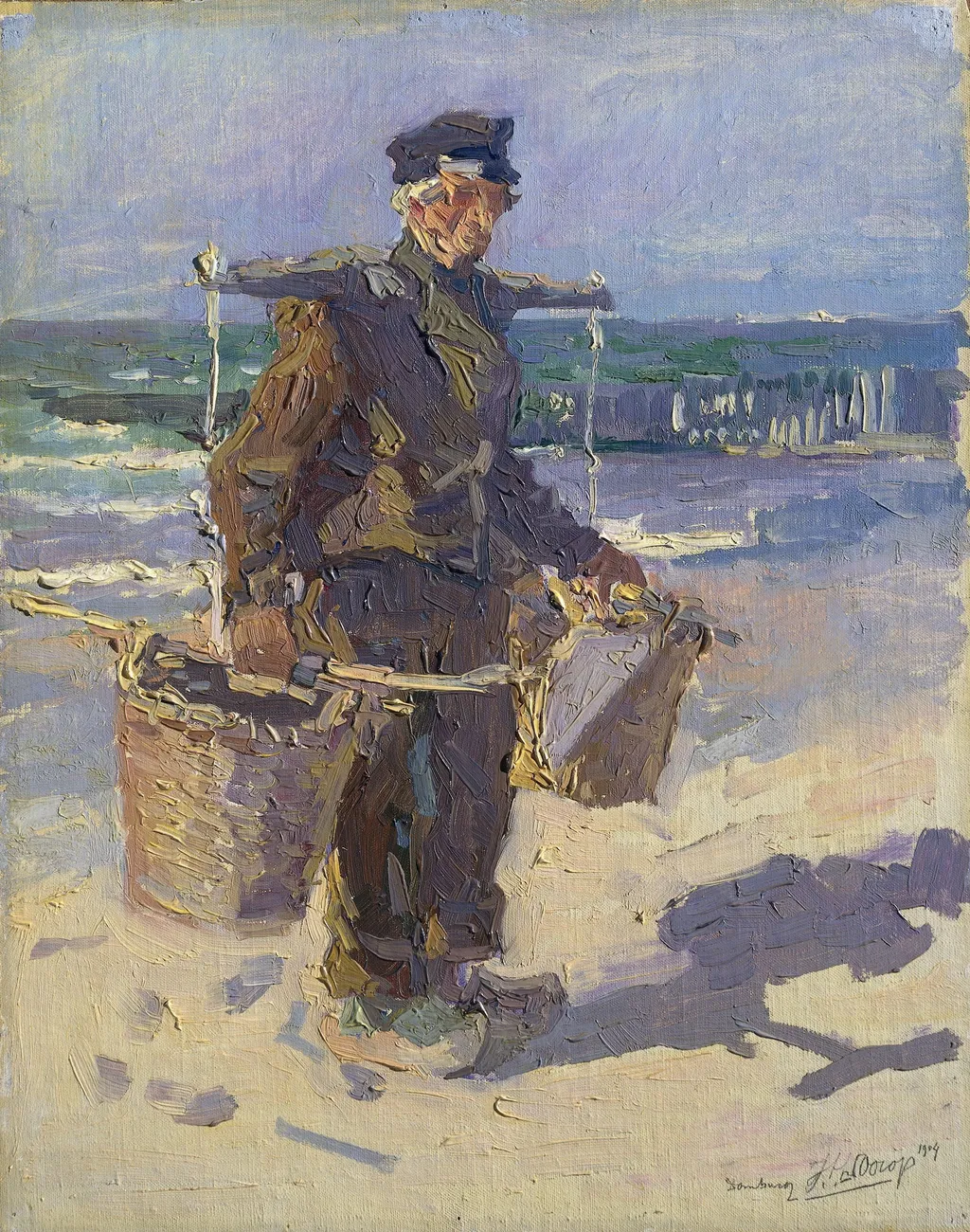
De schelpenvisser is an oil painting by the Post-Impressionist artist Jan Toorop. It dates from 1904 and is held in the collection of the Rijksmuseum.
About this work
Overview
Jan Toorop’s 1904 oil painting entitled *De schelpenvisser* presents a coastal scene rendered in a landscape format. The work is part of the Rijksmuseum’s collection and exemplifies the artist’s late‑career interest in maritime subjects. Its composition centers on a solitary figure on a beach, set against a sky‑sea horizon that balances light and shadow.
Subject & Meaning
The central figure is a lone fisherman, standing on a sandy shore and holding a long pole, perhaps used for gathering shells or probing the surf. Dressed in dark, coarse garments, he gazes out over the water, suggesting contemplation of the sea’s vastness and the solitary nature of his labor.
Technique & Style
Toorop employs a pronounced impasto technique, applying thick layers of paint especially on the fisherman’s coat and the granular sand. This tactile surface creates a subtle three‑dimensional effect, while the broader brushwork conveys the movement of waves and the atmospheric quality of the sky, linking realism with expressive texture.
History & Provenance
Created in 1904, *De schelpenvisser* entered the Rijksmuseum’s holdings through acquisition (or donation) in the early 20th century, reflecting the museum’s commitment to preserving Dutch modern art. The painting has remained in the museum’s collection, where it is displayed as part of its representation of Toorop’s oeuvre.
Context
The work belongs to a period when Toorop, originally associated with Symbolism, turned toward more naturalistic subjects, often depicting coastal life. The early 1900s saw a renewed interest in Dutch maritime heritage, and this painting aligns with contemporary trends that emphasized everyday labor and the relationship between humans and the sea.
Own this work as a print
Artist & collection

Artist
Johannes Theodorus "Jan" Toorop was a Dutch painter who worked in various styles, including Symbolism, Art Nouveau, and Pointillism. His early work was influenced by the Amsterdam Impressionism movement.