Artwork
Persian Flowers
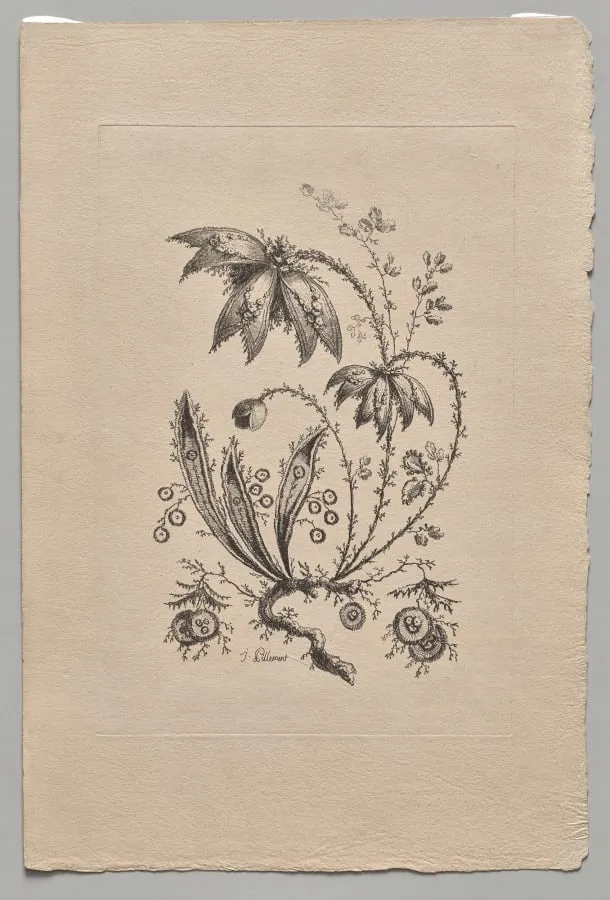
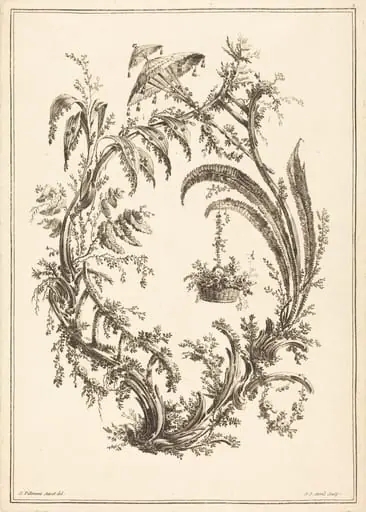
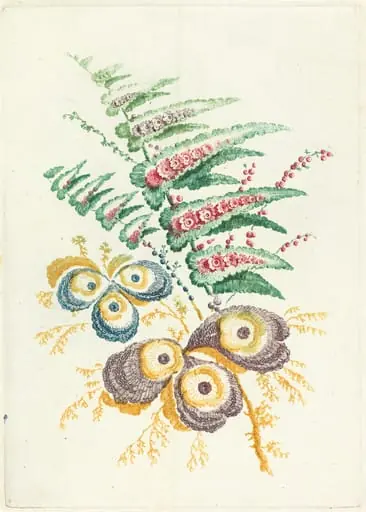
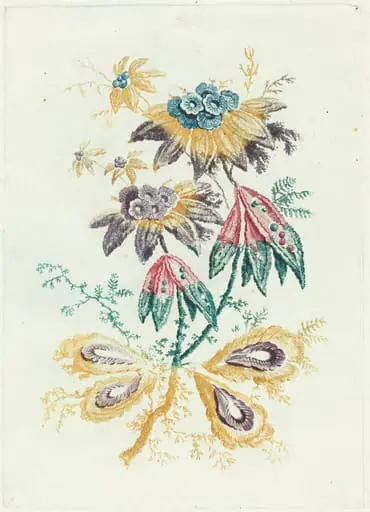
Persian Flowers is a print by the Romanticist artist Jean Pillement. It dates from 1755 and is held in the collection of the Cleveland Museum of Art.
About this work
Overview
Jean-Baptiste Pillement, a French artist active in the mid-18th century, produced a series of six etchings featuring imaginary floral forms labeled as 'Persian.
Jean-Baptiste Pillement, a French artist active in the mid-18th century, produced a series of six etchings featuring imaginary floral forms labeled as 'Persian.' These prints were part of a broader trend in European decorative arts that embraced stylized, non-naturalistic plant designs. Pillement’s work circulated widely through print reproduction, influencing ornamentation across textiles, ceramics, and interior surfaces.
Subject & Meaning
The flowers depicted are entirely invented, blending botanical elements with abstract, almost organic shapes reminiscent of marine life. By labeling them 'Persian,' Pillement invoked an exoticized Eastern aesthetic popular in Rococo Europe, though they bear no actual connection to Persian horticulture. Their purpose was decorative fantasy—designed to evoke mystery and refinement rather than botanical accuracy.
Technique & Style
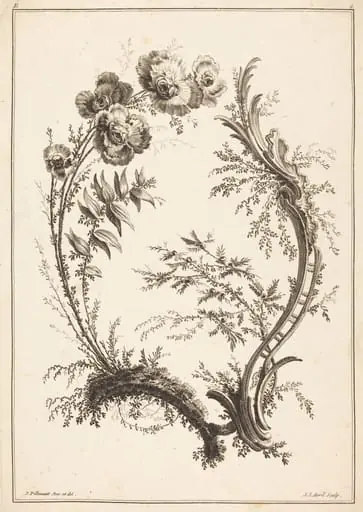
Each image is rendered in fine, linear etching with minimal shading, emphasizing clean contours over depth. The forms are elongated and delicate, arranged vertically against an empty ground to maximize adaptability for repeating patterns. The simplicity of the outlines made them ideal for transfer to mass-produced surfaces, contributing to their popularity among manufacturers.
History & Provenance
Created around the 1760s, the set was among Pillement’s many print designs disseminated across Europe. His prints were widely collected and repurposed by artisans in France, England, and Germany. Though originally published as standalone sheets, they were frequently cropped, scaled, and reprinted in decorative manuals and pattern books, embedding them into everyday material culture.
Context
Pillement’s work emerged during a peak in European fascination with chinoiserie—a European interpretation of East Asian motifs. While often mislabeled as 'Persian' or 'Chinese,' these designs were free inventions shaped by Western tastes for the exotic. The trend reflected a desire to escape classical rigidity, favoring whimsy and fluidity in decorative arts.
Legacy
Pillement’s floral prints helped standardize a visual language for ornamental design in the late 18th century. Their influence extended into Neoclassical interiors, where stylized botanical forms persisted even as tastes shifted. Though no longer associated with exoticism, the prints remain examples of how fantasy and reproduction shaped decorative aesthetics across social classes.
Artist & collection

Artist
Jean-Baptiste Pillement (24 May 1728 – 26 April 1808) was a French painter and designer, known for his exquisite and delicate landscapes, but whose importance lies primarily in the engravings done after his drawings,…